


A Spanish laboratory is breeding and sterilizing thousands of tiger mosquitoes to fight dengue fever and other diseases as climate change encourages the invasive species to spread across Europe.
Using an electron accelerator, the regional government-funded Biological Pest Control Center in Valencia sterilizes and releases about 45,000 male mosquitoes every week so they can pair with females — whose bite transmits diseases among humans — and eventually reduce the overall mosquito population.
“It’s a species that is becoming more common with climate change... There is a favorable environment for its development for longer periods of time throughout the year and its populations are increasing all the time,” said Vicente Dalmau of Valencia region’s health, agriculture and fisheries department.
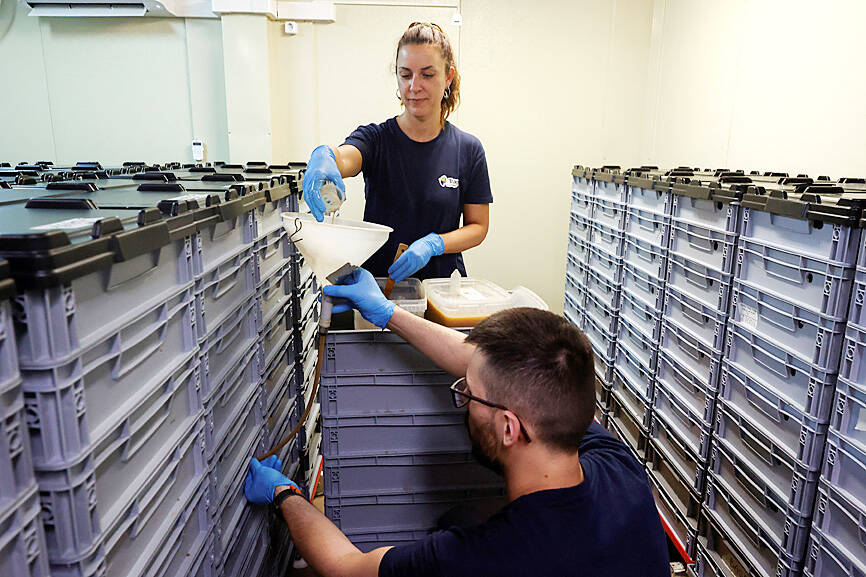
Photo: Reuters
The specimens for reproduction come from the region, and scientists then use a machine to separate female pupae from the males, before using radiation to sterilize the males.
Sterilization techniques have been used in other parts of the world, but the lab, using its experience with fruit flies, is pioneering their use on tiger mosquitoes in Europe at a time of growing concern over a rise in mosquito-born diseases such as dengue fever, zika virus and chikungunya.
Data from the European Centre for Disease Prevention and Control shows an increase in cases imported from regions where dengue fever is endemic, as well as an increasing number of local outbreaks of West Nile virus and dengue in Europe.
The striped tiger mosquito, or Aedes albopictus, is spreading north, east and west in Europe, and now has self-sustaining populations in 13 nations, including Spain.
The WHO last year said that dengue fever rates were rising globally, with reported cases since 2000 up eightfold to 4.2 million in 2022, as a warmer climate is thought to help the mosquitoes multiply faster.

When a hiker fell from a 55m waterfall in wild New Zealand bush, rescuers were forced to evacuate the badly hurt woman without her dog, which could not be found. After strangers raised thousands of dollars for a search, border collie Molly was flown to safety by a helicopter pilot who was determined to reunite the pet and the owner. A week earlier, an emergency rescue helicopter found the woman with bruises and lacerations after a fall at a rocky spot at the waterfall on the South Island’s West Coast. She was airlifted on March 24, but they were forced to

CONFIDENCE BOOSTER: ’After parkour ... you dare to do a lot of things that you think only young people can do,’ a 67-year-old parkour enthusiast said In a corner of suburban Singapore, Betty Boon vaults a guardrail, crawls underneath a slide, executes forward shoulder rolls and scales a steep slope, finishing the course to applause. “Good job,” the 69-year-old’s coach cheers. This is “geriatric parkour,” where about 20 retirees learned to tackle a series of relatively demanding exercises, building their agility and enjoying a sense of camaraderie. Boon, an upbeat grandmother, said learning parkour has aided her confidence and independence as she ages. “When you’re weak, you will be dependent on someone,” she said after sweating it out with her parkour classmates in suburban Toa Payoh,

HIGH HOPES: The power source is expected to have a future, as it is not dependent on the weather or light, and could be useful for places with large desalination facilities A Japanese water plant is harnessing the natural process of osmosis to generate renewable energy that could one day become a common power source. The possibility of generating power from osmosis — when water molecules pass from a less salty solution to a more salty one — has long been known. However, actually generating energy from that has proved more complicated, in part due the difficulty of designing the membrane through which the molecules pass. Engineers in Fukuoka, Japan, and their private partners think they might have cracked it, and have opened what is only the world’s second osmotic power plant. It generates

Chinese dissident artist Gao Zhen (高兟), famous for making provocative satirical sculptures of former Chinese leader Mao Zedong (毛澤東), was tried on Monday over accusations of “defaming national heroes and martyrs,” his wife and a rights group said. Gao, 69, who was detained in 2024 during a visit from the US, faces a maximum three-year prison sentence, said his wife, Zhao Yaliang (趙雅良), and Shane Yi, a researcher at the Chinese Human Rights Defenders group which operates outside the nation. The closed-door, one-day trial took place at Sanhe City People’s Court in Hebei Province neighboring the capital, Beijing, and ended without a


 RSS
RSS