


In a corner of suburban Singapore, Betty Boon vaults a guardrail, crawls underneath a slide, executes forward shoulder rolls and scales a steep slope, finishing the course to applause.
“Good job,” the 69-year-old’s coach cheers.
This is “geriatric parkour,” where about 20 retirees learned to tackle a series of relatively demanding exercises, building their agility and enjoying a sense of camaraderie.
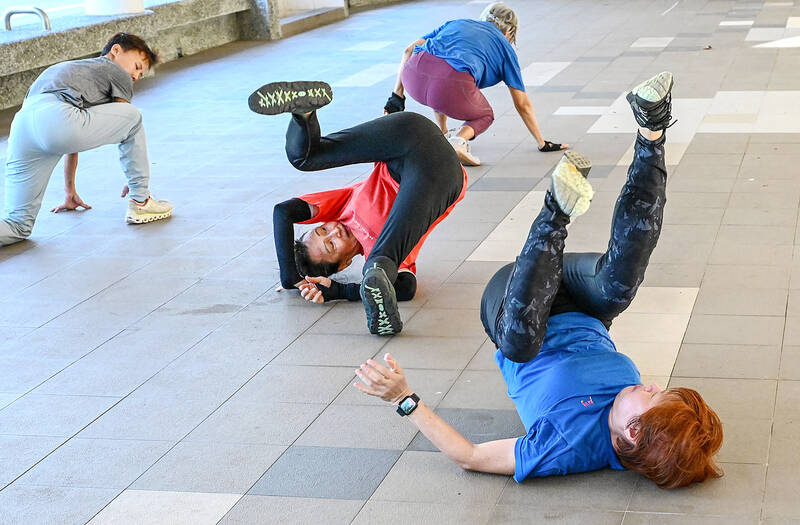
Photo: AFP
Boon, an upbeat grandmother, said learning parkour has aided her confidence and independence as she ages.
“When you’re weak, you will be dependent on someone,” she said after sweating it out with her parkour classmates in suburban Toa Payoh, under the shadow of government-built apartment blocks.
“I feel more alive, it’s a whole new world,” she added.
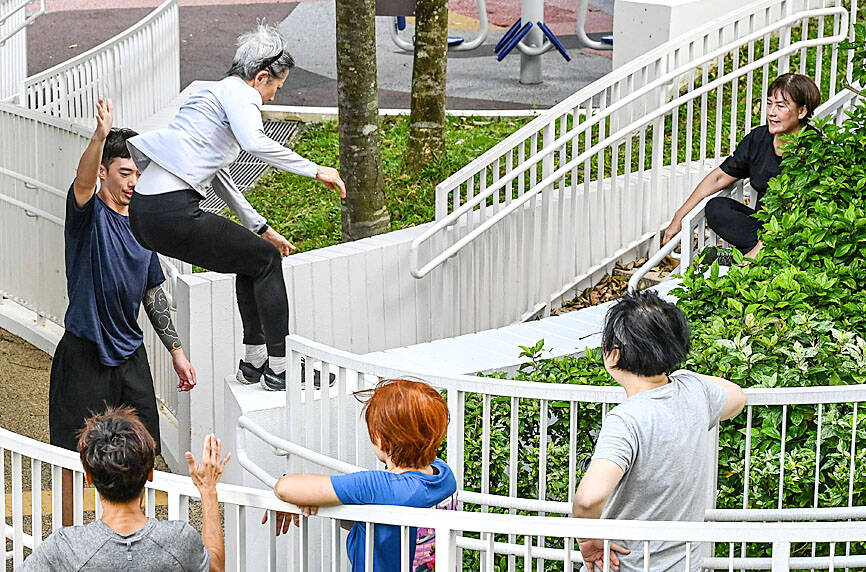
Photo: AFP
The discipline has gained a devoted following of senior citizens in the city-state, which is among the world’s fastest-aging countries.
Singapore is projected to become a “super-aged” nation this year, meaning the proportion of residents aged 65 or above exceeds 21 percent.
By 2030, one in four Singaporeans would be aged 65 or above, according to the health ministry.
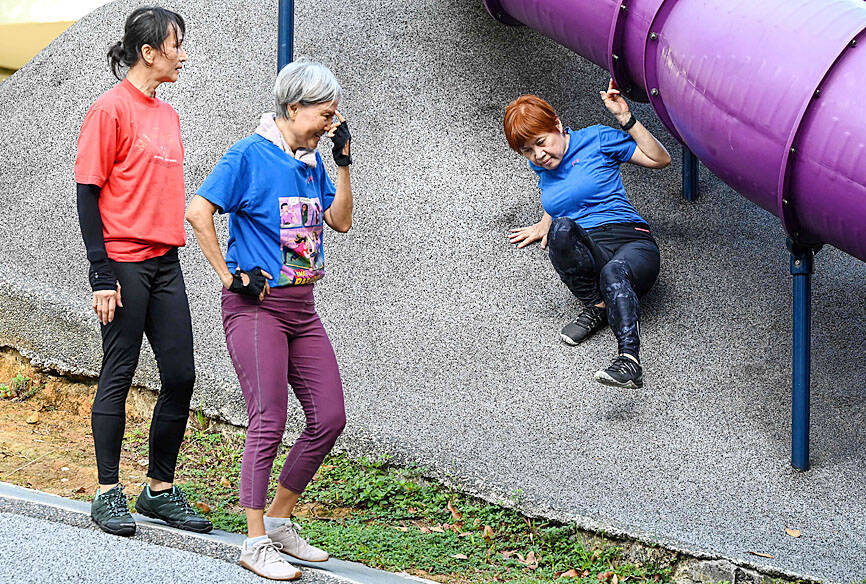
Photo: AFP
As the society grays, various activities and industries have mushroomed up to cater to elderly people’s needs, including social activities and group exercise classes.
Coach Tan Shie Boon, 33, said he was initially met with skepticism when he started offering parkour classes for older students in 2017, especially due to the risk of injury.
However, his idea was to share maneuvers that could help elderly people with their balance, stamina and coordination.

Photo: AFP
“It’s meaningful. I can see the impact of my work,” he said.
Parkour, a discipline that originated in France, focuses on overcoming physical obstacles such as walls, gaps and platforms without any aid.
Often called the “art of displacement,” it involves running, jumping, climbing, rolling and vaulting to quickly dart from one point to another.
The activity has a young, athletic following, but coach Tan and his students insist it can be suitable for every age.
“When people hear the word parkour, they think it’s only for youngsters who can jump from rooftops,” said retired banker and parkour enthusiast Irene Chuah, 67. “We don’t do that. We jump over benches.”
Tan, who specializes in coaching elderly people in his classes across Singapore, tailors all the stunts to match the capabilities of his students, aged between their early 50s and 83.
“The whole point of parkour is to improve your agility... You’ll be faster in your reaction,” he said.
“When seniors fall, they get severely injured, because they have a lack of coordination, balance and agility. They’re not fast enough to react in time,” he added.
Chuah experienced firsthand how the moves she learned in parkour class can apply outside of practice.
When a cart she was pushing at a supermarket hit an obstacle, it overturned and pulled her over.
However, thanks to her training, she managed to jump over the mess, remain on her feet and escape unharmed.
“Nobody helped me because the people thought I was young,” Chuah said with a laugh.
Retired kindergarten teacher Ling Ying Ying, 66, said doing parkour helped her to be able to mop the floor on her knees “like we used to do when we were young.”
At the fitness space in Toa Payoh, the parkour students also practiced traversing down an incline and scaling a low wall during the 90-minute session.
A couple of students jumped over a gap after some encouragement.
Life after retirement used to be “quite dull,” Chuah said.
“After parkour, I can go line dancing, and I can remember the steps. You dare to do a lot of things that you think only young people can do,” she added.
Her classmate Boon said one time she brought her grandchildren to a neighborhood playground and taught them to jump onto a platform and do forward rolls.
When she looked back, she saw a line of other children wanting to try the moves.
“Since then, I became like the favorite grandmother. The children recognize me even when I’m far away,” she said.

SPEAKING OUT: After Siranudh Scott’s allegations surfaced, celebrities and public figures took to social media to share their own experiences of sexual misconduct and abuse A high-profile alleged sexual abuse case within a wealthy Thai beer brewing family has prompted a wave of painful accounts from survivors of unconnected abuse in the conservative nation. Siranudh Scott, a member of the billionaire Thai family that founded the ubiquitous Singha beer brand, posted an emotional video this month accusing his elder brother Sunit of repeatedly abusing him when he was a teenager. Sunit, who is in his 30s, later denied the allegations in a video posted online, but Singha parent Boonrawd dismissed him from his executive role with the company on Tuesday last week. “I felt I needed to speak

SEEKING ORDER: Rodrigo Paz said that ‘anyone who wants to destroy the nation will have to deal with this president and the full force of the constitution’ Bolivian President Rodrigo Paz on Wednesday said that the nation was at a “breaking point” after nearly a month of protests that have caused shortages of food, fuel and medicine. Paz, who took office six months ago amid the worst economic crisis there in four decades, is battling a groundswell of fury over his policies. The political capital, La Paz, has been besieged by low-income workers and members of the indigenous majority calling for his resignation. “The country needs order and is reaching breaking point,” the 58-year-old said at a public event in La Paz, renewing his appeal for dialogue. On Tuesday, the Bolivian

‘CROSSING THE LINE’: China’s embassy in Seoul criticized US Forces Korea Commander General Xavier Brunson, asking if his ‘hostile’ remarks were authorized by Washington South Korea and the US are in talks over recent public remarks by the commander of US Forces Korea, Seoul’s presidential office said yesterday, after the comments drew sharp criticism from China. In a recent podcast interview, US Forces Korea Commander General Xavier Brunson described South Korea as “the dagger in the heart of Asia” from China’s east coast, prompting the Chinese embassy in Seoul to say that he had “truly crossed the line.” The interview came amid growing speculation that Washington might seek to expand the role of US Forces Korea in countering the growing regional influence of China, a key

Forecasters in Europe yesterday warned of exceptional heat as record temperatures driven by a “heat dome” push temperatures well above seasonal norms across the continent. The surge follows a record-breaking Monday, with France logging its hottest day in the month of May on record, its weather agency said, and the UK also posting unprecedented highs. A so-called “heat dome” of warm air from northern Africa trapped under a high-pressure system over western Europe is behind the high temperatures not usually seen until high summer. Restrictions on outdoor work were imposed in parts of Italy, beaches in southwest France filled earlier than usual and


 RSS
RSS