


The death toll from this year’s hajj has exceeded 1,000 on Thursday, more than half unregistered worshipers who performed the pilgrimage in extreme heat in Saudi Arabia.
The new deaths reported on Thursday included 58 from Egypt, said an Arab diplomat who provided a breakdown showing that of 658 Egyptians who died, 630 were unregistered pilgrims.
About 10 countries have reported 1,081 deaths during the pilgrimage, one of the five pillars of Islam which all Muslims with the means must complete at least once.
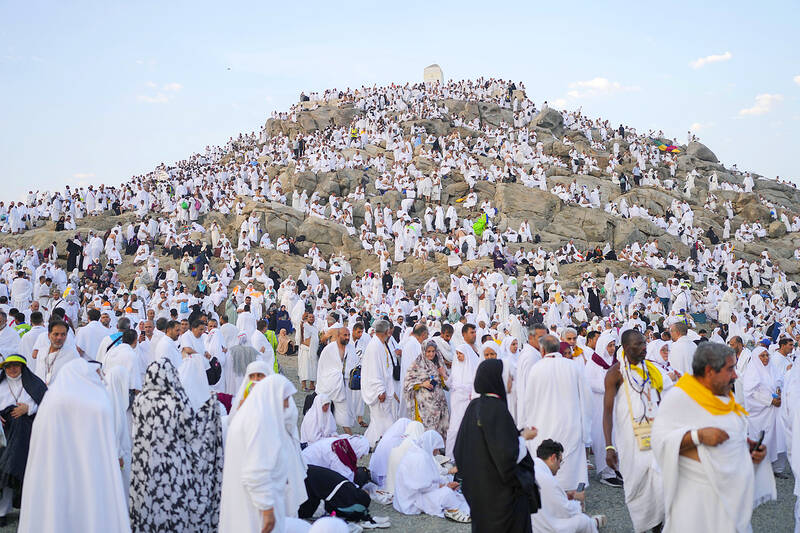
Photo: AP
The hajj, whose timing is determined by the lunar Islamic calendar, fell during the oven-like Saudi summer again this year.
The Saudi national meteorological center reported a high of 51.8°C this week at the Grand Mosque in Mecca.
A Saudi study published last month said temperatures in the area are rising 0.4°C each decade.
Each year tens of thousands of pilgrims try to join the hajj through irregular channels, as they cannot afford the often costly official permits.
Saudi Arabian authorities reported clearing hundreds of thousands of unregistered pilgrims from Mecca this month, but it appears many still participated in the main rites which began on Friday last week.
This group was more vulnerable, because without official permits they could not access air-conditioned spaces provided for the 1.8 million authorized pilgrims to cool down.
“People were tired after being chased by security forces before Arafat day. They were exhausted,” one Arab diplomat said on Thursday of day-long outdoor prayers on Saturday last week that marked the hajj’s climax.
The diplomat said the main cause of death among Egyptian pilgrims was the heat, which triggered complications related to high blood pressure and other issues.
Egyptian officials were visiting hospitals to obtain information and help Egyptian pilgrims get medical care, the Egyptian Ministry of Foreign Affairs said in a statement on Thursday.
“However, there are large numbers of Egyptian citizens who are not registered in hajj databases, which requires double the effort and a longer time to search for missing persons and find their relatives,” it said.
Egyptian President Abdel-Fattah al-Sisi has ordered that a “crisis cell” headed by the Egyptian prime minister follow up on the deaths of the country’s pilgrims.
Sisi stressed “the need for immediate coordination with the Saudi authorities to facilitate receiving the bodies of the deceased and streamline the process,” said a statement from his office.
More fatalities were also confirmed on Thursday by Pakistan and Indonesia.
Out of about 150,000 pilgrims, Pakistan has so far recorded 58 deaths, a diplomat said.
“I think given the number of people, given the weather, this is just natural,” the diplomat said.
Indonesia, which had about 240,000 pilgrims, raised its death toll to 183, the Indonesian Ministry of Religious Affairs said, compared with 313 deaths recorded last year.
Deaths have also been confirmed by Malaysia, India, Jordan, Iran, Senegal, Tunisia, Sudan and Iraq’s autonomous Kurdistan region. In many cases, authorities have not specified the cause.
Friends and relatives have been searching for missing pilgrims, scouring hospitals and pleading online for news, fearing the worst.
Two diplomats on Thursday said that Saudi authorities had begun the burial process for dead pilgrims, cleaning the bodies and putting them in white burial cloth and taking them to be interred.
“The burial is done by the Saudi authorities. They have their own system so we just follow that,” said one diplomat, who said his country was working to notify loved ones as best it could.
A 2019 study by the journal Geophysical Research Letters said because of climate change, heat stress for hajj pilgrims would exceed the “extreme danger threshold” from 2047 to 2052 and 2079 to 2086, “with increasing frequency and intensity as the century progresses.”

SPEAKING OUT: After Siranudh Scott’s allegations surfaced, celebrities and public figures took to social media to share their own experiences of sexual misconduct and abuse A high-profile alleged sexual abuse case within a wealthy Thai beer brewing family has prompted a wave of painful accounts from survivors of unconnected abuse in the conservative nation. Siranudh Scott, a member of the billionaire Thai family that founded the ubiquitous Singha beer brand, posted an emotional video this month accusing his elder brother Sunit of repeatedly abusing him when he was a teenager. Sunit, who is in his 30s, later denied the allegations in a video posted online, but Singha parent Boonrawd dismissed him from his executive role with the company on Tuesday last week. “I felt I needed to speak

A Hong Kong astronaut is to join a Chinese space mission for the first time as part of a three-person crew launching today, as Beijing edges closer to its goal of landing people on the moon. The Tiangong space station — crewed by teams of three astronauts that are typically rotated every six months — is the crown jewel of China’s space program, boosted by billions in state investment in a bid to catch up with the US and Russia. The Shenzhou-23 mission is to blast off at 11:08pm from the Jiuquan Satellite Launch Center in northwestern China, carrying three astronauts to
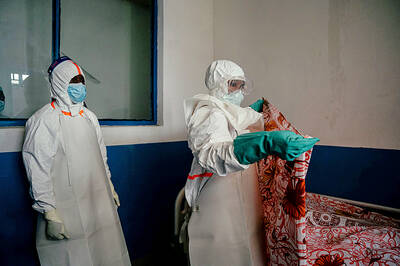
UPGRADED ALERT: The risk inside DR Congo is now considered ‘very high,’ while neighboring countries face a ‘high’ threat as the outbreak continues, the WHO said Ebola is spreading faster than responders can track it in eastern Congo, where health workers managed to follow up with barely one in five identified contacts in a single day. Authorities in the Democratic Republic of the Congo (DR Congo) reported 83 confirmed infections, 746 suspected cases and 1,603 identified contacts as of Thursday, but health workers were able to follow up on only 342 contacts that day — about 21 percent of the total under monitoring — data released by the DR Congo Ministry of Public Health on Friday showed. The figures suggest the response is falling behind the outbreak itself,

SEEKING ORDER: Rodrigo Paz said that ‘anyone who wants to destroy the nation will have to deal with this president and the full force of the constitution’ Bolivian President Rodrigo Paz on Wednesday said that the nation was at a “breaking point” after nearly a month of protests that have caused shortages of food, fuel and medicine. Paz, who took office six months ago amid the worst economic crisis there in four decades, is battling a groundswell of fury over his policies. The political capital, La Paz, has been besieged by low-income workers and members of the indigenous majority calling for his resignation. “The country needs order and is reaching breaking point,” the 58-year-old said at a public event in La Paz, renewing his appeal for dialogue. On Tuesday, the Bolivian


 RSS
RSS