


US hip-hop group Wu-Tang Clan’s one-of-a-kind album Once Upon A Time in Shaolin on Saturday began playing at an Australian museum, organizers said, with fans in attendance describing the music as “very special” and “amazing.”
All timeslots for the twice-a-day sessions at Tasmania’s Museum of Old and New Art are sold out, with about 5,000 people on a waiting list. The museum is showcasing the single-print album from Saturday to Monday next week.
“They’re small sessions, they’re about 30 people,” said a museum spokesperson, who confirmed the start of the first listening session on Saturday afternoon.
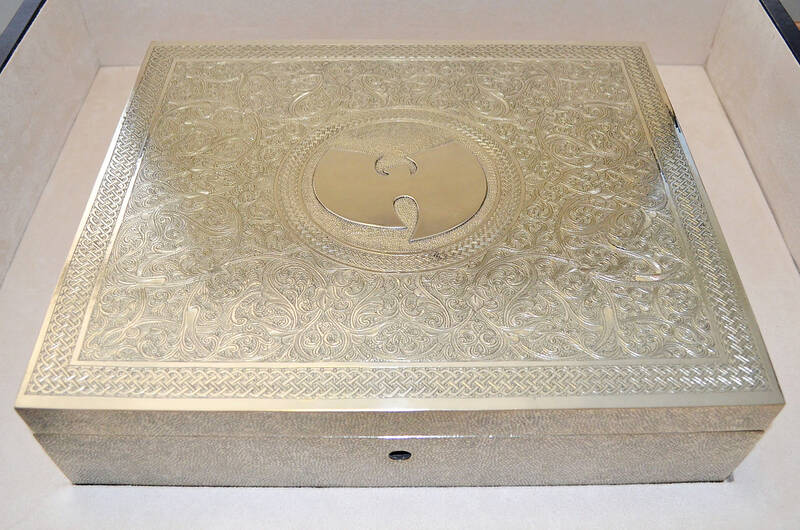
Photo: US Marshals Service via Reuters
The album, which has just one physical copy in the world, has a storied history, having been bought by the convicted pharmaceutical executive Martin Shkreli in 2015 for US$2 million.
Shkreli gave it up to as part of a US$7.4 million forfeiture order after his 2017 conviction for defrauding hedge fund investors and scheming to defraud investors in a drugmaker.
It is now owned by non-fungible token collectors PleasrDAO who purchased the album for US$4 million from the US government. PleasrDAO is also suing Shkreli for making copies of the album and releasing the music to the public.
Music fan Cameron McBryde, who had traveled from Queensland’s capital, Brisbane, described hearing the album as “very special.”
“I don’t know another song or album anywhere else in the world that holds that same value that this one does like that,” McBryde told the Australian Broadcasting Corp (ABC).
Hayden Kovacic, from Hobart, said it was “amazing” to be one of so few to get to listen to the album.
“It was actually hectic,” Kovacic told the ABC. “The production was off its head.”
The album consists of 31 original tracks recorded and produced by the New York-based group over six years from 2007 “in the original Wu-Tang style of the 90s,” according to the album’s official Web site.

James Watson — the Nobel laureate co-credited with the pivotal discovery of DNA’s double-helix structure, but whose career was later tainted by his repeated racist remarks — has died, his former lab said on Friday. He was 97. The eminent biologist died on Thursday in hospice care on Long Island in New York, announced the Cold Spring Harbor Laboratory, where he was based for much of his career. Watson became among the 20th century’s most storied scientists for his 1953 breakthrough discovery of the double helix with researcher partner Francis Crick. Along with Crick and Maurice Wilkins, he shared the

China’s Shenzhou-20 crewed spacecraft has delayed its return mission to Earth after the vessel was possibly hit by tiny bits of space debris, the country’s human spaceflight agency said yesterday, an unusual situation that could disrupt the operation of the country’s space station Tiangong. An impact analysis and risk assessment are underway, the China Manned Space Agency (CMSA) said in a statement, without providing a new schedule for the return mission, which was originally set to land in northern China yesterday. The delay highlights the danger to space travel posed by increasing amounts of debris, such as discarded launch vehicles or vessel

RUBBER STAMP? The latest legislative session was the most productive in the number of bills passed, but critics attributed it to a lack of dissenting voices On their last day at work, Hong Kong’s lawmakers — the first batch chosen under Beijing’s mantra of “patriots administering Hong Kong” — posed for group pictures, celebrating a job well done after four years of opposition-free politics. However, despite their smiles, about one-third of the Legislative Council will not seek another term in next month’s election, with the self-described non-establishment figure Tik Chi-yuen (狄志遠) being among those bowing out. “It used to be that [the legislature] had the benefit of free expression... Now it is more uniform. There are multiple voices, but they are not diverse enough,” Tik said, comparing it

TOWERING FIGURE: To Republicans she was emblematic of the excesses of the liberal elite, but lawmakers admired her ability to corral her caucus through difficult votes Nancy Pelosi, a towering figure in US politics, a leading foe of US President Donald Trump and the first woman to serve as US House of Representatives speaker, on Thursday announced that she would step down at the next election. Admired as a master strategist with a no-nonsense leadership style that delivered for her party, the 85-year-old Democrat shepherded historic legislation through the US Congress as she navigated a bitter partisan divide. In later years, she was a fierce adversary of Trump, twice leading his impeachment and stunning Washington in 2020 when she ripped up a copy of his speech to the


 RSS
RSS