


China has dethroned the US to become the top alignment choice for Southeast Asians, as Washington loses ground on a range of key issues from regional economic engagement to the Israel-Hamas War, a new survey showed.
A survey of 1,994 Southeast Asians by the ISEAS-Yusof Ishak Institute published yesterday shows China’s popularity in a head-to-head race with the US climbing from 38.9 percent last year to 50.5 percent in 2024.
Among individual nations, Beijing garnered some three out of four votes in Muslim-majority Malaysia, Indonesia and Brunei.
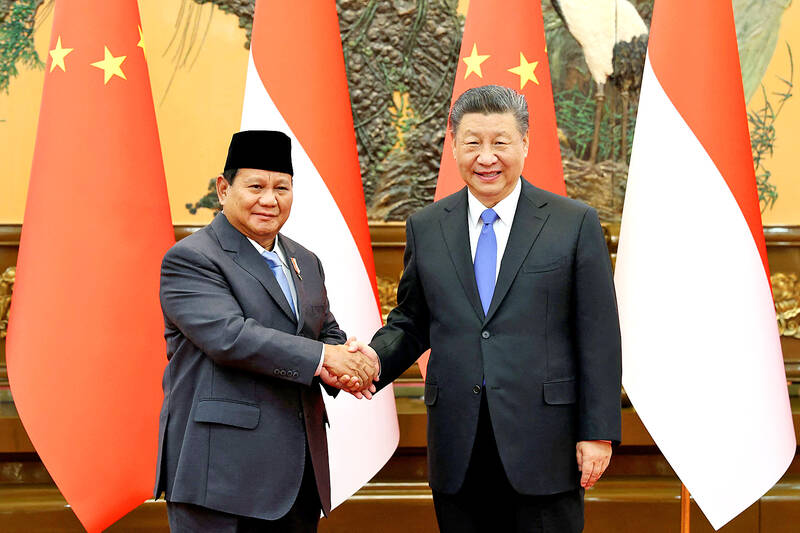
Photo: China Daily via REUTERS
“Confidence in the US has waned,” the survey said. “This could be attributed partly to the escalating rivalry between China and the US, which led to an uptick in anxiety about the US’ growing strategic and political influence.”
Southeast Asian nations have largely embraced the US as a necessary security presence as US President Joe Biden’s administration ramps up military-to-military cooperation in a bid to counter Bejing’s growing defense prowess. However, the region also counts on China as a key financier and trading partner at a time regional leaders seek new investments to bolster their own economies.
Part of the issue for the US are concerns over economic engagement.
Southeast Asians are “increasingly unsure” about the effectiveness of the Indo-Pacific Economic Framework for Prosperity, a US-led endeavor to increase trade that has been criticized for its lack of meaningful market access.
China is once again seen as the most influential economic and political strategic power in the region, “outpacing the US by significant margins in both domains,” it said.
The latest poll also puts the Israel-Hamas conflict at the top of the list of the region’s geopolitical concerns, with a large proportion of respondents worried “Israel’s attack on Gaza has gone too far.”
Nearly a third of respondents were wary that the Middle East war would catalyze the rise of extremist activities, while diminished trust in international law and a rules-based order was the second-top concern.
“The ongoing Israel-Hamas conflict has emerged as a contentious issue in Southeast Asia, commanding significant attention in the region’s domestic politics,” the survey said. “Despite its geographical distance, the conflict has reverberated strongly across this diverse multi-racial and multi-religious region.”
Whether those sentiments are responsible for the US’ drop in standing among regional nations is unclear, said Bonnie Glaser, head of the Indo-Pacific program at the German Marshall Fund.
“Without more data it’s impossible to answer that,” she said during a presentation of the results.
The US has diplomatically and militarily backed Israel in its quest to destroy Hamas, in the aftermath of the group’s Oct. 7 attack.
While sentiments have broadly shifted toward China, tensions in the South China Sea was the second-biggest geopolitical concern in the latest study. In a hypothetical choice between the US and China, Washington still commands majority support from the Philippines at 83.3 percent and Vietnam at 79 percent, which are at the forefront of the territorial disputes with Beijing.
Broadly, “there is a growing sense of optimism among Southeast Asians regarding their future relations with China,” the report said. “The Philippines emerged as the most cautious.”
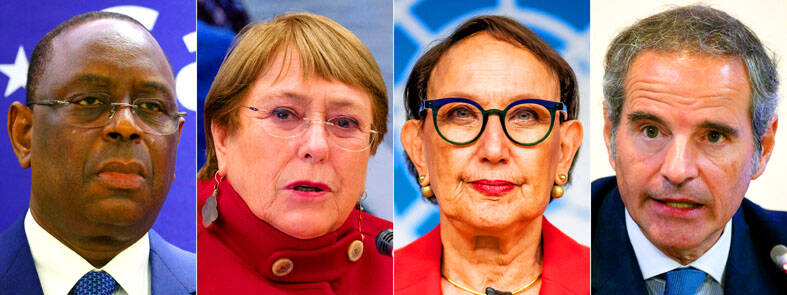
Four contenders are squaring up to succeed Antonio Guterres as secretary-general of the UN, which faces unprecedented global instability, wars and its own crushing budget crisis. Chile’s Michelle Bachelet, Argentina’s Rafael Grossi, Costa Rica’s Rebeca Grynspan and Senegal’s Macky Sall are each to face grillings by 193 member states and non-governmental organizations for three hours today and tomorrow. It is only the second time the UN has held a public question-and-answer, a format created in 2016 to boost transparency. Ultimately the five permanent members of the UN’s top body, the Security Council, hold the power, wielding vetoes over who leads the
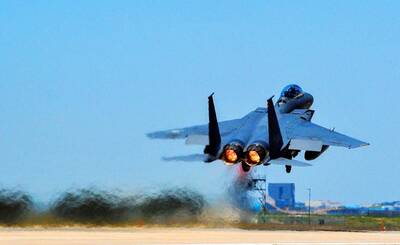
South Korea’s air force yesterday apologized for a 2021 midair collision involving two fighter jets, a day after auditors said the pilots were taking selfies and filming during the flight and held them responsible for the accident. “We sincerely apologize to the public for the concern caused by the accident that occurred in 2021,” an air force spokesman told a news conference, adding that one of the pilots involved had been suspended from flying duties, received severe disciplinary action and has since left the military. The apology followed a report released on Wednesday by the South Korean Board of Audit and Inspection,

Young Chinese, many who fear age discrimination in their workplace after turning 35, are increasingly starting “one-person companies” that have artificial intelligence (AI) do most of the work. Smaller start-ups are already in vogue in Silicon Valley and elsewhere, with rapidly advancing AI tools seen as a welcome teammate even as they threaten layoffs at existing firms. More young people in China are subscribing to the model, as cities pledge millions of dollars in funding and rent subsidies for such ventures, in alignment with Beijing’s political goal of “technological self-reliance.” “The one-person company is a product of the AI era,” said Karen Dai

About 240 Indians claiming descent from a Biblical tribe landed at Tel Aviv airport on Thursday as part of a government operation to relocate them to Israel. The newcomers passed under a balloon arch in blue and white, the colors of the Israeli flag, as dozens of well-wishers welcomed them with a traditional Jewish song. They were the first “bnei Menashe” (“sons of Manasseh”) to arrive in Israel since the government in November last year announced funding for the immigration of about 6,000 members of the community from the states of Manipur and Mizoram in northeast India. The community claims to descend from


 RSS
RSS