


China’s Li Qiang (李強) is to become the first premier in three decades to not hold a press briefing at the annual parliamentary meetings, removing a rare platform for investors to learn more about the nation’s policy direction as Chinese President Xi Jinping (習近平) consolidates control over the world’s second-largest economy.
The nation’s No. 2 official would not take questions at the close of the National People’s Congress (NPC) for the rest of its five-year term apart from in “special circumstances,” official spokesperson Lou Qinjian (婁勤儉) said yesterday at a briefing in Beijing. This cohort of lawmakers are to gather each year until 2027.
The annual press conference by the sitting premier has been in place since at least 1993. Scrapping one of the few events in China’s political calendar where a top leader can interact with the public comes at a moment when the Chinese Communist Party is facing scrutiny over restricting access to information.
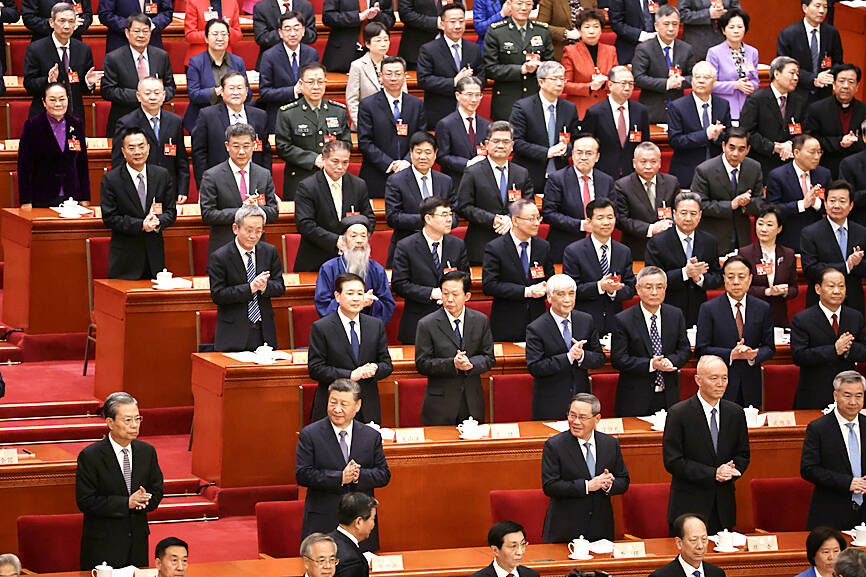
Photo: EPA-EFE
China stopped releasing some key economic data for parts of last year, such as the then-soaring youth unemployment rate, while Xi has mysteriously delayed a twice-a-decade meeting on long-term reforms, expected last autumn.
The growing opacity comes as Beijing tries to boost confidence in an economy grappling with a multiyear real-estate crisis and facing headwinds from geopolitical tensions with the US. Foreign direct investment slumped to a 30-year low last year, while mainland Chinese and Hong Kong stocks lost US$7 trillion during a market meltdown, despite official pledges to woo foreign capital.
“This is a big loss, and yet another sign the government slowly becoming ever-more opaque, both to outsiders and even those within the system,” said Christopher Beddor, deputy China research director at Gavekal Dragonomics.
Canceling the yearly briefing removes a key vehicle for the government to convey its plans in informal language and to respond to criticisms, he added.
The NPC itself had previously touted the press briefing as “one of the important windows for observing China’s openness and transparency” in a post published on its WeChat account in 2018.
Discussion of the premier’s media briefing was tightly controlled on Chinese microblogging platform Weibo yesterday afternoon, with searches only returning posts from government-linked accounts. Users shared an article celebrating past premiers’ briefings, in an apparent bid to skirt censors.
Li is still to deliver the government’s annual work report at the parliament’s opening today, where he is expected to repeat last year’s growth target of about 5 percent. While that number is the most important policy message of this month’s huddle of thousands of delegates from across the nation, the press briefing gave past premiers a rare chance to establish a personal rapport with the public.
Former premier Li Keqiang (李克強) set off a nationwide debate on poverty alleviation after complaining at the 2020 briefing that two-fifths of China’s population’s earned “not even enough to rent a room in a medium-sized Chinese city.”
Those type of comments afforded him a reputation as the “people’s premier” and his passing in October triggered an outpouring of nostalgia and grief.

When a hiker fell from a 55m waterfall in wild New Zealand bush, rescuers were forced to evacuate the badly hurt woman without her dog, which could not be found. After strangers raised thousands of dollars for a search, border collie Molly was flown to safety by a helicopter pilot who was determined to reunite the pet and the owner. A week earlier, an emergency rescue helicopter found the woman with bruises and lacerations after a fall at a rocky spot at the waterfall on the South Island’s West Coast. She was airlifted on March 24, but they were forced to

CONFIDENCE BOOSTER: ’After parkour ... you dare to do a lot of things that you think only young people can do,’ a 67-year-old parkour enthusiast said In a corner of suburban Singapore, Betty Boon vaults a guardrail, crawls underneath a slide, executes forward shoulder rolls and scales a steep slope, finishing the course to applause. “Good job,” the 69-year-old’s coach cheers. This is “geriatric parkour,” where about 20 retirees learned to tackle a series of relatively demanding exercises, building their agility and enjoying a sense of camaraderie. Boon, an upbeat grandmother, said learning parkour has aided her confidence and independence as she ages. “When you’re weak, you will be dependent on someone,” she said after sweating it out with her parkour classmates in suburban Toa Payoh,
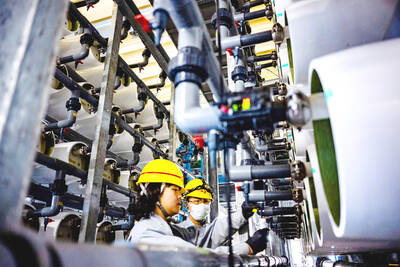
HIGH HOPES: The power source is expected to have a future, as it is not dependent on the weather or light, and could be useful for places with large desalination facilities A Japanese water plant is harnessing the natural process of osmosis to generate renewable energy that could one day become a common power source. The possibility of generating power from osmosis — when water molecules pass from a less salty solution to a more salty one — has long been known. However, actually generating energy from that has proved more complicated, in part due the difficulty of designing the membrane through which the molecules pass. Engineers in Fukuoka, Japan, and their private partners think they might have cracked it, and have opened what is only the world’s second osmotic power plant. It generates
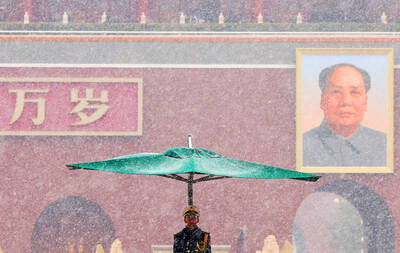
Chinese dissident artist Gao Zhen (高兟), famous for making provocative satirical sculptures of former Chinese leader Mao Zedong (毛澤東), was tried on Monday over accusations of “defaming national heroes and martyrs,” his wife and a rights group said. Gao, 69, who was detained in 2024 during a visit from the US, faces a maximum three-year prison sentence, said his wife, Zhao Yaliang (趙雅良), and Shane Yi, a researcher at the Chinese Human Rights Defenders group which operates outside the nation. The closed-door, one-day trial took place at Sanhe City People’s Court in Hebei Province neighboring the capital, Beijing, and ended without a


 RSS
RSS