


Aamir Mughal brandishes an eggplant before a gaggle of voters, rallying support behind the Pakistani staple during an election campaign that he says is being undermined by bizarre symbols assigned to candidates.
“The eggplant is now a famous symbol across all Pakistan,” said the Pakistan Tehreek-e-Insaf’s (PTI) candidate for the capital, Islamabad. “Now this has become the king of the vegetables.”
In Pakistan — where literacy rates hover at just 60 percent — political parties use icons to identify their candidates on the campaign trail and ballot papers.
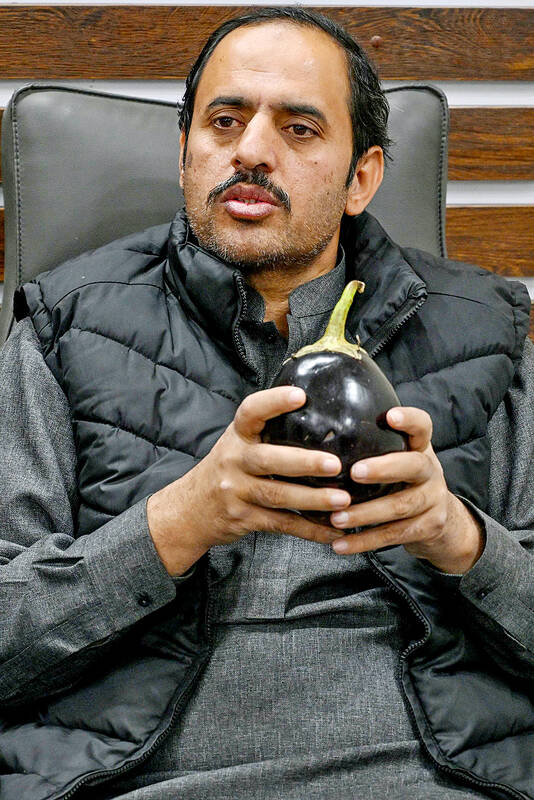
Photo: AFP
However, as a military-backed crackdown puts the squeeze on opposition parties, some candidates say authorities are trying to hinder their campaigns by allotting them symbols that are either degrading or downright weird.
Former Pakistani prime minister Imran Khan has been barred from standing and his PTI party has been stripped of its long-time cricket bat emblem over failing to meet election commission rules.
Dozens of his followers are also not allowed to stand, and some of those on the ticket — now running as independents — have reported harassment or been forced into hiding.
Others have been assigned a random bric-a-brac of symbols and are scrabbling to make an impression on the campaign trail.
A spokesman for the Election Commission of Pakistan said that the symbols are chosen from a list designed for independents and “are purely the prerogative of the returning officers.”
The humble eggplant — or baingan in Pakistan’s Urdu language — is a key ingredient in Pakistani cuisine.
It is also ripe with symbolic connotations, notably deployed as an emoji suggestive of male anatomy.
“The election commission assigned us this symbol to make a mockery of us,” 46-year-old Mughal said. “We felt weird.”
However, Mughal’s team have leaned into their fate. An aide trails him with a sack of the purple produce. He carries it like a mascot and makes speeches against a backdrop of festooned aubergines.
When addressing voters he holds it aloft like Shakespeare’s Hamlet contemplating a skull. Such is the popularity of their campaign, they claim the cost of eggplants has risen fourfold at grocers.
“This symbol is giving me an extraordinary fame,” Mughal said. “Everyone wants to look at it as they know the symbol belongs to Imran Khan’s candidate.”
Ejaz Gaddan romantically describes his constituency in Punjab Province as his ancestral homeland — his people’s “final resting place.”
Perhaps fittingly, he was assigned a symbol of a bed.
“They tried to humiliate us with the symbols they are giving us. Some candidates feel embarrassed telling people what symbol they have gotten,” the 50-year-old Bahawalpur candidate said. “This is not an election, this is cruelty.”
His symbol is a charpai — a simple wood-frame bed with a sprung surface of woven rope, commonly used in lower-income homes.
“It is a very useful household item. When we are alive, the charpai allows us to rest. When we die, it takes us on our final journey,” Gaddan said. “My symbol is already available in every household. I don’t have to introduce it to my constituents.”
The Pakistan Muslim League-Nawaz party is canvassing with the symbol of a fearsome big cat, but Gaddan is unfazed.
“The lion is a bloodthirsty beast,” he said. “There is no place in our society for a beast.”
In northwestern Pakistan, Shehryar Afridi was incensed when he was issued the bottle symbol.
In the local Pashto language, calling someone a bottle implies they are an “empty vessel” — vapid and thoughtless.
It also has connotations of alcohol consumption in Khyber Pakhtunkhwa Province.
“Most of the PTI candidates, including myself, were given symbols that were meant to create a negative bias,” the 45-year-old candidate for Kohat said. “We were deliberately given symbols that could be used to ridicule us.”
Afridi took his case to the High Court in the provincial capital, Peshawar, but won no relief.
“When we entered the field during the election campaign, we received so much backlash regarding the bottle symbol that it sabotaged our campaign automatically,” he said.
However, he has tweaked his symbol.
“A bottle doesn’t only represent alcohol, it also represents medicine,” he said. “That’s why we’ve transformed our electoral symbol into a medicine bottle — so that we can address all societal ailments.”
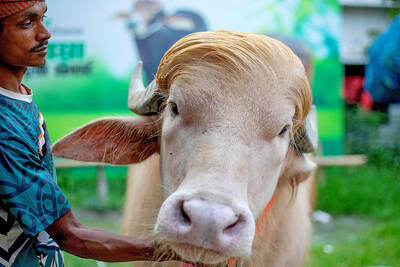
Crowds in Bangladesh are flocking to snap photographs with an unlikely social media star — an albino buffalo with flowing blond hair nicknamed “Donald Trump” that is due to be sacrificed within days. Owner Zia Uddin Mridha, 38, said his brother named the 700kg bull over its flowing helmet of hair resembling the signature look of the US president. “My younger brother picked this name because of the buffalo’s extraordinary hair,” he said at his farm in Narayanganj, just outside the capital, Dhaka. Mridha said that a constant stream of curious visitors — social media fans, onlookers and children — have come throughout

It began as a satirical online project. Now millions of young people in India are flocking to it as an outlet for their frustration. A parody political party called the Cockroach Janta Party, with the insect as its symbol, has exploded across India’s social media by turning absurdist humor into protest. Memes and short videos mocking corruption, joblessness and political dysfunction have flooded social media sites, where millions of users are embracing the cockroach — known for its ability to survive harsh conditions — as a tongue-in-cheek symbol of endurance. The online movement’s rise has been unusually rapid. The Cockroach Janta Party (CJP)
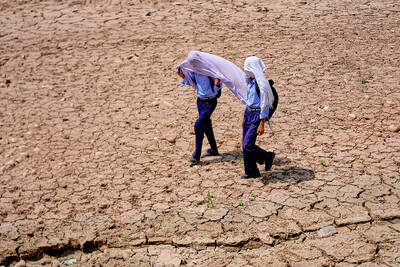
HOTTER: While Indians are accustomed to summer heat, climate change has caused northwestern India to warm faster than other parts of the country, an academic said Roads and markets have emptied during afternoons and some farmers have switched to nighttime work to avoid scorching temperatures as a heat wave grips large parts of India. The India Meteorological Department forecast maximum temperatures for yesterday of about 45°C in the capital, New Delhi, where authorities have opened temporary “cooling zones” to help people cope. The weather department warned that conditions would likely persist across several northern regions in the coming days, with temperatures staying well above seasonal averages. Authorities urged people to stay indoors during the hottest hours and take precautions against heat-related illnesses. India declares a heat wave whenever maximum temperatures

A Hong Kong astronaut is to join a Chinese space mission for the first time as part of a three-person crew launching today, as Beijing edges closer to its goal of landing people on the moon. The Tiangong space station — crewed by teams of three astronauts that are typically rotated every six months — is the crown jewel of China’s space program, boosted by billions in state investment in a bid to catch up with the US and Russia. The Shenzhou-23 mission is to blast off at 11:08pm from the Jiuquan Satellite Launch Center in northwestern China, carrying three astronauts to


 RSS
RSS