


Two US fighter jets flew over Bosnia on Monday in a demonstration of support for the Balkan nation’s integrity in the face of the increasingly secessionist policies of Bosnian Serb pro-Russia leader Milorad Dodik.
The US Air Force F-16 Fighting Falcons flew as part of joint air-to-ground training involving US and Bosnian forces. The flyovers took part in the regions of the eastern town of Tuzla and northern Brcko, a statement from the US embassy in Sarajevo said.
“This bilateral training is an example of advanced military-to-military cooperation that contributes to peace and security in the Western Balkans as well as demonstrates the United States’ commitment to ensuring the territorial integrity of BiH [Bosnia and Herzegovina] in the face of anti-Dayton and secessionist activity,” the statement said.
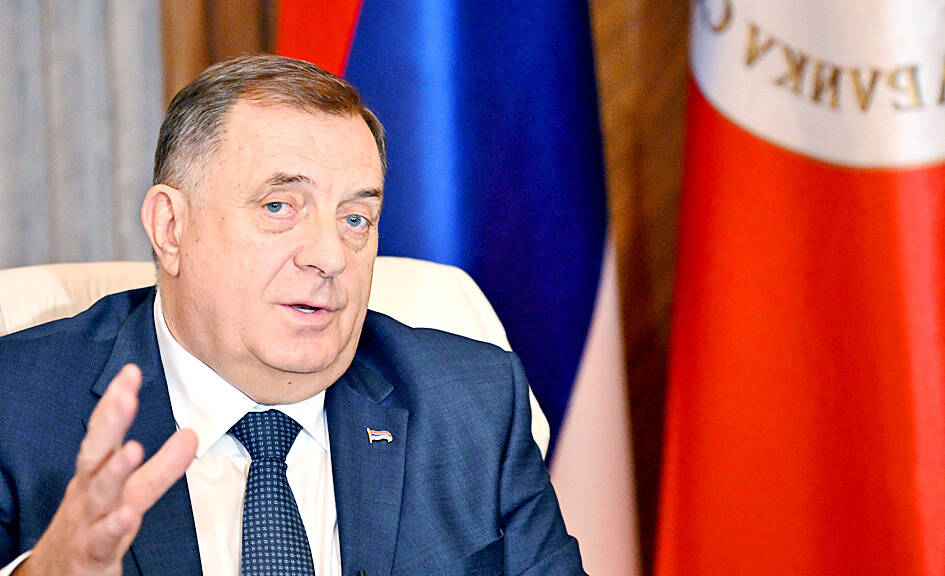
Photo: AFP
“The United States has underscored that the BiH Constitution provides no right of secession, and it will act if anyone tries to change this basic element” of the Dayton peace agreements that ended the 1992 to 1995 war in the nation, the statement added.
The ethnic conflict in the 1990s erupted because Bosnia’s Serbs wanted to create their own state and join neighboring Serbia. More than 100,000 people were killed before the war ended in a US-brokered peace accord that created Serb and Bosniak-Croat entities held together by joint institutions.
Dodik, who is president of the Serb entity called Republika Srpska, has defied US and British sanctions over his policies. Backed by Russia, he has repeatedly threatened to split the Serb-run half from the rest of Bosnia.
Dodik’s government on Monday started marking a controversial national holiday that Bosnia’s top court has declared unlawful. On Jan. 9, 1992, Bosnian Serbs proclaimed the creation of an independent state in Bosnia, which led to the bloodshed.
Bosnian media reported that the thunderous sound of jets flying over could be heard in the northwestern town of Banja Luka — the main town in the Serb entity — during a ceremonial gathering there.
In a speech, Dodik reiterated that the “the aim of the Serb people is a Serb state in these areas,” regional N1 TV reported.
Western nations fear that Russia could try to stir trouble in the Balkans to avert attention from its invasion of Ukraine, which was launched by Moscow nearly two years ago.
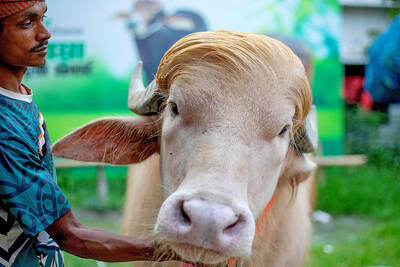
Crowds in Bangladesh are flocking to snap photographs with an unlikely social media star — an albino buffalo with flowing blond hair nicknamed “Donald Trump” that is due to be sacrificed within days. Owner Zia Uddin Mridha, 38, said his brother named the 700kg bull over its flowing helmet of hair resembling the signature look of the US president. “My younger brother picked this name because of the buffalo’s extraordinary hair,” he said at his farm in Narayanganj, just outside the capital, Dhaka. Mridha said that a constant stream of curious visitors — social media fans, onlookers and children — have come throughout

It began as a satirical online project. Now millions of young people in India are flocking to it as an outlet for their frustration. A parody political party called the Cockroach Janta Party, with the insect as its symbol, has exploded across India’s social media by turning absurdist humor into protest. Memes and short videos mocking corruption, joblessness and political dysfunction have flooded social media sites, where millions of users are embracing the cockroach — known for its ability to survive harsh conditions — as a tongue-in-cheek symbol of endurance. The online movement’s rise has been unusually rapid. The Cockroach Janta Party (CJP)
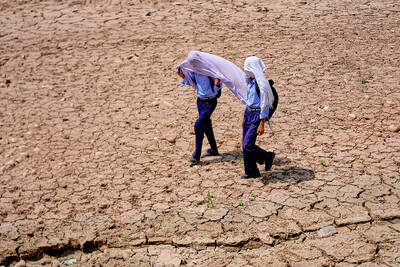
HOTTER: While Indians are accustomed to summer heat, climate change has caused northwestern India to warm faster than other parts of the country, an academic said Roads and markets have emptied during afternoons and some farmers have switched to nighttime work to avoid scorching temperatures as a heat wave grips large parts of India. The India Meteorological Department forecast maximum temperatures for yesterday of about 45°C in the capital, New Delhi, where authorities have opened temporary “cooling zones” to help people cope. The weather department warned that conditions would likely persist across several northern regions in the coming days, with temperatures staying well above seasonal averages. Authorities urged people to stay indoors during the hottest hours and take precautions against heat-related illnesses. India declares a heat wave whenever maximum temperatures

SPEAKING OUT: After Siranudh Scott’s allegations surfaced, celebrities and public figures took to social media to share their own experiences of sexual misconduct and abuse A high-profile alleged sexual abuse case within a wealthy Thai beer brewing family has prompted a wave of painful accounts from survivors of unconnected abuse in the conservative nation. Siranudh Scott, a member of the billionaire Thai family that founded the ubiquitous Singha beer brand, posted an emotional video this month accusing his elder brother Sunit of repeatedly abusing him when he was a teenager. Sunit, who is in his 30s, later denied the allegations in a video posted online, but Singha parent Boonrawd dismissed him from his executive role with the company on Tuesday last week. “I felt I needed to speak


 RSS
RSS