


An ethnic armed group in northeastern Myanmar has seized a major crossing point for trade along the Chinese border, residents and media reports said.
The border gate in Laukkaing township, the capital of the Kokang Self-Administered Zone in the northern part of Shan State, became the fifth crossing seized by the group since it launched a coordinated offensive on Oct. 27 alongside two other ethnic armed groups.
The Myanmar National Democratic Alliance Army (MNDAA), which took control of the crossing, joined with the Ta’ang National Liberation Army and the Arakan Army for the offensive that began in October and call themselves the Three Brotherhood Alliance.
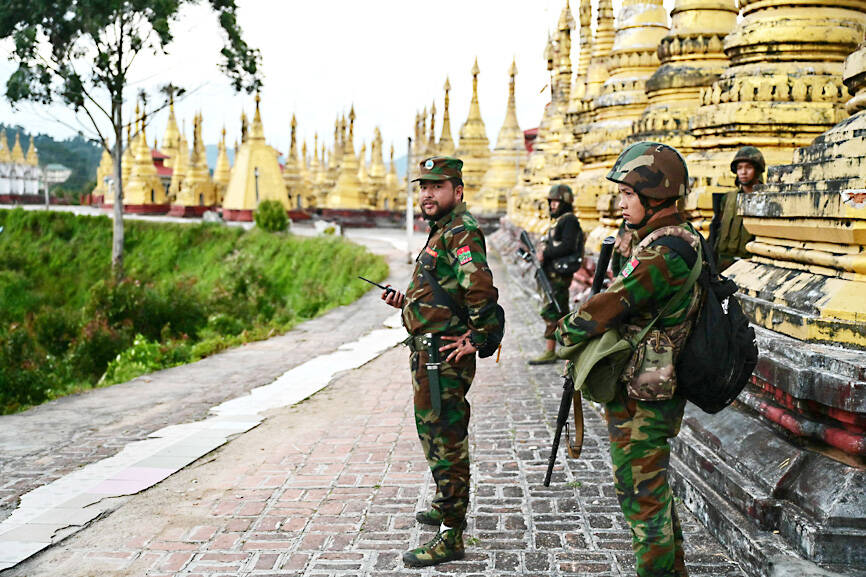
Photo: AFP
Laukkaing is known for hosting major organized criminal enterprises including cyberscam operations controlled by Chinese investors in cooperation with local Burmese warlords.
The Chinese government in the past few weeks has initiated a crackdown on such operations and thousands of people involved have been repatriated to China.
Many of those who were employed were tricked into working there and then held against their will.
The MNDAA is a military group of the Kokang minority that is trying to oust a rival Kokang group, which is backed by the military government, from power in the town.
A Laukkaing resident on Tuesday told reporters that the Yan Lon Kyaing border gate was seized on Monday after members of the army-affiliated militia guarding the gate laid down their weapons.
He spoke on condition of anonymity for fear of reprisals from the army and the ethnic armed group.
Another Laukkaing resident who also asked not to be identified for fear of being arrested said that he saw MNDAA troops near the trading gate on Monday.
Shwe Phee Myay news agency, a Shan-based online media group, on Tuesday reported that a resident saw MNDAA’s flags flying at the gate.
There were similar reports in other Burmese media.
There was no response after reporters reached out to MNDAA representatives seeking confirmation of the reports.
The alliance’s attacks since October have posed a challenge to Myanmar’s military government, which has struggled to contain a nationwide uprising by members of the Peoples’ Defense Force, a pro-democracy armed group established after the army seized power from the elected government of Aung San Suu Kyi in February 2021.
The alliance has claimed several victories, including the seizure of more than 200 military posts and four border crossing points controlling crucial trade with China.
It says it has killed hundreds of Burmese army soldiers.
The fighting has blocked cross-border trade and raised concerns in Beijing. It also threatens further political destabilization in Myanmar, a strategic ally to China that is embroiled in civil war in many parts of the country.
China called for a ceasefire after the fighting escalated near its border. It also brokered peace talks between the military and the alliance, and on Thursday last week announced that the two sides had reached an agreement on a ceasefire.
However, fighting has continued in at least five townships in the northern part of Shan.
The Ta’ang National Liberation Army has claimed it captured two of the townships.
The Kokang, an MNDAA-backed online media group, wrote on Facebook that fighting in the Kokang region resumed on Tuesday after the military carried out aerial attacks against MNDAA outposts.
Laukkaing residents also told reporters that fighting between the army and the MNDAA broke out in the town while military aircraft dropped bombs on parts of the town on Tuesday.
See US on page 9
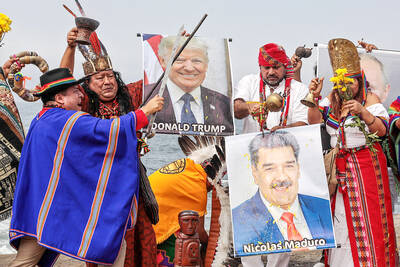
Shamans in Peru on Monday gathered for an annual New Year’s ritual where they made predictions for the year to come, including illness for US President Donald Trump and the downfall of Venezuelan President Nicolas Maduro. “The United States should prepare itself because Donald Trump will fall seriously ill,” Juan de Dios Garcia proclaimed as he gathered with other shamans on a beach in southern Lima, dressed in traditional Andean ponchos and headdresses, and sprinkling flowers on the sand. The shamans carried large posters of world leaders, over which they crossed swords and burned incense, some of which they stomped on. In this
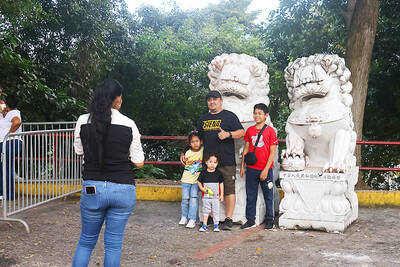
Near the entrance to the Panama Canal, a monument to China’s contributions to the interoceanic waterway was torn down on Saturday night by order of local authorities. The move comes as US President Donald Trump has made threats in the past few months to retake control of the canal, claiming Beijing has too much influence in its operations. In a surprising move that has been criticized by leaders in Panama and China, the mayor’s office of the locality of Arraijan ordered the demolition of the monument built in 2004 to symbolize friendship between the countries. The mayor’s office said in

‘TRUMP’S LONG GAME’: Minnesota Governor Tim Walz said that while fraud was a serious issue, the US president was politicizing it to defund programs for Minnesotans US President Donald Trump’s administration on Tuesday said it was auditing immigration cases involving US citizens of Somalian origin to detect fraud that could lead to denaturalization, or revocation of citizenship, while also announcing a freeze of childcare funds to Minnesota and demanding an audit of some daycare centers. “Under US law, if an individual procures citizenship on a fraudulent basis, that is grounds for denaturalization,” US Department of Homeland Security Assistant Secretary Tricia McLaughlin said in a statement. Denaturalization cases are rare and can take years. About 11 cases were pursued per year between 1990 and 2017, the Immigrant Legal Resource
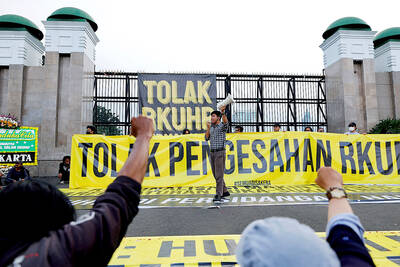
Indonesia yesterday began enforcing its newly ratified penal code, replacing a Dutch-era criminal law that had governed the country for more than 80 years and marking a major shift in its legal landscape. Since proclaiming independence in 1945, the Southeast Asian country had continued to operate under a colonial framework widely criticized as outdated and misaligned with Indonesia’s social values. Efforts to revise the code stalled for decades as lawmakers debated how to balance human rights, religious norms and local traditions in the world’s most populous Muslim-majority nation. The 345-page Indonesian Penal Code, known as the KUHP, was passed in 2022. It


 RSS
RSS