


A Vatican court on Saturday sentenced a once-powerful Italian cardinal to five years and six months in jail for financial crimes at the end of a historic trial.
Angelo Becciu, 75, a former adviser to Pope Francis who was once considered a papal contender himself, was the most senior clergyman in the Catholic Church to face a Vatican criminal court.
His lawyer, Fabio Viglione, said they respected the sentence — which included an 8,000-euro (US$8,727) fine — but would appeal, continuing to insist on Becciu’s innocence.
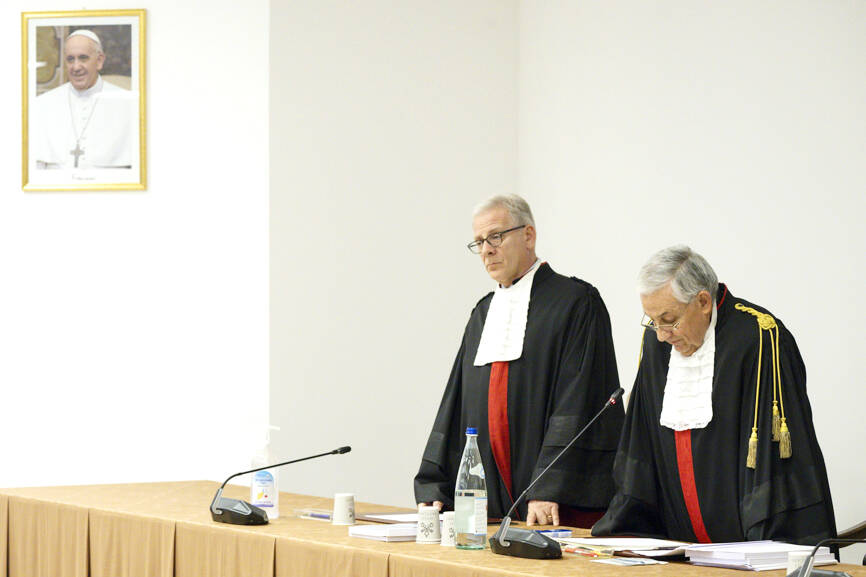
Photo: EPA-EFE / VATICAN MEDIA HANDOUT
The cardinal had been accused of embezzlement, abuse of office and witness tampering, one of 10 defendants in a trial focused on a disastrous investment by the Vatican in a luxury building in London.
They included financiers, lawyers and ex-Vatican employees accused of a range of financial crimes — all of whom were found guilty on Saturday, barring one, Becciu’s former secretary Mauro Carlino.
More than two-and-a-half years after the trial opened, Vatican City State Court President Giuseppe Pignatone read out sentences ranging from a fine to more than seven years in jail.
The court also ordered the confiscation from those convicted of 166 million euros, and ordered them to compensate the civil parties to the tune of more than 200 million euros.
The Holy See had declared itself “an offended party” and four Vatican entities were civil parties, claiming hundreds of millions of euros, including for moral and reputational damage.
The trial shone a light on the Holy See’s murky finances, which Pope Francis has sought to clean up since taking the helm of the Catholic Church in March 2013.
Just weeks before the first hearing, Francis gave the Vatican’s civilian courts the power to try cardinals and bishops, where previously they were judged by a court presided over by cardinals.
At the heart of the trial was the purchase of a building in London’s upmarket Chelsea neighborhood, which resulted in losses that the Vatican claimed dipped into resources intended for charity.
Becciu was found guilty of embezzlement over the decision to invest US$200 million in 2013-2014 into a fund run by financier Raffaele Mincione, which the judges said was hugely risky.
Some of this money went to buying part of the Sloane Avenue property — a deal in which the Vatican lost between 140 million and 190 million euros, prosecutors said.
Prosecutor Alessandro Diddi had requested seven years and three months in jail for Becciu, who had always insisted he never took a cent.
Mincione was on Saturday jailed for five-and-a-half years, while another broker involved in the London deal, Gianluigi Torzi, was jailed for six.
The trial involved more than 80 hearings in the dedicated room within the Vatican Museums, where a portrait of a smiling Pope Francis hangs on the wall.

‘CROSSING THE LINE’: China’s embassy in Seoul criticized US Forces Korea Commander General Xavier Brunson, asking if his ‘hostile’ remarks were authorized by Washington South Korea and the US are in talks over recent public remarks by the commander of US Forces Korea, Seoul’s presidential office said yesterday, after the comments drew sharp criticism from China. In a recent podcast interview, US Forces Korea Commander General Xavier Brunson described South Korea as “the dagger in the heart of Asia” from China’s east coast, prompting the Chinese embassy in Seoul to say that he had “truly crossed the line.” The interview came amid growing speculation that Washington might seek to expand the role of US Forces Korea in countering the growing regional influence of China, a key

Through the noise of rushing papers and whirring belts at a print factory in Kyoto, two creators watch their photo essay come to life in broadsheet form — part of an effort to win new audiences in the age of artificial intelligence (AI). Despite the decline of the publishing industry, self-publication and handmade “zine” magazines are growing in popularity in Japan, reflecting the nation’s enduring love of paper in the digital era. While speaking to Agence France-Presse at the plant, his hands black with ink, one of the creators, Kazuma Obara, said: “I think [paper] is a medium that engages all five

Australian researchers have trained lab-grown brain cells on a silicon computer chip to play the 1990s shooter game Doom and said they are just scratching the surface of what the neurons could be capable of doing. It is the science-fiction work of biotech boffins at Cortical Labs, who researched and developed the technology that harnesses the workings of the brain’s networking system. Each so-called “biological computer” contains about 200,000 living human brain cells, grown from stem cells that were harvested from blood donations. Having mastered the simple computer game Pong, where a paddle is moved up and down to send a ball
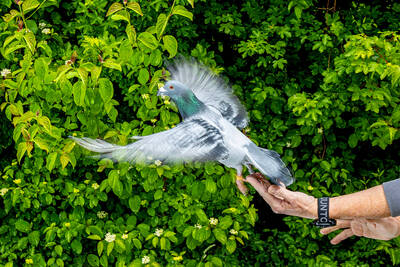
A surprising gut feeling may help pigeons find their way home. Animals use various techniques to navigate, including following the stars and remembering key landmarks. Birds, fish and turtles orient themselves using Earth’s magnetic field as a compass, but it is not yet clear how exactly they do this. Pigeons are a well-known group of frequent flyers that can traverse hundreds of kilometers in a single day. For thousands of years, humans have used them to carry news, notes and military messages. Scientists have long tried to untangle how pigeons travel without getting lost. Some think the birds detect magnetic cues using light-sensitive


 RSS
RSS