


Elves, queens and mythological beings on Tuesday paraded through the streets of El Salvador, in annual celebrations for the Central American country’s patron saint and namesake.
The Salvador del Mundo (Savior of the World) festivities honor Christian and local mythological traditions. This year saw thousands of people gather for a procession in the capital, San Salvador, accompanied by parade floats and bands.
“We have always attended with my family to see the parade, it is part of our culture that should not be missed,” Reina Carpio, 54, told reporters while attending the parade with her husband and three children.

Photo: AFP
The parade was led by people dressed as creatures from Salvadoran mythology, such as the siguanaba, a cursed female being, or the cadejo, a black, dog-like animal with large fangs.
Queens adorned in multicolored flowers threw sweets to those in the audience, while elves and other fantastic beings showed off for passersby.
Each year, parades, children’s events and sporting competitions are held as part of the festivities, typically under an increased police presence.
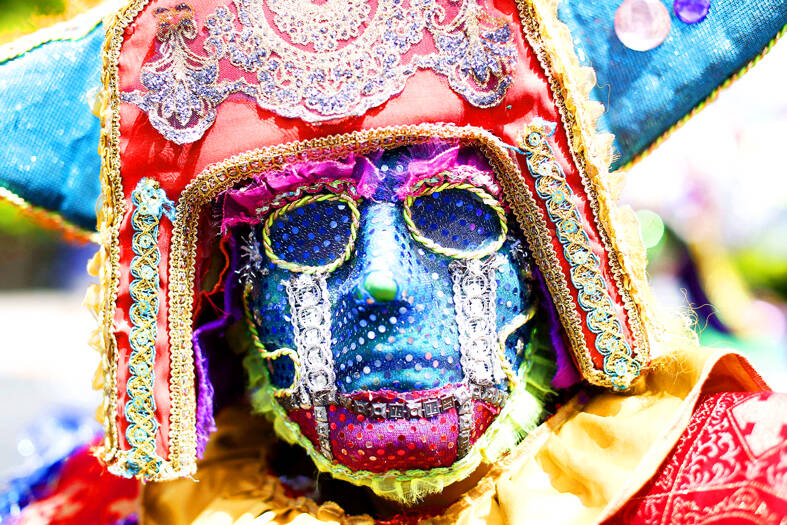
Photo: EPA-EFE
The celebrations this year are taking place under an anti-gang “state of emergency,” in place since March last year.
The director of Civil Protection, Luis Amaya, said that about 42,000 personnel — including police officers, firefighters and medical workers — were monitoring events this year.
The festivities are to conclude on Sunday with a mass officiated by all of the country’s bishops in San Salvador cathedral.

Crowds in Bangladesh are flocking to snap photographs with an unlikely social media star — an albino buffalo with flowing blond hair nicknamed “Donald Trump” that is due to be sacrificed within days. Owner Zia Uddin Mridha, 38, said his brother named the 700kg bull over its flowing helmet of hair resembling the signature look of the US president. “My younger brother picked this name because of the buffalo’s extraordinary hair,” he said at his farm in Narayanganj, just outside the capital, Dhaka. Mridha said that a constant stream of curious visitors — social media fans, onlookers and children — have come throughout

It began as a satirical online project. Now millions of young people in India are flocking to it as an outlet for their frustration. A parody political party called the Cockroach Janta Party, with the insect as its symbol, has exploded across India’s social media by turning absurdist humor into protest. Memes and short videos mocking corruption, joblessness and political dysfunction have flooded social media sites, where millions of users are embracing the cockroach — known for its ability to survive harsh conditions — as a tongue-in-cheek symbol of endurance. The online movement’s rise has been unusually rapid. The Cockroach Janta Party (CJP)
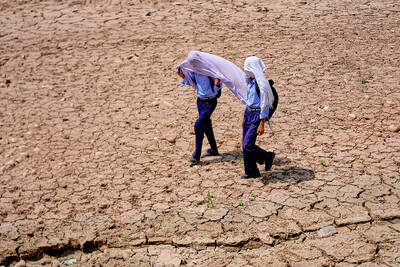
HOTTER: While Indians are accustomed to summer heat, climate change has caused northwestern India to warm faster than other parts of the country, an academic said Roads and markets have emptied during afternoons and some farmers have switched to nighttime work to avoid scorching temperatures as a heat wave grips large parts of India. The India Meteorological Department forecast maximum temperatures for yesterday of about 45°C in the capital, New Delhi, where authorities have opened temporary “cooling zones” to help people cope. The weather department warned that conditions would likely persist across several northern regions in the coming days, with temperatures staying well above seasonal averages. Authorities urged people to stay indoors during the hottest hours and take precautions against heat-related illnesses. India declares a heat wave whenever maximum temperatures

A Hong Kong astronaut is to join a Chinese space mission for the first time as part of a three-person crew launching today, as Beijing edges closer to its goal of landing people on the moon. The Tiangong space station — crewed by teams of three astronauts that are typically rotated every six months — is the crown jewel of China’s space program, boosted by billions in state investment in a bid to catch up with the US and Russia. The Shenzhou-23 mission is to blast off at 11:08pm from the Jiuquan Satellite Launch Center in northwestern China, carrying three astronauts to


 RSS
RSS