


In an escalation of Moscow’s anger at Ukraine and its Western backers, Russia refused to speak at a UN Security Council meeting called to discuss its recent devastating attacks on the key port of Odesa immediately following its refusal to extend the Black Sea grain deal.
The confrontation began at the start of a council session called by Russia on the divided Orthodox Church in Ukraine. Russian Deputy Ambassador to the UN Dmitry Polyansky protested that Britain, which holds the council presidency, was allowing only two briefers and Moscow wanted a third — Archbishop Gideon of the Ukrainian Orthodox Church.
The Ukrainian government has cracked down on the Ukrainian Orthodox Church over its historic ties to the Russian Orthodox Church, whose leader, Patriarch Kirill, supported Russian President Vladimir Putin over the invasion of Ukraine.

Photo: AP
Polyansky accused the UK of bias, censorship and obstruction for limiting the number of briefers.
British Deputy Ambassador to the UN James Kariuki responded that because of a tight time schedule to fit in two council meetings, the UK had offered a compromise to allow a third Russian briefer to submit a statement to the council, which he said was “not unreasonable.”
Polyansky was not satisfied, and Kariuki then put Russia’s proposal to have the archbishop speak to a vote. Russia got support only from China and Brazil, with the 12 other council members abstaining.
Polyansky called the council’s refusal to allow the archbishop to speak an “egregious” example of double standards on human rights and freedom of religion.
As “a sign of protest,” he said, Russia would not speak in the Ukraine-backed council session called by Kyiv to take up the Odesa attacks.
The meeting on the Orthodox Church then went ahead. The director of the UN Alliance of Civilizations, Nihal Saad, told the council that the division between Ukraine’s Orthodox bodies “has existed for decades.”
However, she said it has been exacerbated since the Russian invasion in February last year and has “reverberated worldwide as Orthodox churches have struggled with how and whether to take sides.”
Saad said the “heartbreaking” damage to Odesa’s historic church, the Transfiguration Cathedral, caused by a Russian missile strike on Sunday was condemned by many, including the UN secretary-general.
The cathedral is in Odesa’s historic city center that is a UNESCO world heritage site and had been largely spared since the beginning of the war.
Saad lamented that it was one of 116 religious sites damaged since the invasion, according to a preliminary assessment by the UN Educational, Scientific and Cultural Organization.
In her briefing, Saad cited restrictions to freedom of religion by both Russia and Ukraine since the invasion, saying that “the politicization of religion in the war in Ukraine fuels intercommunal tensions, stokes fear and triggers violence.”
Polyansky called the devastation to the cathedral “a horrible tragedy” and reiterated Russia’s claim that the cathedral was damaged by a piece from Ukraine’s anti-air defenses — not a Russian missile.
If a Russian missile targeted the cathedral, “then there would be nothing left of the cathedral at all,” he said.
The Russian deputy ambassador left the council chamber at the end of the session.
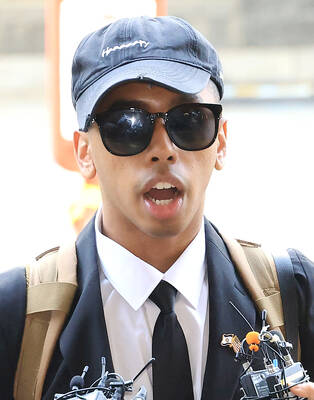
A US YouTuber who caused outrage for filming himself kissing a statue commemorating Korean wartime sex slaves has been sentenced to six months in prison, a court in Seoul said yesterday. Johnny Somali, 25, gained notoriety several years ago for recording himself doing a series of provocative stunts in South Korea and Japan, and streaming them on platforms such as YouTube and Twitch. South Korean authorities indicted Somali — whose real name is Ramsey Khalid Ismael — in 2024 on public order violations and obstruction of business, and banned him from leaving the country. “The court has sentenced him to six months in
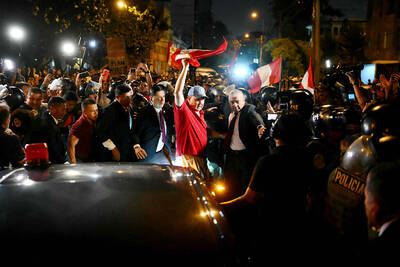
Former Lima mayor Rafael Lopez Aliaga, a Peruvian presidential hopeful, gathered hundreds of supporters in Lima on Tuesday and gave authorities 24 hours to annul the first round of the country’s election over allegations of fraud. Lopez Aliaga is locked in a tight three-way race with two other candidates for second place in Sunday’s vote. The election runner-up wins a ticket to June’s presidential run-off against front-runner Keiko Fujimori. “I am giving them 24 hours to declare this electoral fraud null and void,” said Lopez Aliaga, surrounded by a crowd of several hundred supporters. “If it is not declared null and void tomorrow,

PAPAL RETORT: Pope Leo told reporters that he has ‘no fear, neither of the Trump administration nor speaking out loudly about the message of the Gospel’ US President Donald Trump has feuded with Pope Leo XIV over the Iran conflict — setting off an unholy row that could have serious political implications for the Republican leader back in the US. Trump has drawn barbs even from some allies over the attacks on the US-born pontiff, who has criticized the Trump administration over its immigration crackdown, the intervention in Venezuela and the Iran war. The president risks alienating the religious right in November’s crucial US midterm elections. So far the unprecedented clash between the leader of the most powerful military on Earth and the head of the world’s 1.4 billion

A 16-year-old boy has been charged with murder and aggravated sexual abuse in Florida in the death of his 18-year-old stepsister on a Carnival Cruise ship, the US Department of Justice said on Monday. Timothy Hudson was initially charged in February and subsequently indicted on March 10, but the breadth of the case was not known until a seal was lifted on Friday last week, weeks after US District Judge Beth Bloom in Miami said that he would be prosecuted as an adult at the request of the government. Anna Kepner had been traveling on the Carnival Horizon ship in November last


 RSS
RSS