

South African lawmakers on Tuesday voted in favor of a controversial new law which aims to provide free universal healthcare, but which critics fear might not be sustainable.
A fund to be established under the law, which still has to be passed by the upper house of parliament, before being signed into law by South African President Cyril Ramaphosa, would provide healthcare for all at rates to be determined by the government.
After a heated debate the bill was adopted by 205 members of parliament and rejected by 125.
South African Minister of Health Joe Phaahla described the passing of the bill, which has been 12 years in the making, as a “historic milestone” and “one of the most revolutionary pieces of legislation” since the end of apartheid.
The National Health Insurance (NHI) would be “an equitable, accessible, affordable and strengthened healthcare system,” he said.
“As inequality has been growing in our country even cutting across race, access to quality health services has been a casualty with those who have private medical insurance consuming 51 percent of the national spending, while constituting only 16 percent of the population, while 84 percent depend on 49 percent resources from the fiscus and services provided” by public hospitals, he said.
If signed into law, it would “ensure all the people of South Africa have access to the same clinic or hospital [either public or private], closer to where they live or work without paying — government will pay,” the minister said after the adoption of the bill.
Everyone will contribute to the fund through taxes and special contributions.
Critics say the bill risks collapsing the health system.
South African Shadow Minister of Health Michele Clarke from the main opposition Democratic Alliance party rejected the bill as a ploy by the ruling African National Congress (ANC) party to canvas for votes ahead of next year’s crunch election.
“NHI will inevitably destroy all healthcare in South Africa,” Clarke said in parliament.
Busi Mavuso, CEO of Business Leadership South Africa, an independent forum representing some of the country’s largest business enterprises, said she feared the bill “would leave all South Africans worse off, in a system in which state provision becomes impossible and private health provision is effectively closed down.”
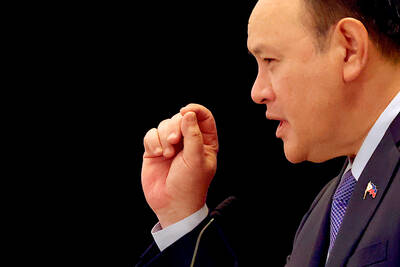
Philippine Secretary of National Defense Gilberto Teodoro Jr on Tuesday hit out at China at an international forum after a memo asserting Beijing’s position over their longstanding maritime dispute was delivered to him while he was speaking on stage. The unusual incident was captured on video at the Seoul Defense Dialogue as the secretary was responding to a question about “gray zone” coercion in the South China Sea. The video shows what appears to be a conference staffer placing it on the table next to him while speaking. “I have a note here, I think this is from China,” he said, describing

PAINSTAKING PROCESS: Ice makers freeze water for up to 72 hours, replace tainted water with a fresh batch once freezing begins, and are constantly stirring In the historic Japanese city of Kanazawa, craftsmen painstakingly shape and slice blocks of ice destined to chill negronis in some of the world’s trendiest bars. The men work for Kuramoto Ice, a century-old company in Ishikawa on the Sea of Japan coast and one of dozens of Japanese firms producing ultra-clear, premium ice. This luxury product, believed by those in the industry to melt more slowly than regular blocks, is a staple of Japan’s cocktail culture, but its popularity is also spilling over to bars abroad, from the US to Australia, who pay as much as ¥200 (US$1.28) per cube. Kuramoto Ice
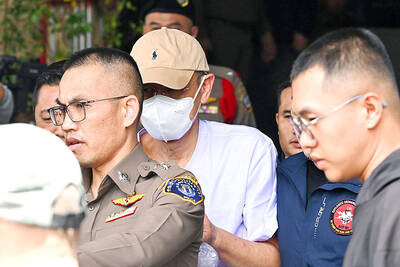
Thai police yesterday said that they arrested a senior Buddhist monk on suspicion of embezzling US$2.8 million intended for his monastery, alongside a suspected female accomplice he was having sex with. The case is the latest scandal to hit the clergy in Buddhist-majority Thailand after a sex and extortion case involving senior monks last year prompted public outrage and calls for greater scrutiny of temple finances. Phra Wachirayan Wi, the 66-year-old abbot of the 14th-century Wat Phutthaisawan in the ancient capital of Ayutthaya, was arrested on Thursday on charges including embezzlement and money laundering, lead police investigator Pattanasak Bupphasuwan said. A 47-year-old woman
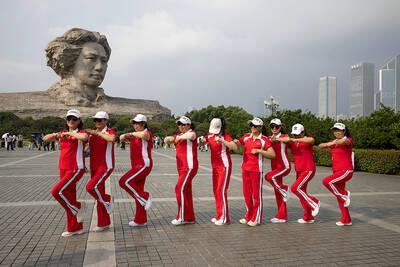
China yesterday marked half a century since the death of Mao Zedong (毛澤東), founder of the People’s Republic, who brought roughly one-quarter of the world’s population under communist rule and whose specter still haunts China’s future. Mao’s death on Sept. 9, 1976, at age 82, mourned by many and welcomed by some who suffered under his nearly three-decade rule, also hastened the end of the Cultural Revolution, a frenzied mass movement he launched in 1966. The party later condemned the Cultural Revolution as a grave error for which Mao bore primary responsibility, but still reveres him, saying his achievements outweigh his mistakes. Mao’s


 RSS
RSS