


In the foothills of Mexico’s Popocatepetl volcano, locals have their own beliefs about why ash is recently raining down on them — and it has little to do with conventional science.
According to legend, the spirit of the volcano located 70km southeast of Mexico City is embodied by a man known locally as “Don Goyo.”
When he gets upset, “El Popo” starts to rumble as it has for more than a week.
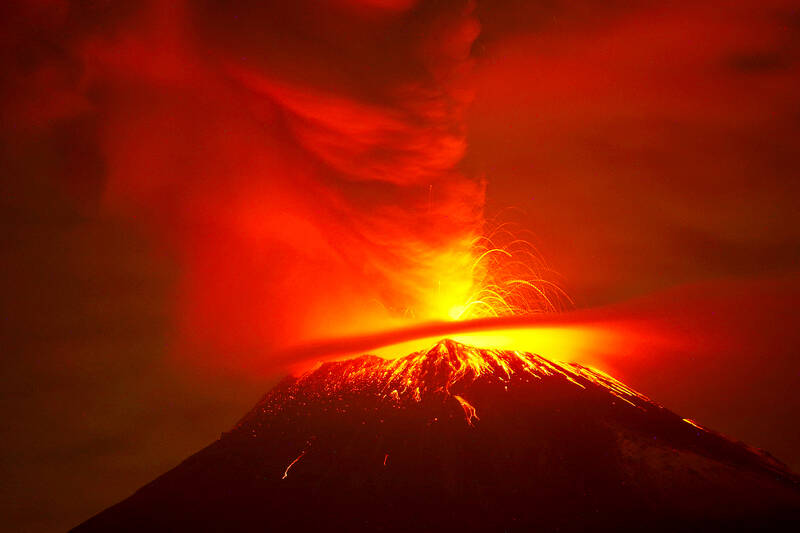
Photo: AFP
“Don Goyo’s angry, because they didn’t put out his offering,” said Jose Luis, a 55-year-old charcoal seller in Xalitzintla, the community closest to Popocatepetl.
Some residents even report having seen the mountain incarnate appear before them.
Jose Marcos said that when he was a child, Don Goyo — full name Gregorio Chino Popocatepetl — came to his house for a glass of water and a taco.
“We asked him: ‘Who are you?’ He said: ‘Don’t you know me? I’m Gregorio Chino Popocatepetl. I’m the volcano,’” the 77-year-old farmer said.
Every year on March 12, residents mark the day known as Don Goyo’s birthday.
Hundreds of people approach the crater to offer typical dishes, liquor, flowers and clothes, and sing a traditional song.
However, this year, authorities restricted access to the site, due to the increased danger, dismaying locals who said that it would anger the mountain’s spirit.
“We’ve already asked Don Goyo to wait for us until next year,” Xalitzintla Mayor Gumaro Sandre Popoca said.
Life in Xalitzintla, home to about 2,000 inhabitants, revolves around volcanoes.
The walls are dotted with images of Popocatepetl and the neighboring Iztaccihuatl volcano.
Mediums who claim to communicate with “Don Goyo” are influential figures in the community.
One of them, Nazario Castro, blames people who enter the exclusion zone to take selfies for upsetting the volcano.
“They’re provoking it, because they go up” to take pictures and “it starts to thunder,” Castro said.
Isabel, a restaurant owner in the town, said that as an 11-year-old girl she also saw the man who embodies Popocatepetl.
“He comes down from the mountain. He’s tall, with white hair and green eyes,” she said.
“He scared me. I ran home and got under the bed,” added the 54-year-old, who did not want to give her full name for fear of being called a “gossip.”
However, she enthusiastically recounted a pre-Hispanic love story involving Popocatepetl and Iztaccihuatl.
According to legend, Iztaccihuatl (“white woman” in the indigenous Nahuatl language) was the daughter of a local chief who fell in love with a handsome warrior called Popocatepetl (“smoking mountain”).
However, Popocatepetl was sent to war and a lovelorn Iztaccihuatl died of grief.
When the warrior returned, he found her body and carried it to the mountain, where both were covered with snow and became majestic volcanoes.
For the past week, “El Popo,” which awoke from decades of slumber in 1994, has unnerved locals with several explosions, and repeated emissions of ash, gasses and molten rock.
Authorities increased their warning level to one step below red alert, which, if reached, would mean evacuation for thousands of people living near the volcano.
While some residents have already left as a precaution, others prefer to stay.
“We’re not afraid,” said Eufemia de Jesus Ramos, who sells birds at an animal market in San Andres Calpan, about 25km from Popocatepetl.
“If we leave, the thieves will take advantage of it,” the 65-year-old said.

‘CROSSING THE LINE’: China’s embassy in Seoul criticized US Forces Korea Commander General Xavier Brunson, asking if his ‘hostile’ remarks were authorized by Washington South Korea and the US are in talks over recent public remarks by the commander of US Forces Korea, Seoul’s presidential office said yesterday, after the comments drew sharp criticism from China. In a recent podcast interview, US Forces Korea Commander General Xavier Brunson described South Korea as “the dagger in the heart of Asia” from China’s east coast, prompting the Chinese embassy in Seoul to say that he had “truly crossed the line.” The interview came amid growing speculation that Washington might seek to expand the role of US Forces Korea in countering the growing regional influence of China, a key

SEEKING ORDER: Rodrigo Paz said that ‘anyone who wants to destroy the nation will have to deal with this president and the full force of the constitution’ Bolivian President Rodrigo Paz on Wednesday said that the nation was at a “breaking point” after nearly a month of protests that have caused shortages of food, fuel and medicine. Paz, who took office six months ago amid the worst economic crisis there in four decades, is battling a groundswell of fury over his policies. The political capital, La Paz, has been besieged by low-income workers and members of the indigenous majority calling for his resignation. “The country needs order and is reaching breaking point,” the 58-year-old said at a public event in La Paz, renewing his appeal for dialogue. On Tuesday, the Bolivian

Australian researchers have trained lab-grown brain cells on a silicon computer chip to play the 1990s shooter game Doom and said they are just scratching the surface of what the neurons could be capable of doing. It is the science-fiction work of biotech boffins at Cortical Labs, who researched and developed the technology that harnesses the workings of the brain’s networking system. Each so-called “biological computer” contains about 200,000 living human brain cells, grown from stem cells that were harvested from blood donations. Having mastered the simple computer game Pong, where a paddle is moved up and down to send a ball

Through the noise of rushing papers and whirring belts at a print factory in Kyoto, two creators watch their photo essay come to life in broadsheet form — part of an effort to win new audiences in the age of artificial intelligence (AI). Despite the decline of the publishing industry, self-publication and handmade “zine” magazines are growing in popularity in Japan, reflecting the nation’s enduring love of paper in the digital era. While speaking to Agence France-Presse at the plant, his hands black with ink, one of the creators, Kazuma Obara, said: “I think [paper] is a medium that engages all five


 RSS
RSS