


China has sentenced a 78-year-old US citizen to life in prison for espionage, a court said yesterday, but revealed few details about the case that had previously gone unreported.
Such heavy terms are relatively rare for foreign citizens in China, and the jailing of US passport holder John Shing-wan Leung (梁成運) is likely to further strain already damaged ties between Beijing and Washington.
Leung, who is a Hong Kong permanent resident, “was found guilty of espionage, sentenced to life imprisonment, deprived of political rights for life,” the Suzhou Intermediate People’s Court said in a statement.
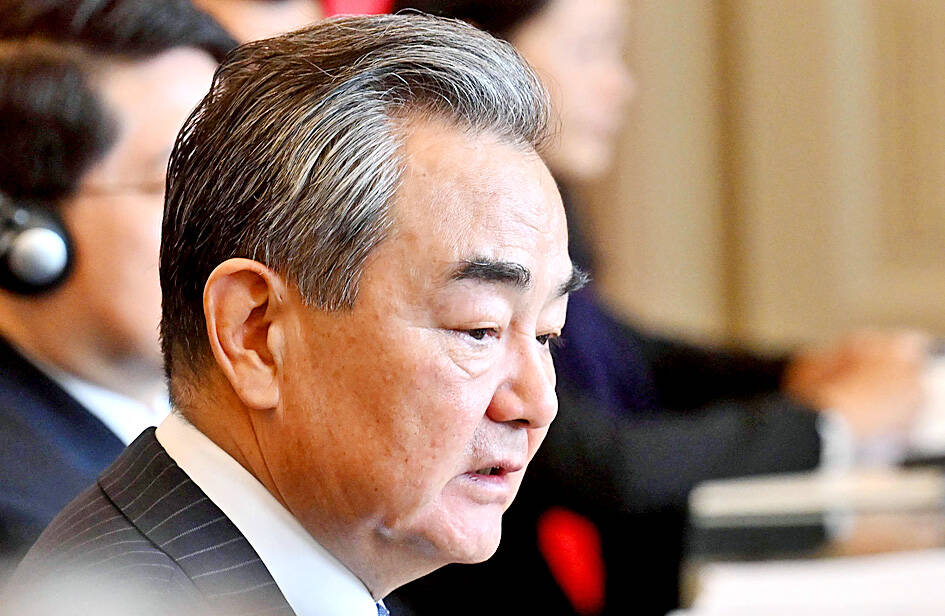
Photo: AFP
Authorities in Suzhou, a city in eastern China, “took compulsory measures according to the law” against Leung in April 2021, it said, without specifying when he had been taken into custody.
It was unclear where Leung had been living at the time of his arrest.
A spokesperson for the US embassy in Beijing said they were aware of reports that a US citizen had been convicted and sentenced in Suzhou.
“The [US] Department of State has no greater priority than the safety and security of US citizens overseas,” the spokesperson said. “Due to privacy considerations, we have no further comment.”
The court statement provided no further details on the charges, and closed door trials are routine in China for sensitive cases.
Chinese Ministry of Foreign Affairs spokesperson Wang Wenbin (汪文斌) declined to comment further on the case at a news conference yesterday.
The jailing is likely to damage relations with Washington, which are already severely strained over issues such as trade, human rights and Taiwan.
Washington and Beijing have ended an unofficial pause in high-level contacts over the US’ shooting down in February of a suspected Chinese surveillance balloon.
In an apparent breakthrough last week, US National Security Advisor Jake Sullivan and Chinese Central Foreign Affairs Commission Director Wang Yi (王毅) held eight hours of talks in Vienna, with both sides describing the meeting as “candid, substantive and constructive.”
On Friday, Washington issued a statement condemning the reported sentencing of a human rights activist for “inciting subversion of state power.”
Guo Feixiong (郭飛雄), also known as Yang Maodong (楊茂東), was jailed for eight years, according to rights groups. There has been no official confirmation from China of the sentencing.
In its statement, the US Department of State said its diplomats had been barred from attending the trial in southern China.
“We urge the PRC to live up to its international commitments, give its citizens due process, respect their human rights and fundamental freedoms including freedom of speech, and end the use of arbitrary detentions and exit bans,” US Department of State spokesman Matthew Miller said, referring to the People’s Republic of China.

‘CROSSING THE LINE’: China’s embassy in Seoul criticized US Forces Korea Commander General Xavier Brunson, asking if his ‘hostile’ remarks were authorized by Washington South Korea and the US are in talks over recent public remarks by the commander of US Forces Korea, Seoul’s presidential office said yesterday, after the comments drew sharp criticism from China. In a recent podcast interview, US Forces Korea Commander General Xavier Brunson described South Korea as “the dagger in the heart of Asia” from China’s east coast, prompting the Chinese embassy in Seoul to say that he had “truly crossed the line.” The interview came amid growing speculation that Washington might seek to expand the role of US Forces Korea in countering the growing regional influence of China, a key

SEEKING ORDER: Rodrigo Paz said that ‘anyone who wants to destroy the nation will have to deal with this president and the full force of the constitution’ Bolivian President Rodrigo Paz on Wednesday said that the nation was at a “breaking point” after nearly a month of protests that have caused shortages of food, fuel and medicine. Paz, who took office six months ago amid the worst economic crisis there in four decades, is battling a groundswell of fury over his policies. The political capital, La Paz, has been besieged by low-income workers and members of the indigenous majority calling for his resignation. “The country needs order and is reaching breaking point,” the 58-year-old said at a public event in La Paz, renewing his appeal for dialogue. On Tuesday, the Bolivian

Forecasters in Europe yesterday warned of exceptional heat as record temperatures driven by a “heat dome” push temperatures well above seasonal norms across the continent. The surge follows a record-breaking Monday, with France logging its hottest day in the month of May on record, its weather agency said, and the UK also posting unprecedented highs. A so-called “heat dome” of warm air from northern Africa trapped under a high-pressure system over western Europe is behind the high temperatures not usually seen until high summer. Restrictions on outdoor work were imposed in parts of Italy, beaches in southwest France filled earlier than usual and

Australian researchers have trained lab-grown brain cells on a silicon computer chip to play the 1990s shooter game Doom and said they are just scratching the surface of what the neurons could be capable of doing. It is the science-fiction work of biotech boffins at Cortical Labs, who researched and developed the technology that harnesses the workings of the brain’s networking system. Each so-called “biological computer” contains about 200,000 living human brain cells, grown from stem cells that were harvested from blood donations. Having mastered the simple computer game Pong, where a paddle is moved up and down to send a ball


 RSS
RSS