


Foreign ministers from a group of nations led by China and Russia on Friday criticized the ability of world institutions to resolve geopolitical problems, including the COVID-19 pandemic, and said their organization should do more to address such challenges.
Indian Minister of External Affairs Subrahmanyam Jaishankar said in remarks at a meeting of the Shanghai Cooperation Organization (SCO) that the crises have disrupted global supply chains and hit developing nations the hardest.
They have “exposed a credibility and trust deficit in the ability of global institutions to manage challenges in a timely and efficient manner,” he said, adding that alternative organizations, such as the SCO, can help address such challenges.
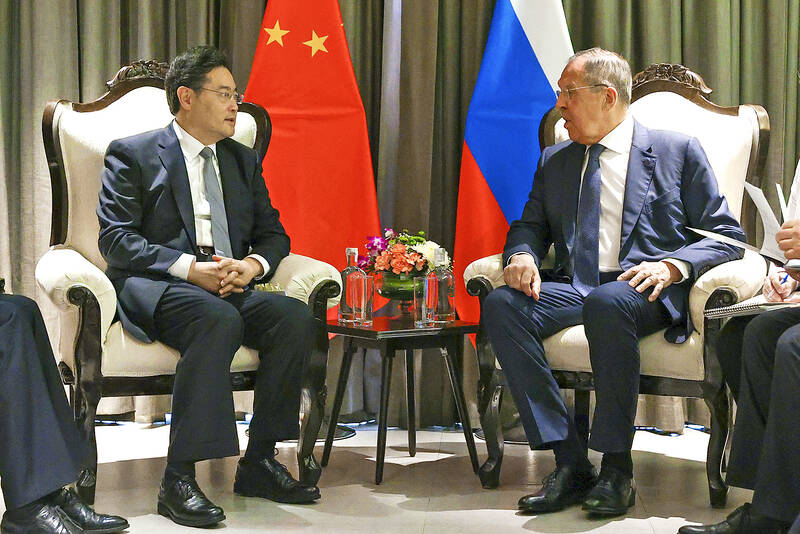
Photo: AP
“With more than 40 percent of the world’s population within the SCO, our collective decisions will surely have a global impact,” he said.
Russia and China founded the SCO in 2001 as a counterweight to US alliances across East Asia to the Indian Ocean. The group includes four Central Asian nations — Kazakhstan, Kyrgyzstan, Tajikistan and Uzbekistan, which Russia considers its backyard. In 2017, India and Pakistan became members, and Iran and Belarus are set to join later this year.
Russia and China have sought to reduce the dominance of what they see as US and Western-led global institutions and alliances, and China accuses Washington of attempting to contain its economic and military rise.
Chinese Minister of Foreign Affairs Qin Gang (秦剛) told his counterparts that “the world is faced with multiple crises and challenges featuring a resurgence of the Cold War mentality, headwinds of unilateral protectionism, as well as rising hegemonism and power politics,” Xinhua news agency reported.
“SCO members should support each other in safeguarding sovereignty, security and development interests, and oppose external forces interfering in regional issues,” he said.
At a briefing after the meeting, Jaishankar dismissed questions about whether the SCO is anti-Western, saying: “How people perceive it is something I cannot answer for.”
Instead, he stressed India’s “multidirectional foreign policy” and said that “it’s not always possible that all our partners get along with other partners.”
India enjoys strong ties with Cold War ally Russia, while its relations with the US have warmed in the past few years and its ties with China have cooled over a border dispute.
It is increasingly seen by the West as a counterweight to China’s growing global ambitions.
Jaishankar did not mention Russia’s invasion of Ukraine, and analysts said Moscow was unlikely to face a backlash over its aggression from the SCO and would instead use the meeting to flex its influence in the region.
For Russia, the SCO remains one of the few international groups in which it can still comfortably engage with members and further ties.
The visit by Pakistani Minister of Foreign Affairs Bilawal Bhutto Zardari to archrival India to attend the meeting was the first by a senior official from the country in nearly a decade.
Jaishankar in his remarks stressed the need to stop cross-border terrorism, a dig at Pakistan, which India accuses of arming and training rebels fighting for the independence of Indian-controlled Kashmir or its integration into Pakistan, a charge Islamabad denies.
“Let’s not get caught up in weaponizing terrorism for diplomatic point scoring,” Zardari said in his opening remarks.
India and Pakistan did not hold bilateral talks on the sidelines of the meeting.
“Victims of terrorism do not sit together with perpetrators of terrorism to discuss terrorism,” Jaishankar told the briefing.
Jaishankar held separate talks with his Chinese and Russian counterparts on Thursday.
The meeting with Qin came amid continued tensions along the countries’ disputed border, where a three-year standoff involves thousands of soldiers stationed in the eastern Ladakh region.
Qin earlier said the border situation was “stable overall” and that both sides should abide by existing agreements to “promote the further cooling and easing of the border situation and maintain sustainable peace and tranquility in the border area,” the Chinese Ministry of Foreign Affairs said.
India did not release a statement after the meeting, but Jaishankar said relations between the two countries were not normal and “cannot be if peace and tranquility in border areas is disturbed.”
Qin also met with Russian Minister of Foreign Affairs Sergey Lavrov on Thursday.
China has blamed the US and NATO for provoking Russia, although it has refrained from issuing a full-throated endorsement of the invasion and is not known to have provided arms or other resources to the Russian military effort.

When a hiker fell from a 55m waterfall in wild New Zealand bush, rescuers were forced to evacuate the badly hurt woman without her dog, which could not be found. After strangers raised thousands of dollars for a search, border collie Molly was flown to safety by a helicopter pilot who was determined to reunite the pet and the owner. A week earlier, an emergency rescue helicopter found the woman with bruises and lacerations after a fall at a rocky spot at the waterfall on the South Island’s West Coast. She was airlifted on March 24, but they were forced to
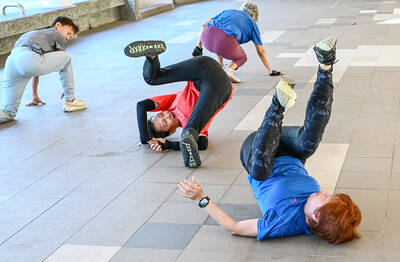
CONFIDENCE BOOSTER: ’After parkour ... you dare to do a lot of things that you think only young people can do,’ a 67-year-old parkour enthusiast said In a corner of suburban Singapore, Betty Boon vaults a guardrail, crawls underneath a slide, executes forward shoulder rolls and scales a steep slope, finishing the course to applause. “Good job,” the 69-year-old’s coach cheers. This is “geriatric parkour,” where about 20 retirees learned to tackle a series of relatively demanding exercises, building their agility and enjoying a sense of camaraderie. Boon, an upbeat grandmother, said learning parkour has aided her confidence and independence as she ages. “When you’re weak, you will be dependent on someone,” she said after sweating it out with her parkour classmates in suburban Toa Payoh,
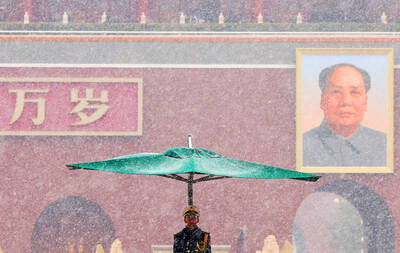
Chinese dissident artist Gao Zhen (高兟), famous for making provocative satirical sculptures of former Chinese leader Mao Zedong (毛澤東), was tried on Monday over accusations of “defaming national heroes and martyrs,” his wife and a rights group said. Gao, 69, who was detained in 2024 during a visit from the US, faces a maximum three-year prison sentence, said his wife, Zhao Yaliang (趙雅良), and Shane Yi, a researcher at the Chinese Human Rights Defenders group which operates outside the nation. The closed-door, one-day trial took place at Sanhe City People’s Court in Hebei Province neighboring the capital, Beijing, and ended without a
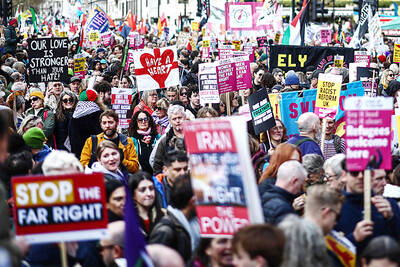
‘TOXIC CLIMATE’: ‘I don’t really recognize Labour anymore... The idea that you can implement far-right ideas in order to stop the far right is nonsense,’ a protester said Tens of thousands of people on Saturday marched through central London to protest against the far right, weeks ahead of local elections and six months after Britain saw one of its largest far-right demonstrations. Organized by hundreds of civic groups, including trade unions, anti-racism campaigners and Muslim representative bodies, Saturday’s Together Alliance event was billed as the biggest in UK history to counter right-wing extremism. A separate pro-Palestinian march had also converged with the main rally. While organizers claimed 500,000 had turned out in total, the police gave a figure of about 50,000. Protesters carrying placards with slogans such as


 RSS
RSS