


Indigenous leaders from a string of former British colonies yesterday urged King Charles to apologize for “centuries of racism” and the “legacy of genocide” perpetrated by the British crown.
In a staunchly worded letter that could sour the buildup to tomorrow’s coronation, indigenous representatives from 12 Commonwealth nations called for financial reparations and the return of stolen cultural treasures.
The letter was signed by leaders from Australia — where indigenous people were massacred by British colonizers and forced off their lands — as well as several Caribbean nations once plundered for slaves.
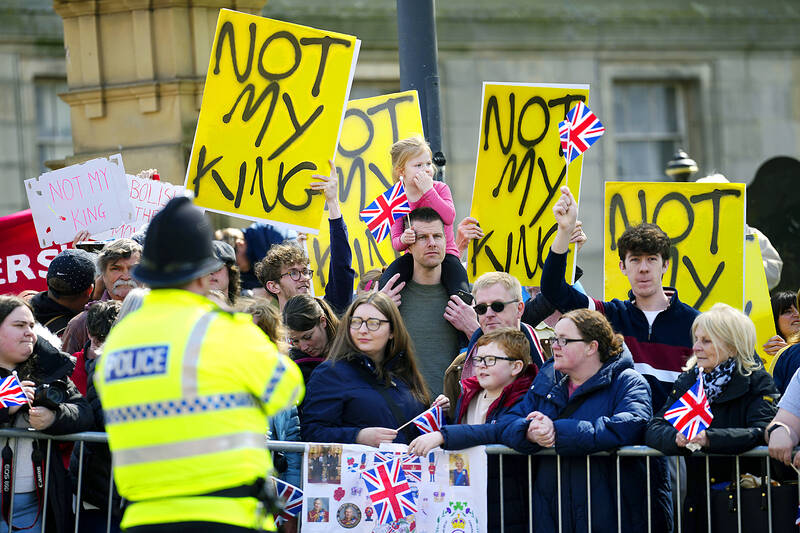
Photo: AP
The group said they had banded together to help their people “recover from centuries of racism, oppression, colonialism and slavery.”
Charles has in recent years stepped up efforts to engage with indigenous leaders, as the monarchy faces a reckoning over its links to the slave trade and the British Empire’s legacy of violence.
Although he has conceded that the crown must “acknowledge the wrongs which have shaped our past,” the letter implores him to go further by offering a formal, royal apology.
Former Olympian Nova Peris, the first indigenous woman elected to Australia’s federal parliament, was one of the leaders to sign the letter.
A staunch critic of Australia’s ties to the royal family, Peris said it was time to “acknowledge the horrific and enduring impacts” of colonization and the “legacy of genocide” felt by many indigenous populations.
“It’s vital for us to discuss and educate people on the truth behind colonization, during the week of the coronation,” she said. “Conversations start with listening.”
The king should start discussions about compensating indigenous people, who watched as British colonizers pilfered their treasures and trashed their cultures, the letter said.
Human rights expert Hannah McGlade, an indigenous woman from Western Australia, said reparations remained a key sticking point for many.
“We are increasingly seeing indigenous people call for reparations from the royal family,” she said.
BOYCOTT
A Maori artist has designed a way for the public to tune out of royal coverage, with a Web browser plugin that replaces all monarchy and coronation stories with indigenous news.
Despite a distance of more than 18,000km from the UK, New Zealand news headlines have featured a steady flow of royal family gossip: the latest potential snubbing, deep-dive analysis of the king’s conduct, invitation list scandals and features on the coronation quiche.
For some, the fanfare and compulsive coverage has been grating.
“People are sick of it — they don’t care about how much a diamond costs and who’s wearing what dress,” said Hmiora Bailey, a Maori artist who created the plugin. “Across the globe, indigenous folk are tired of [this] rhetoric around frivolity and class.”
The service, called Pikari Mai, is a free plugin to download, and promises users an opportunity to “switch off the toff.”
Made with agency Colenso BBDO, it uses data scraping to scan Web pages for words and images related to the royals, then replaces those with articles linked to indigenous news produced by indigenous Maori outlets.
Although King Charles III is New Zealand’s ceremonial head of state, Maori never ceded sovereignty to the crown.
New Zealand continues to reckon with a violent colonial legacy — for which the crown has made a number of formal apologies — including land confiscation, atrocities, aggressive warfare and unlawful arrests.
Although the app’s creator held that in mind, Bailey said he hoped to offer a playful vision — one of “independence, where we can talk about our own people, and if we want to we can switch off and we don’t have to rationalize and we don’t have to contextualize ourselves as victim or respondent.”
Maori authors made up about 1.8 percent of authors at news outlets, he said, adding that swapping monarchy news for their writing is an opportunity to raise the profile of their work, and of indigenous stories more broadly.
“I want to give my koroua, my grandparents or my elders, and indigenous nationhood as big of a platform as the crown gets,” Bailey said. “And why not?”


Through the noise of rushing papers and whirring belts at a print factory in Kyoto, two creators watch their photo essay come to life in broadsheet form — part of an effort to win new audiences in the age of artificial intelligence (AI). Despite the decline of the publishing industry, self-publication and handmade “zine” magazines are growing in popularity in Japan, reflecting the nation’s enduring love of paper in the digital era. While speaking to Agence France-Presse at the plant, his hands black with ink, one of the creators, Kazuma Obara, said: “I think [paper] is a medium that engages all five
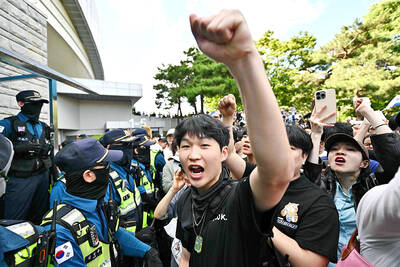
‘ABSURD MISTAKE’: The election commission said that there had been a failure to anticipate turnout after 14 polling stations ran short of ballot papers South Korean riot police yesterday cleared protesters from a Seoul polling station after a 35-hour blockade sparked by a shortage of ballot papers during local elections earlier this week. Wednesday’s election was the first nationwide vote since South Korean President Lee Jae-myung took office following the ouster of Yoon Suk-yeol over his short-lived martial law declaration. Lee’s ruling Democratic Party swept most races, but failed to flip the crucial Seoul mayoral seat. The South Korean National Election Commission apologized, blaming a failure to anticipate turnout after 14 polling stations in Seoul ran short of ballot papers. Some polling stations stayed open until 10pm to

France experienced its hottest spring on record, the French weather service said on Tuesday, after an exceptional early heat wave that also broke highs for the season in England and Wales. Meteo-France said the average nationwide temperature over March to May was 13.8°C — about 1.7°C above the norm, and surpassing records set in 2011 and 2020. “The warmest spring since records began in 1900,” it said in a bulletin. All three months were warmer than average, but the onset of an “unprecedented heatwave” late last month pushed the mercury to highs typically seen at the height of the summer. “Our country had never

A Sherpa guide was found crawling to base camp on Mount Everest a week after he went missing and was reunited with his family, who had given up hope he would return. Dawa Sherpa was last seen on Friday last week descending the mountain, but he did not reach base camp even though his client did. The pair were among the last climbers on the mountain as the climbing season came to an end and the route was dismantled. Dawa was located by a cleaning crew on Thursday morning as he was crawling down the snowy slopes around the Khumbu Icefall, just above


 RSS
RSS