


A Swedish legal expert investigating the country’s international adoption practices yesterday said that she is trying to determine whether Swedish authorities were aware of falsified child origins when they approved the adoptions of thousands of South Korean children.
Uppsala University law professor Anna Singer spoke to The Associated Press during a week-long trip to South Korea, where she plans to meet with officials from the government and a Seoul-based agency that handled adoptions to Sweden to gather details on how South Korea procured and documented children for foreign adoptions.
Many South Korean adoptees accuse their agencies of fabricating documents to expedite adoptions by foreigners, such as falsely registering them as abandoned orphans when they had relatives who could be easily identified, making their origins difficult to trace.
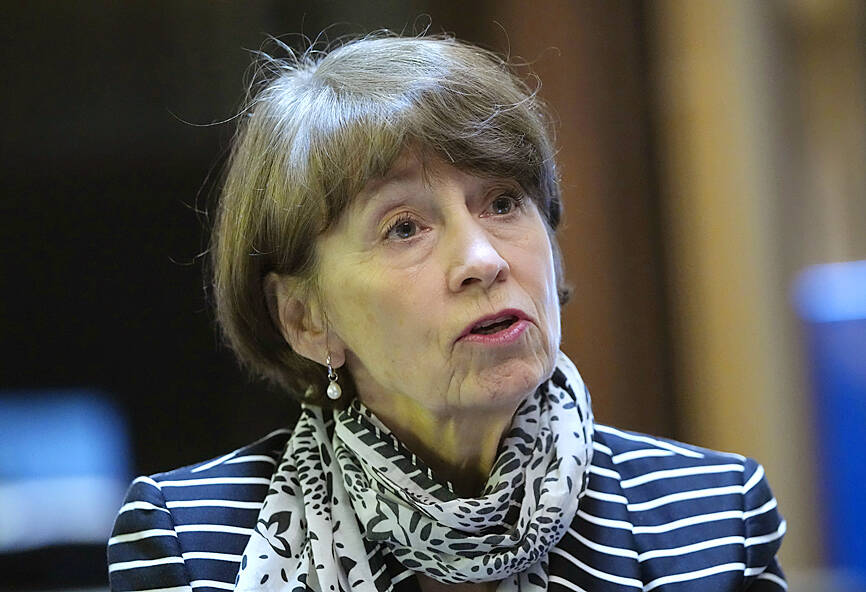
Photo: AP
Most South Korean adoptees were sent overseas during the 1970s and 1980s, when Seoul was ruled by a succession of military governments that saw adoptions as a way to deepen ties with the democratic West while reducing the number of mouths to feed.
“Our primary focus is the Swedish organizations and the Swedish actors — what did they do and what did they know? But in order to get a full understanding, we also need to know how [adoptions were] organized in the countries of origin,” said Singer, who the Swedish government in 2021 appointed to lead the investigation.
She said such findings would be key to determining whether Sweden had effective safeguards or monitoring measures to ensure South Korean adoptees were not wrongfully displaced from their biological parents.
Singer’s investigation is aimed at identifying irregularities in the way Swedish government agencies, municipalities and adoption organizations handled international adoptions, which came from about 80 countries, including whether they were aware that child origins were being fabricated in the nations sending the children.
A number of European countries have begun investigating how they have conducted international adoptions, in the face of growing concerns that children were being wrongfully removed from their biological families.
While the investigations have been triggered by more recent adoptions from South America and other parts of Asia, another focus has been the thousands of children adopted from South Korea during the country’s 1970s to 1980s adoption boom, which created the world’s largest diaspora of adoptees.
Hundreds of South Korean adoptees from Europe, the US and Australia are demanding that the South Korean Truth and Reconciliation Commission investigate the circumstances surrounding their adoptions, which they say were based on documents that falsified or obscured their origins.
The commission has accepted dozens of the nearly 400 applications filed last year, and is expected to take more cases in the following months, opening what is likely to be most meaningful inquiry into South Korea’s foreign adoptions yet.
South Korea sent about 200,000 children to the West for adoptions in the past six decades, with more than half of them placed in the US. Along with France and Denmark, Sweden was a major European destination of South Korean children, adopting nearly 10,000 of them since the 1960s.
Singer said that she has no immediate plans to investigate the cases of the 21 Swedish adoptees who submitted applications to the South Korean truth commission, but was communicating with South Korean adoptee groups in Sweden while trying to establish details about systemic problems surrounding the South’s adoptions.

When a hiker fell from a 55m waterfall in wild New Zealand bush, rescuers were forced to evacuate the badly hurt woman without her dog, which could not be found. After strangers raised thousands of dollars for a search, border collie Molly was flown to safety by a helicopter pilot who was determined to reunite the pet and the owner. A week earlier, an emergency rescue helicopter found the woman with bruises and lacerations after a fall at a rocky spot at the waterfall on the South Island’s West Coast. She was airlifted on March 24, but they were forced to

CONFIDENCE BOOSTER: ’After parkour ... you dare to do a lot of things that you think only young people can do,’ a 67-year-old parkour enthusiast said In a corner of suburban Singapore, Betty Boon vaults a guardrail, crawls underneath a slide, executes forward shoulder rolls and scales a steep slope, finishing the course to applause. “Good job,” the 69-year-old’s coach cheers. This is “geriatric parkour,” where about 20 retirees learned to tackle a series of relatively demanding exercises, building their agility and enjoying a sense of camaraderie. Boon, an upbeat grandmother, said learning parkour has aided her confidence and independence as she ages. “When you’re weak, you will be dependent on someone,” she said after sweating it out with her parkour classmates in suburban Toa Payoh,

HIGH HOPES: The power source is expected to have a future, as it is not dependent on the weather or light, and could be useful for places with large desalination facilities A Japanese water plant is harnessing the natural process of osmosis to generate renewable energy that could one day become a common power source. The possibility of generating power from osmosis — when water molecules pass from a less salty solution to a more salty one — has long been known. However, actually generating energy from that has proved more complicated, in part due the difficulty of designing the membrane through which the molecules pass. Engineers in Fukuoka, Japan, and their private partners think they might have cracked it, and have opened what is only the world’s second osmotic power plant. It generates

Chinese dissident artist Gao Zhen (高兟), famous for making provocative satirical sculptures of former Chinese leader Mao Zedong (毛澤東), was tried on Monday over accusations of “defaming national heroes and martyrs,” his wife and a rights group said. Gao, 69, who was detained in 2024 during a visit from the US, faces a maximum three-year prison sentence, said his wife, Zhao Yaliang (趙雅良), and Shane Yi, a researcher at the Chinese Human Rights Defenders group which operates outside the nation. The closed-door, one-day trial took place at Sanhe City People’s Court in Hebei Province neighboring the capital, Beijing, and ended without a


 RSS
RSS