


North Korean leader Kim Jong-un oversaw a nuclear counterstrike drill involving a missile with a mock atomic warhead capable of reaching Japan’s west coast, state media reported yesterday.
Kim took his daughter to exercises over the weekend, where he issued a threat to the US over joint Freedom Shield military drills it is conducting with South Korea, saying that his country is preparing to make “an immediate and overwhelming nuclear counterattack anytime,” the Korean Central News Agency (KCNA) reported.
Sunday’s launch of the solid-fueled KN-23, a short-range ballistic missile, was an element of drills simulating a nuclear counterattack against the US and South Korea, the KCNA said.
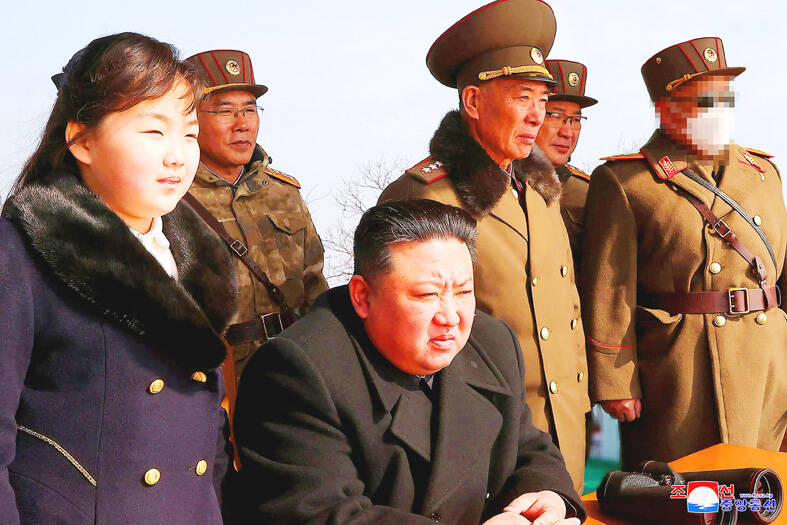
Photo: AFP / KCNA via KNS
The missile, fitted with detonators and devices to simulate a nuclear attack, exploded at a height of about 800m above its target, it said
The test seems to be the first of its type to be mentioned in state media.
State media photographs showed that the missile soared from what appeared to be a buried silo, which analysts said would help fire missiles with little warning while evading outside monitoring, as Pyongyang races to perfect ICBMs capable of striking anywhere in the US.
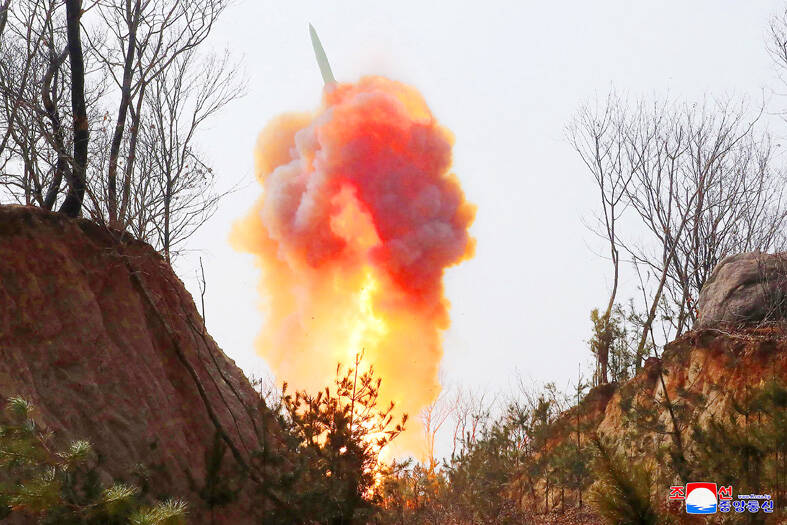
Photo: AFP / KCNA via KNS
“With a silo, you can quickly fire a missile, almost immediately, and without launch preparations being detected in advance, you can just press a button,” said Yang Uk, a fellow at the Asan Institute for Policy Studies in Seoul.
Unlike the KN-23, liquid-fueled missiles such as North Korea’s Hwasong-17 ICBM require time for fueling. With a silo that can take place underground, out of sight.
North Korea typically relies on mobile launchers, but its lack of infrastructure could make launches from such trucks challenging, Yang said.
“But the downside is that silos can be detected with satellite imagery, so someone would always keep an eye on them, and they might just be incapacitated in a pre-emptive strike,” he said.
North Korea started breaking ground on the silo in late January, which means the deployment time for a missile based in such a structure could be less than 60 days, said Decker Eveleth at the James Martin Center for Nonproliferation Studies in California.
Satellite imagery on Feb. 13 and March 18 indicated recent excavation and construction of possible fixed launch sites at the North’s Sohae missile launching station, said Joseph Dempsey, a defense researcher at the International Institute for Strategic Studies.
ROCKY RELATIONS: The figures on residents come as Chinese tourist numbers drop following Beijing’s warnings to avoid traveling to Japan The number of Chinese residents in Japan has continued to rise, even as ties between the two countries have become increasingly fractious, data released on Friday showed. As of the end of December last year, the number of Chinese residents had increased by 6.5 percent from the previous year to 930,428. Chinese people accounted for 22.6 percent of all foreign residents in Japan, making them by far the largest group, Japanese Ministry of Justice data showed. Beijing has criticized Tokyo in increasingly strident terms since Japanese Prime Minister Sanae Takaichi last year suggested that a military conflict around Taiwan could
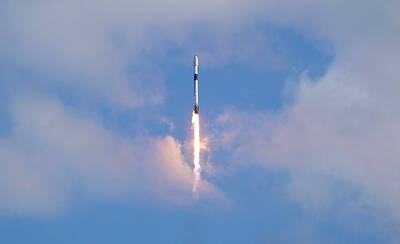
A retired US colonel behind a privately financed rocket launch site in the Dominican Republic sees the project as a response to China’s dominance of the space race in Latin America. Florida-based Launch on Demand is slated to begin building a US$600 million facility in a remote region near the border with Haiti late this year. The project is designed to meet surging demand for the heavy-lift rockets needed to put clusters of satellites into orbit. It is also an answer to China’s growing presence in the region, said CEO Burton Catledge, a former commander of the US Air Force’s 45th Operations
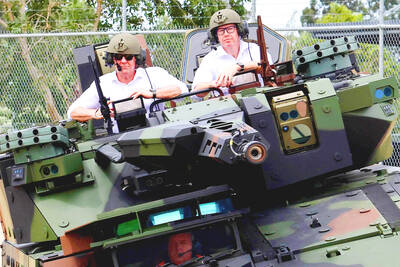
Germany is considering Australia’s Ghost Bat robot fighter as it looks to select a combat drone to modernize its air force, German Minister of Defense Boris Pistorius said yesterday. Germany has said it wants to field hundreds of uncrewed fighter jets by 2029, and would make a decision soon as it considers a range of German, European and US projects developing so-called “collaborative combat aircraft.” Australia has said it will integrate the Ghost Bat, jointly developed by Boeing Australia and the Royal Australian Air Force, into its military after a successful weapons test last year. After inspecting the Ghost Bat in Queensland yesterday,

A pro-Iran hacking group claimed to breach FBI Director Kash Patel’s personal e-mail inbox and posted some of the contents online. The e-mails provided by the hacking group include travel details, correspondence with leasing agents in Washington and global entry, and loyalty account numbers. The e-mail address the hackers claim to have compromised has been previously tied to Patel’s personal details, and the leaked e-mails contain photos of Patel and others, in addition to correspondence with family members and colleagues. “The FBI is aware of malicious actors targeting Director Patel’s personal email information,” the agency said in a statement on


 RSS
RSS