


A Czech company producing inflatable weapon decoys, including HIMARS rocket launchers and Abrams tanks, on Monday said that it had seen a spike in demand since the Russian invasion of Ukraine started last year.
The synthetic silk decoys inflated with an electric or gasoline blower are used to fool the enemy in the battlefield, making them target the air-filled decoys instead of real weaponry.
Inflatech Co’s managers have refused to confirm selling their products to Ukraine, citing military secrecy, but they said that output had jumped by 100 percent over the past 12 months.
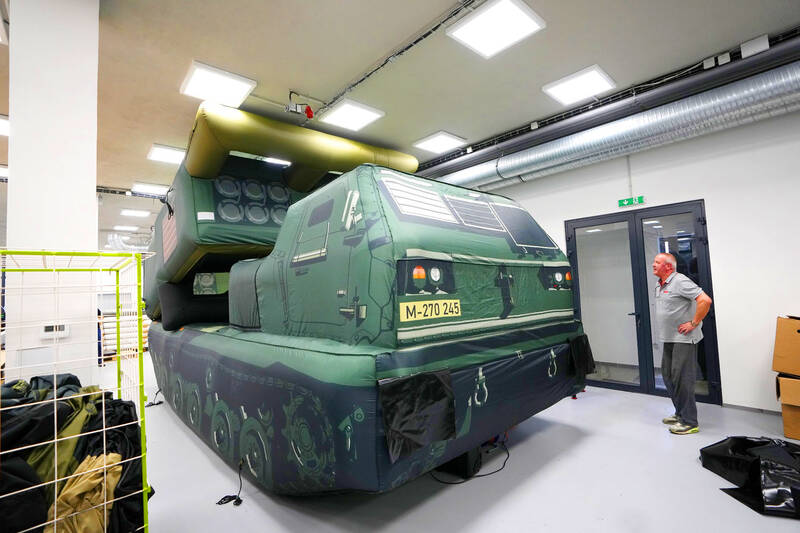
Photo: AP
“Definitely we’re selling to a lot of governments around the world, not only in Europe,” Inflatech sales and marketing director Poven Kumaresan told reporters.
The company’s three dozen employees produce 30 to 40 decoys a month, Kumaresan said.
The decoys including tanks, armored vehicles and even jet fighters weigh between 25kg and 90kg, and take two to four people to handle in the battlefield.
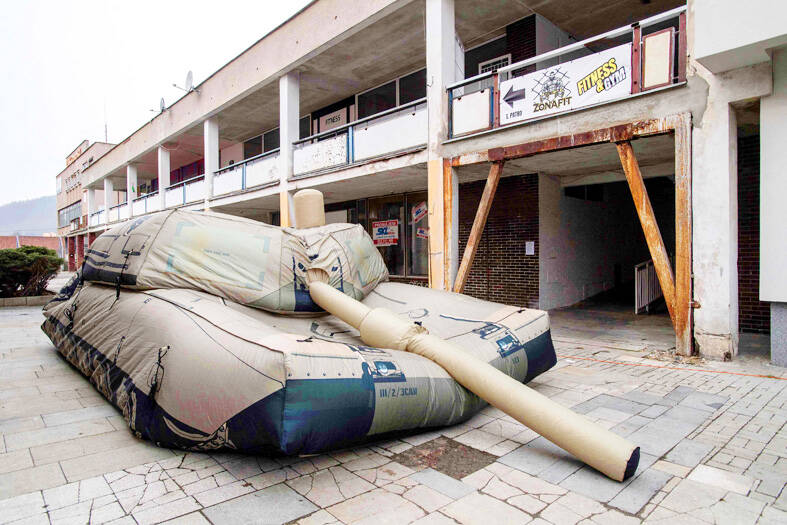
Photo: AFP
The company can come up with a new design within 72 hours if it has the exact plans of the original piece of military hardware, while it takes up to two weeks if working “from scratch,” Kumaresan said.
It had taken 60 days to ship a replica HIMARS rocket launcher after the order was placed, he said.
Inflatech has so far rolled out “dozens” of fake HIMARS while the real weapon is wreaking havoc on Russian invaders in Ukraine.
Inflatech’s products are classified as military materiel and must be approved by government authorities.
The Czech government last month said that it had provided Ukraine with military aid worth about US$500 million since the invasion started on Feb. 24 last year.
Inflatech chief executive officer Vojtech Fresser said that key qualities of the firm’s products included a look true to the original.
“If I don’t have binoculars, looking from a distance of 150-200 metres, I won’t be able to tell whether it is a real weapon or a decoy,” Fresser said.
The engine used to inflate the weapons also emanates heat that fools infrared sensors.
The inflatable decoys cost US$10,000 to US$100,000, much less than the rockets used to destroy them, Fresser said.
“If I force the enemy to destroy my product with something that is at least four times as expensive, but in practice it is even 20 times, then I win economically,” he said.
Kumaresan said that the company keeps upgrading its products, looking to make the decoys mobile in the future.
Inflatech, which originally made the decoys for training purposes, used to produce toys or tailor-made models according to customers’ wishes.
“We produce according to the customer’s specific needs. We’re not an e-shop where you could choose,” Fresser said.
There is “no limit” on output or product range and the company expects rapid growth over the next three years, he said.
“Of course I would prefer to produce toys for children, but first of all we must ensure a safe world for them,” Fresser said.
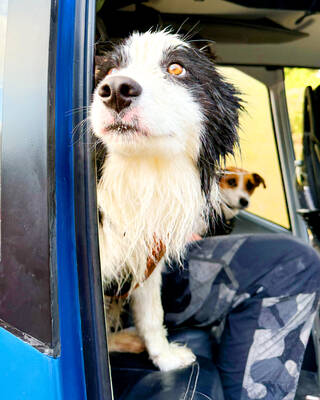
When a hiker fell from a 55m waterfall in wild New Zealand bush, rescuers were forced to evacuate the badly hurt woman without her dog, which could not be found. After strangers raised thousands of dollars for a search, border collie Molly was flown to safety by a helicopter pilot who was determined to reunite the pet and the owner. A week earlier, an emergency rescue helicopter found the woman with bruises and lacerations after a fall at a rocky spot at the waterfall on the South Island’s West Coast. She was airlifted on March 24, but they were forced to
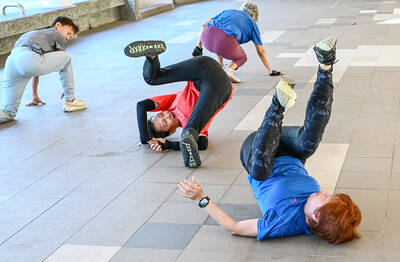
CONFIDENCE BOOSTER: ’After parkour ... you dare to do a lot of things that you think only young people can do,’ a 67-year-old parkour enthusiast said In a corner of suburban Singapore, Betty Boon vaults a guardrail, crawls underneath a slide, executes forward shoulder rolls and scales a steep slope, finishing the course to applause. “Good job,” the 69-year-old’s coach cheers. This is “geriatric parkour,” where about 20 retirees learned to tackle a series of relatively demanding exercises, building their agility and enjoying a sense of camaraderie. Boon, an upbeat grandmother, said learning parkour has aided her confidence and independence as she ages. “When you’re weak, you will be dependent on someone,” she said after sweating it out with her parkour classmates in suburban Toa Payoh,

Chinese dissident artist Gao Zhen (高兟), famous for making provocative satirical sculptures of former Chinese leader Mao Zedong (毛澤東), was tried on Monday over accusations of “defaming national heroes and martyrs,” his wife and a rights group said. Gao, 69, who was detained in 2024 during a visit from the US, faces a maximum three-year prison sentence, said his wife, Zhao Yaliang (趙雅良), and Shane Yi, a researcher at the Chinese Human Rights Defenders group which operates outside the nation. The closed-door, one-day trial took place at Sanhe City People’s Court in Hebei Province neighboring the capital, Beijing, and ended without a

‘TOXIC CLIMATE’: ‘I don’t really recognize Labour anymore... The idea that you can implement far-right ideas in order to stop the far right is nonsense,’ a protester said Tens of thousands of people on Saturday marched through central London to protest against the far right, weeks ahead of local elections and six months after Britain saw one of its largest far-right demonstrations. Organized by hundreds of civic groups, including trade unions, anti-racism campaigners and Muslim representative bodies, Saturday’s Together Alliance event was billed as the biggest in UK history to counter right-wing extremism. A separate pro-Palestinian march had also converged with the main rally. While organizers claimed 500,000 had turned out in total, the police gave a figure of about 50,000. Protesters carrying placards with slogans such as


 RSS
RSS