


A military helicopter flies over verdant mountains in southern Mexico, the scene of unusual coca crop discoveries that suggest drug cartels are adapting to shifts in the multimillion-dollar narcotics trade.
For years, poppies — the raw material for heroin — and marijuana have provided a livelihood for thousands of small farmers in the impoverished state of Guerrero, but in recent years, the growing US addiction crisis surrounding the potent synthetic drug fentanyl has caused opium demand and prices to fall.
The result is that Mexican traffickers are experimenting with growing coca leaves, whose production has historically been dominated by Bolivia, Peru and Colombia.
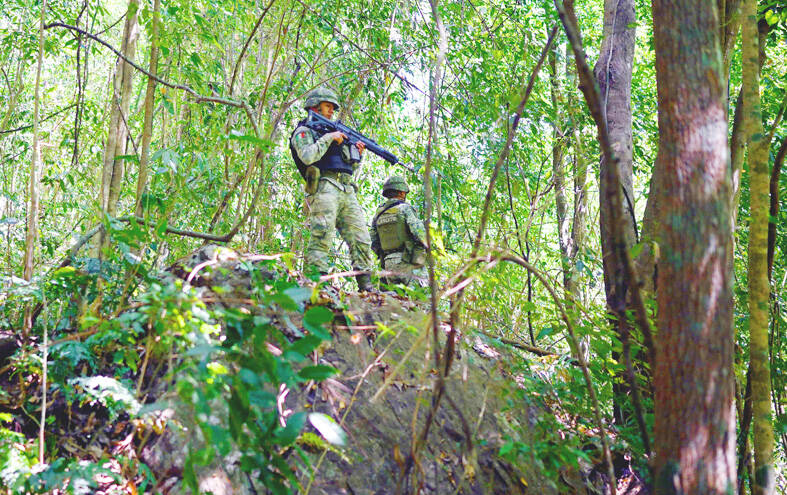
Photo: AFP
“It’s an activity that hadn’t been detected here before,” said Colonel Carlos Javier Perez, who heads the unit in charge of destroying coca in Guerrero. “In a month and a half, we’ve found 27 plantations.”
Mexico’s coca fields are in their infancy, with a surface area of about 36 hectares eradicated in the past four years — a drop in the ocean compared with Colombia.
“Organized crime groups are trying to diversify their activities and experiment with coca planting,” Perez said, as soldiers uprooted the bushes by hand and burned them in the town of Atoyac de Alvarez.
Cocaine is hugely profitable. In Europe, 1kg can sell for about US$40,000.
It is a sum most farmers could only dream of in Guerrero, one of Mexico’s poorest states, which has endured years of violence linked to turf wars between drug cartels.
Mexican cartels have come to control almost the entire cocaine trafficking chain in Colombia.
Now coca crops are also flourishing in Honduras and Guatemala, once just transit points for the drug from South America.
In the Mexican case, “it is linked to the production of fentanyl,” said Libertad Arguello, an expert at the Colegio de Mexico institute of higher education. “It’s no coincidence that coca leaves began to be cultivated.”
The Mexican government reported the first coca plantation discoveries in February 2021.
Mexican President Andres Manuel Lopez Obrador said that criminal groups were experimenting with the crop.
The 1 hectare field found in Guerrero had a small irrigation system.
A few meters away, the soldiers also found an improvised laboratory, tools, chemicals, gasoline and clothing left behind by those in charge.
To reach the crops, the military traveled nearly an hour in off-road vehicles and on foot through dense vegetation.
The soldiers must explore the area on foot because it is almost impossible to spot the coca plants from the air, Perez said.
In the laboratory where the coca paste was produced, a sleeping bag, blankets and a cap had been abandoned by workers, who the military said fled when they saw the troops.
The paste, obtained by mixing chopped leaves with lime, cement, gasoline and ammonium sulfate, is usually taken elsewhere to be turned into cocaine, Perez said.

A US YouTuber who caused outrage for filming himself kissing a statue commemorating Korean wartime sex slaves has been sentenced to six months in prison, a court in Seoul said yesterday. Johnny Somali, 25, gained notoriety several years ago for recording himself doing a series of provocative stunts in South Korea and Japan, and streaming them on platforms such as YouTube and Twitch. South Korean authorities indicted Somali — whose real name is Ramsey Khalid Ismael — in 2024 on public order violations and obstruction of business, and banned him from leaving the country. “The court has sentenced him to six months in

Former Lima mayor Rafael Lopez Aliaga, a Peruvian presidential hopeful, gathered hundreds of supporters in Lima on Tuesday and gave authorities 24 hours to annul the first round of the country’s election over allegations of fraud. Lopez Aliaga is locked in a tight three-way race with two other candidates for second place in Sunday’s vote. The election runner-up wins a ticket to June’s presidential run-off against front-runner Keiko Fujimori. “I am giving them 24 hours to declare this electoral fraud null and void,” said Lopez Aliaga, surrounded by a crowd of several hundred supporters. “If it is not declared null and void tomorrow,
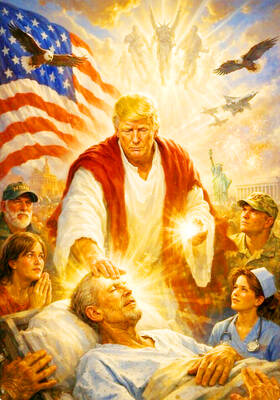
PAPAL RETORT: Pope Leo told reporters that he has ‘no fear, neither of the Trump administration nor speaking out loudly about the message of the Gospel’ US President Donald Trump has feuded with Pope Leo XIV over the Iran conflict — setting off an unholy row that could have serious political implications for the Republican leader back in the US. Trump has drawn barbs even from some allies over the attacks on the US-born pontiff, who has criticized the Trump administration over its immigration crackdown, the intervention in Venezuela and the Iran war. The president risks alienating the religious right in November’s crucial US midterm elections. So far the unprecedented clash between the leader of the most powerful military on Earth and the head of the world’s 1.4 billion

A 16-year-old boy has been charged with murder and aggravated sexual abuse in Florida in the death of his 18-year-old stepsister on a Carnival Cruise ship, the US Department of Justice said on Monday. Timothy Hudson was initially charged in February and subsequently indicted on March 10, but the breadth of the case was not known until a seal was lifted on Friday last week, weeks after US District Judge Beth Bloom in Miami said that he would be prosecuted as an adult at the request of the government. Anna Kepner had been traveling on the Carnival Horizon ship in November last


 RSS
RSS