


Rome is famous the world over as the final resting place of emperors, popes, martyrs and kings from Augustus to Saint Peter, but few know about former Italian prime minister Benito Mussolini’s pet chicken.
The hen is buried in Italy’s oldest pet cemetery, which this year marks 100 years of laying to rest much-missed cats, dogs and other four-legged companions in an atypical graveyard in the southwest of the capital.
Over the decades, more than 1,000 pets have been buried in Casa Rosa, where brightly painted wooden shrines adorned with stuffed animals and figurines share the space with classic headstones under the shade of pines and palms.

Photo: AFP
Many boast pedigree owners, including La Dolce Vita director Federico Fellini, Oscar-winning actress Anna Magnani and Brigitte Bardot, whose poodle died while the French sex symbol was shooting a movie in Rome.
However, the most famous was late Mussolini.
“It all really started with the hen of Mussolini,” said Luigi Molon, the cemetery’s owner, 73. “Not having the land to bury her ... he brought her here, where Mussolini’s kids would come with flowers to remember the happy times they spent together.”
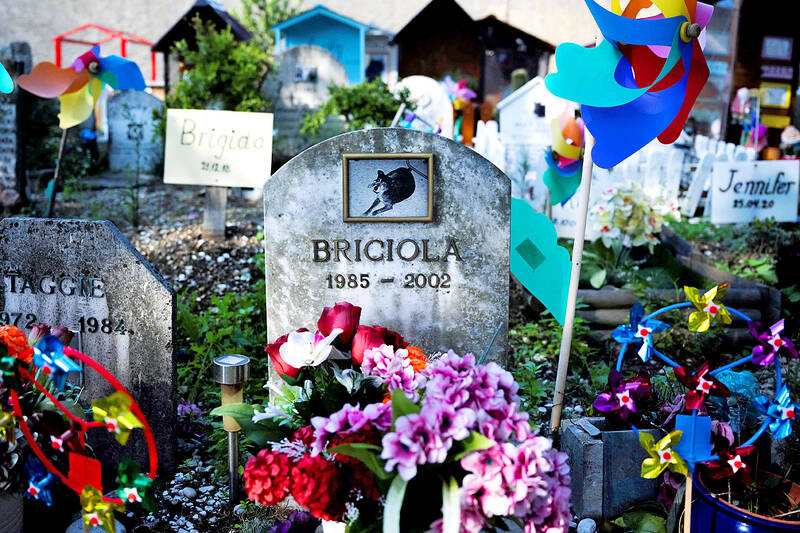
Photo: AFP
The children’s playmate came to the Mussolini family as a chick after being won at a fair and was buried in the plot of land owned by Molon’s father, the trusted veterinarian for the Great Danes of “Il Duce.”
No signs of the hen remain and Molon laughs when asked where exactly she is buried — he does not know.
However, the interment of the near-famous fowl inspired others and before long the elder Molon’s backyard became a pet cemetery, since licensed by Rome’s public authorities.
Today, the vast majority of pets at Casa Rosa have more modest lineage, from Carlitos the shih tzu to Lord Byron the Irish setter, but they are no less loved.
“The house is empty and sad without you,” reads the inscription on the granite tombstone of Ringo, a German shepherd who died in 1979.
“I love you,” reads that of Ruga the turtle, who died in 2017.
Many of the graves include photographs of the deceased: Billo the black and white spaniel is shown in the arms of his adoring family, while a puppy photo of Jack the German shepherd is placed next to one showing him as a gray-in-the-muzzle hound.
Horses, rabbits, monkeys, a hamster, turtles, ducks, pigeons, parrots, a sparrow and a lioness named Greta are also under the earth there.
Some of the bereaved visit their former companions every other day or week, Molon said.
The ritual of visiting and bringing flowers or stuffed animals “is nothing more than the continuation of brushing him or taking him for a walk,” he said, his yippy white terrier Jenny at his side.
Molon would not say how much it costs for a five-year plot, although reports suggest about 150 euros (US$146) a year. Many renew their plot, but many do not, opening the space for others to follow.
“And it’s not a bad thing, because if you don’t renew, it means the pain has passed,” Molon said.
A tail-less ginger cat — who Molon rescued, but has yet to name — snoozes on fake green grass atop an unmarked grave adorned with dog figurines.
Nearby rests Michelangelo, a yellow Labrador, Mike Tyson the Scotty and Cindy the rabbit, two stuffed bunny toys placed over her grave.
“A sweet little pest who ran everywhere, you left us too soon,” reads the inscription for Giotto the tabby, who died in 2020 at age two. “Now you can run and climb among the clouds.”

The team behind the long-awaited Vera Rubin Observatory in Chile yesterday published their first images, revealing breathtaking views of star-forming regions as well as distant galaxies. More than two decades in the making, the giant US-funded telescope sits perched at the summit of Cerro Pachon in central Chile, where dark skies and dry air provide ideal conditions for observing the cosmos. One of the debut images is a composite of 678 exposures taken over just seven hours, capturing the Trifid Nebula and the Lagoon Nebula — both several thousand light-years from Earth — glowing in vivid pinks against orange-red backdrops. The new image
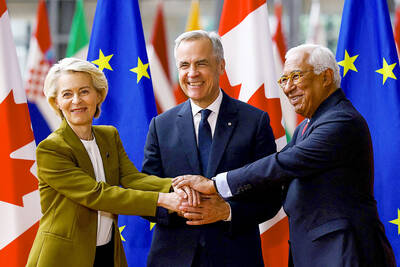
Canada and the EU on Monday signed a defense and security pact as the transatlantic partners seek to better confront Russia, with worries over Washington’s reliability under US President Donald Trump. The deal was announced after a summit in Brussels between Canadian Prime Minister Mark Carney and European Commission President Ursula von der Leyen and European Council President Antonio Costa. “While NATO remains the cornerstone of our collective defense, this partnership will allow us to strengthen our preparedness ... to invest more and to invest smarter,” Costa told a news conference. “It opens new opportunities for companies on both sides of the

ESPIONAGE: The British government’s decision on the proposed embassy hinges on the security of underground data cables, a former diplomat has said A US intervention over China’s proposed new embassy in London has thrown a potential resolution “up in the air,” campaigners have said, amid concerns over the site’s proximity to a sensitive hub of critical communication cables. The furor over a new “super-embassy” on the edge of London’s financial district was reignited last week when the White House said it was “deeply concerned” over potential Chinese access to “the sensitive communications of one of our closest allies.” The Dutch parliament has also raised concerns about Beijing’s ideal location of Royal Mint Court, on the edge of the City of London, which has so

OVERHAUL: The move would likely mark the end to Voice of America, which was founded in 1942 to counter Nazi propaganda and operated in nearly 50 languages The parent agency of Voice of America (VOA) on Friday said it had issued termination notices to more than 639 more staff, completing an 85 percent decrease in personnel since March and effectively spelling the end of a broadcasting network founded to counter Nazi propaganda. US Agency for Global Media (USAGM) senior advisor Kari Lake said the staff reduction meant 1,400 positions had been eliminated as part of US President Donald Trump’s agenda to cut staffing at the agency to a statutory minimum. “Reduction in Force Termination Notices were sent to 639 employees at USAGM and Voice of America, part of a


 RSS
RSS