


North Korea fired two ballistic missiles yesterday as it claimed its recent blitz of sanctions-busting tests were necessary countermeasures against joint military drills by the US and South Korea.
As the UN Security Council met to discuss Pyongyang’s Tuesday launch of an intermediate-range ballistic missile over Japan, North Korea blamed Washington for “escalating the military tensions” on the Korean Peninsula.
The recent launches — six in less than two weeks — were “the just counteraction measures of the Korean People’s Army on South Korea-US joint drills,” the North Korean Ministry of Foreign Affairs said in a statement yesterday.

Photo: AFP
Seoul, Tokyo and Washington have ramped up joint military drills in recent weeks, including large-scale naval maneuvers and anti-submarine exercises. The US would redeploy the nuclear-powered USS Ronald Reagan to waters east of South Korea for a second visit in less than a month, Seoul said on Wednesday.
The North Korean Ministry of Foreign Affairs said in a statement carried by North Korean Central News Agency that this posed “a serious threat to the stability of the situation on the Korean Peninsula.”
Early yesterday, South Korea’s military said it had detected two short-range ballistic missiles launched from the Samsok area in Pyongyang toward the East China Sea, also known as the Sea of Japan.
The first missile traveled 350km at a maximum altitude of about 80km, according to their analysis, with the second flying 800km at an altitude of 60km. It appears to be the first time North Korea has fired missiles from Samsok, a South Korean Joint Chiefs of Staff official told reporters, adding that they look like a “different type of short-range ballistic missiles” from previous launches.
Tokyo also confirmed the launches, with Japanese Minister of Defense Yasukazu Hamada telling reporters that it was important not to “overlook the significant improvement of [North Korea’s] missile technology.”
Pyongyang’s Tuesday firing of what officials and analysts said was a Hwasong-12 that likely traveled the longest horizontal distance of any North Korean test, prompted the US to call for the emergency Security Council meeting. At the meeting, North Korea’s longtime ally and economic benefactor Beijing also blamed Washington for provoking the spate of launches by North Korean leader Kim Jong-un’s regime.
Chinese Deputy Ambassador to the UN Geng Shuang (耿爽) said North Korea’s recent launches were “closely related” to military exercises in the region conducted by the US and its allies.
Geng accused the US of “poisoning the regional security environment.”
The spate of launches is part of a record year of weapons tests by isolated North Korea, which Kim has declared an “irreversible” nuclear power, effectively ending the possibility of denuclearization talks.
US Ambassador to the UN Linda Thomas-Greenfield called for “strengthening” existing sanctions on North Korea, something China and Russia vetoed in May.
The council has been divided on responding to Pyongyang’s nuclear ambitions for months, with Russia and China on the sympathetic side and the rest of the council pushing for punishment. Analysts say that Pyongyang has seized the opportunity of a stalemate at the UN to conduct ever more provocative weapons tests.
Officials in Seoul and Washington have been warning for months that Pyongyang would conduct another nuclear test, likely after the National Congress of the Chinese Communist Party which starts on Oct. 16.
“At this point, for Kim to turn back and halt provocations would seem counterproductive to his interests, not to mention the amount of resources squandered to conduct these weapons tests,” RAND Corp analyst Soo Kim told Agence France-Presse.
“We are indeed in a cycle of weapons provocations. What’s left, essentially, is an ICBM test and potentially the long-awaited seventh nuclear test,” Soo Kim said.
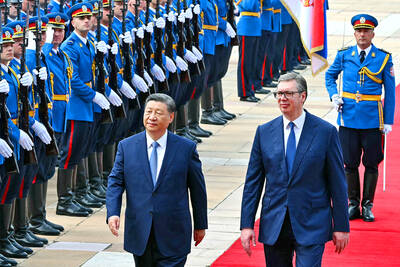
MONEY MATTERS: Xi was to highlight projects such as a new high-speed railway between Belgrade and Budapest, as Serbia is entirely open to Chinese trade and investment Serbian President Aleksandar Vucic yesterday said that “Taiwan is China” as he made a speech welcoming Chinese President Xi Jinping (習近平) to Belgrade, state broadcaster Radio Television of Serbia (RTS) said. “We have a clear and simple position regarding Chinese territorial integrity,” he told a crowd outside the government offices while Xi applauded him. “Yes, Taiwan is China.” Xi landed in Belgrade on Tuesday night on the second leg of his European tour, and was greeted by Vucic and most government ministers. Xi had just completed a two-day trip to France, where he held talks with French President Emmanuel Macron as the
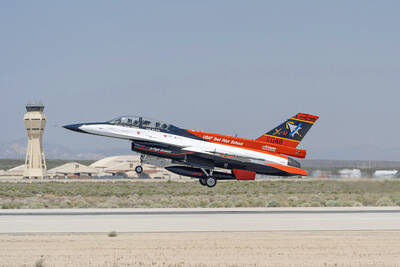
With the midday sun blazing, an experimental orange and white F-16 fighter jet launched with a familiar roar that is a hallmark of US airpower, but the aerial combat that followed was unlike any other: This F-16 was controlled by artificial intelligence (AI), not a human pilot, and riding in the front seat was US Secretary of the Air Force Frank Kendall. AI marks one of the biggest advances in military aviation since the introduction of stealth in the early 1990s, and the US Air Force has aggressively leaned in. Even though the technology is not fully developed, the service is planning
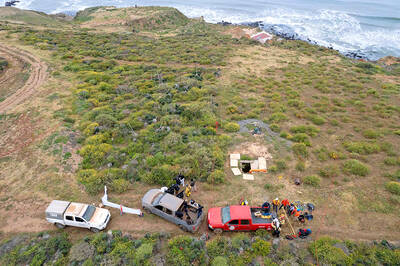
INTERNATIONAL PROBE: Australian and US authorities were helping coordinate the investigation of the case, which follows the 2015 murder of Australian surfers in Mexico Three bodies were found in Mexico’s Baja California state, the FBI said on Friday, days after two Australians and an American went missing during a surfing trip in an area hit by cartel violence. Authorities used a pulley system to hoist what appeared to be lifeless bodies covered in mud from a shaft on a cliff high above the Pacific. “We confirm there were three individuals found deceased in Santo Tomas, Baja California,” a statement from the FBI’s office in San Diego, California, said without providing the identities of the victims. Australian brothers Jake and Callum Robinson and their American friend Jack Carter
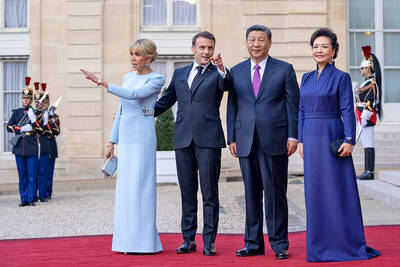
CUSTOMS DUTIES: France’s cognac industry was closely watching the talks, fearing that an anti-dumping investigation opened by China is retaliation for trade tensions French President Emmanuel Macron yesterday hosted Chinese President Xi Jinping (習近平) at one of his beloved childhood haunts in the Pyrenees, seeking to press a message to Beijing not to support Russia’s war against Ukraine and to accept fairer trade. The first day of Xi’s state visit to France, his first to Europe since 2019, saw respectful, but sometimes robust exchanges between the two men during a succession of talks on Monday. Macron, joined initially by EU Commission President Ursula von der Leyen, urged Xi not to allow the export of any technology that could be used by Russia in its invasion


 RSS
RSS