


An increase in Taiwanese boats using China-made automatic identification systems (AIS) could confuse coast guards patrolling waters off Taiwan’s southwest coast and become a loophole in the national security system, sources familiar with the matter said yesterday.
Taiwan ADIZ, a Facebook page created by enthusiasts who monitor Chinese military activities in airspace and waters off Taiwan’s southwest coast, on Saturday identified what seemed to be a Chinese cargo container ship near Penghu County.
The Coast Guard Administration went to the location after receiving the tip and found that it was a Taiwanese yacht, which had a Chinese AIS installed.
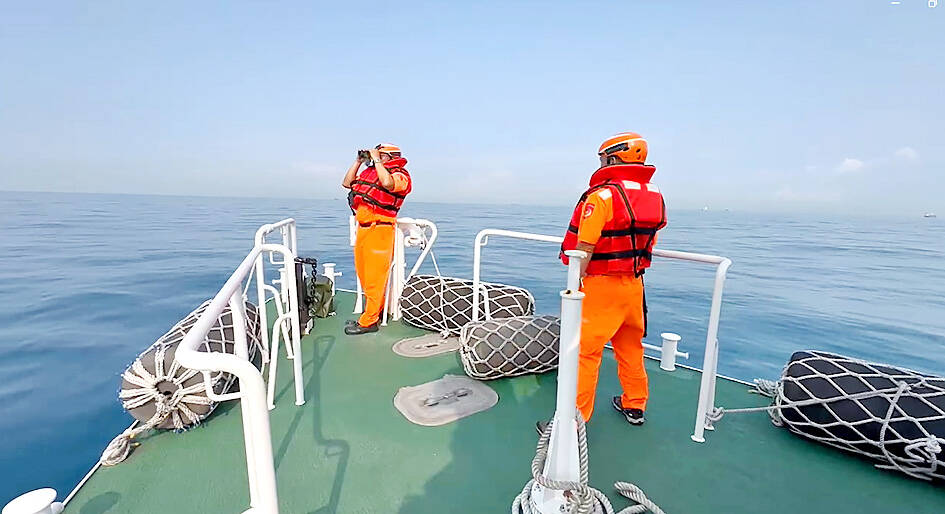
Photo courtesy of the Coast Guard Administration
Similar instances had also occurred when volunteers patrolling waters in South Penghu Marine National Park reported seeing Chinese fishing boats, only to find out later they were all Taiwanese vessels using the Chinese navigation system.
Ships with AIS can exchange electronic data with other vessels, onshore stations, satellites and other equipment using its Maritime Mobile Service Identity (MMSI). It provides identification and positioning for the ship traffic management system as well.
Though the Maritime Port Bureau and the Fisheries Agency had subsidized boat owners that purchase AIS, most of them continue to buy ones with Chinese chips, because they are relatively cheaper, sources familiar with the matter said.
As regulations do not require AIS to be installed on 12m-long or shorter boats, owners are more likely to use the same MMSI instead of applying for a new one, the sources said.
The Fisheries Agencies said it could consider banning the use of Chinese AIS on fishing boats.
Last year, the Taiwan Statebuilding Party reported that a Taiwanese fishing boat used the BeiDou Navigation Satellite System, a satellite-based radio navigation system owned and operated by the Chinese National Space Administration, for drug trafficking purposes.
The boat had used the Chinese system to evade the Taiwanese government, the National Communication Commission (NCC) said, adding that the system is regulated by the Telecommunications Management Act (電信管理法) and must be certified and approved by the NCC before it can be imported to, manufactured and sold in Taiwan.
People who sell the system without NCC’s approval would be fined NT$10,000 to NT$200,000 (US$309 to US$6,177), while those who illegally manufacture the system or import it would be fined NT$100,000 to NT$1 million and would be asked to rectify the situation within a designated period, it said.

Yangmingshan National Park authorities yesterday urged visitors to respect public spaces and obey the law after a couple was caught on a camera livestream having sex at the park’s Qingtiangang (擎天崗) earlier in the day. The Shilin Police Precinct in Taipei said it has identified a suspect and his vehicle registration number, and would summon him for questioning. The case would be handled in accordance with public indecency charges, it added. The couple entered the park at about 11pm on Thursday and began fooling around by 1am yesterday, the police said, adding that the two were unaware of the park’s all-day live

A former soldier and an active-duty army officer were yesterday indicted for allegedly selling classified military training materials to a Chinese intelligence operative for a total of NT$79,440. The Taipei District Prosecutors’ Office indicted Chen Tai-yin (陳泰尹) and Lee Chun-ta (李俊達) for contravening the National Security Act (國家安全法) and the Anti-Corruption Act (貪污治罪條例). Chen left the military in September 2013 after serving alongside then-staff sergeant Lee, now an army lieutenant, at the 21st Artillery Command of the army’s Sixth Corps from 2011 to 2013, according to the indictment. Chen met a Chinese intelligence operative identified as “Wang” (王) through a friend in November

Minister of Digital Affairs Lin Yi-ching (林宜敬) yesterday cited regulatory issues and national security concerns as an expert said that Taiwan is among the few Asian regions without Starlink. Lin made the remarks on Facebook after funP Innovation Group chief executive officer Nathan Chiu (邱繼弘) on Friday said Taiwan and four other countries in Asia — China, North Korea, Afghanistan and Syria — have no access to Starlink. Starlink has become available in 166 countries worldwide, including Ukraine, Malaysia, the Philippines and Vietnam, in the six years since it became commercial, he said. While China and North Korea block Starlink, Syria is not

The Grand Hotel Taipei has rejected media reports claiming that the hotel had prevented CBS from broadcasting coverage of the Beijing summit between U.S. President Donald Trump and Chinese President Xi Jinping (習近平) on its premises. Media reports alleging that the hotel owner, dissatisfied with CBS’s coverage, prohibited the network from broadcasting political content on the hotel premises, are not true, the hotel said in a statement issued last night. The reports were “inconsistent with how the hotel actually handled the matter,” it said. The hotel said it received a refund request from a


 RSS
RSS