


Taiwan can play a leadership role in the Asia-Pacific region, vice president-elect Hsiao Bi-khim (蕭美琴) told a forum in Taipei yesterday, highlighting the nation’s resilience in the face of geopolitical challenges.
“Not only can Taiwan help, but Taiwan can lead ... not only can Taiwan play a leadership role, but Taiwan’s leadership is important to the world,” Hsiao told the annual forum hosted by the Center for Asia-Pacific Resilience and Innovation think tank.
Hsiao thanked Taiwan’s international friends for their long-term support, citing the example of US President Joe Biden last month signing into law a bill to provide aid to Taiwan, Ukraine and Israel.
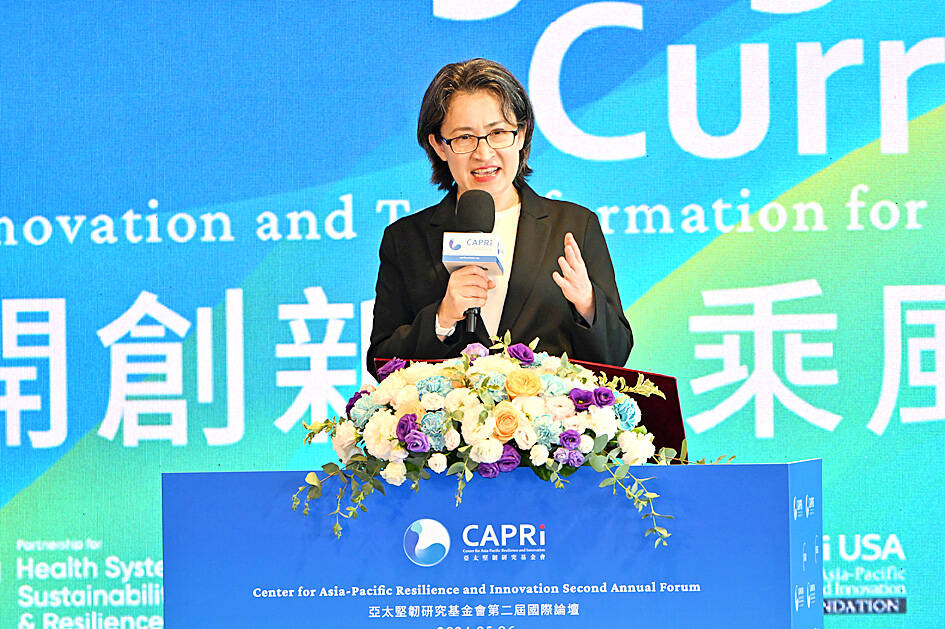
Photo: Tien Yu-hua, Taipei Times
The nation’s own efforts in strengthening itself are also of great importance, Hsiao said.
“We must have the confidence that Taiwan is worthy of galvanizing international support,” she said.
Taiwan has demonstrated its economic, social, democratic and defense resilience in the face of natural disasters, limited natural resources, the martial law era, diplomatic isolation, cyberattacks, disinformation, political interference and near-daily military incursions, she said.
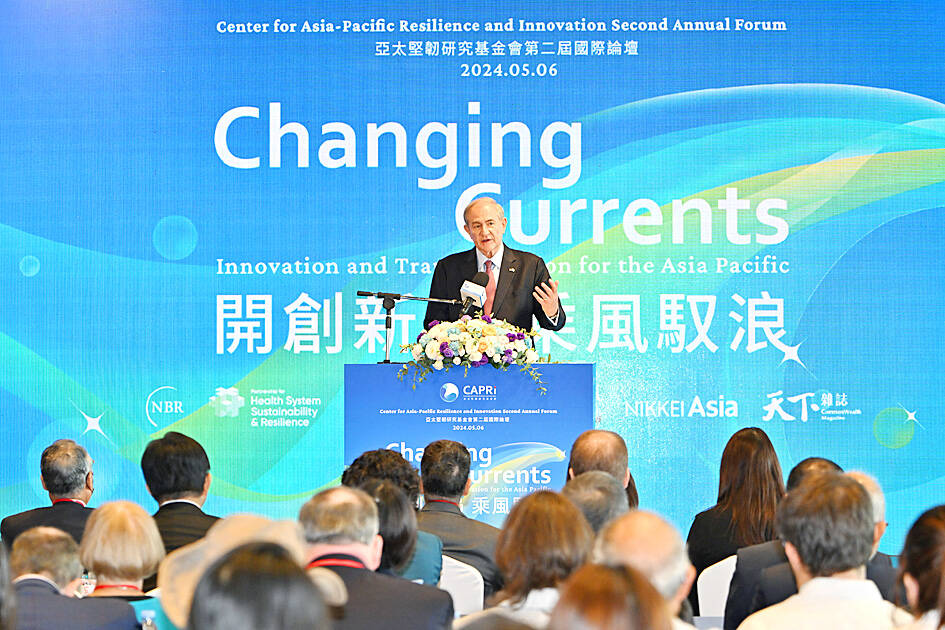
Photo: Tien Yu-hua, Taipei Times
“Against all these odds and long overshadowed by our larger neighbors, Taiwan’s remarkable story of perseverance and determination has propelled it onto the world stage,” she said.
Taiwan has been a model in the Asia-Pacific region with its democratic transition, regularly held free and fair elections, and an open society that has become home to a growing number of international non-governmental organizations, think tanks and media organizations, Hsiao said.
The progress the nation made in universal healthcare accessibility, gender equality and LGBTQ rights are also inspiring neighboring nations, she added.
Through humanitarian assistance and charity programs, “Taiwan has managed to lead in our soft power as a force for good extending the influence of kindness and humanity across the region,” she said.
On the economic front, Taiwan boasts high-tech innovation and a thriving ecosystem largely driven by small and medium-sized enterprises, she said.
Hsiao said she and president-elect William Lai (賴清德) “are committed to leveraging these assets as we work to forge stronger partnerships with like-minded societies around the world.”
At the same forum, former Virginia governor James Gilmore expressed the US’ determination to cooperate with allies around the world in its leadership.
“America is stronger, our country is stronger ... when we work with other people,” Gilmore said.
The US has a stake in the Asia-Pacific region and has to consider the impacts of its actions on other nations, including Taiwan, said Gilmore, who was also former US president Donald Trump’s ambassador to the Organization for Security and Co-operation in Europe.
“Taiwan is our friend, and we have a stake in the success and strength and friendship of Taiwan,” he said.
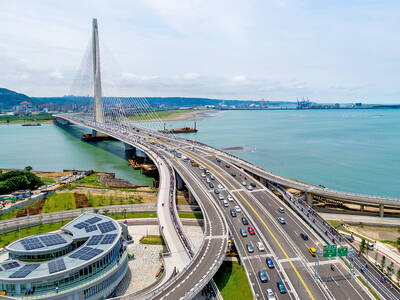
The Ministry of Transportation and Communications yesterday inaugurated the Danjiang Bridge across the Tamsui River in New Taipei City, saying that the structure would be an architectural icon and traffic artery for Taiwan. Feted as a major engineering achievement, the Danjiang Bridge is 920m long, 211m tall at the top of its pylon, and is the longest single-pylon asymmetric cable-stayed bridge in the world, the government’s Web site for the structure said. It was designed by late Iraqi-British architect Zaha Hadid. The structure, with a maximum deck of 70m, accommodates road and light rail traffic, and affords a 200m navigation channel for boats,
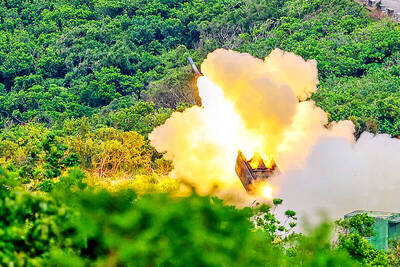
PRECISION STRIKES: The most significant reason to deploy HIMARS to outlying islands is to establish a ‘dead zone’ that the PLA would not dare enter, a source said A High Mobility Artillery Rocket System (HIMARS) would be deployed to Penghu County and Dongyin Island (東引) in Lienchiang County (Matsu) to force the Chinese military to retreat at least 100km from the coastline, a military source said yesterday. Taiwan has been procuring HIMARS and Army Tactical Missile Systems (ATACMS) from the US in batches. Once all batches have been delivered, Taiwan would possess 111 HIMARS units and 504 ATACMS, which have a range of 300km. Considering that “offense is the best defense,” the military plans to forward-deploy the systems to outlying islands such as Penghu and Dongyin so that
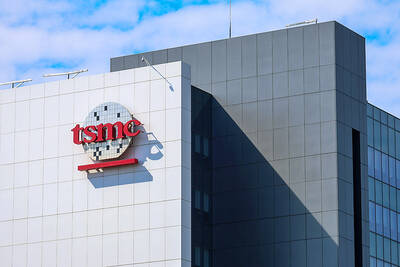
Taiwan Semiconductor Manufacturing Co (TSMC, 台積電), the world’s largest foundry service provider, yesterday said that global semiconductor revenue is projected to hit US$1.5 trillion in 2030, after the figure exceeds US$1 trillion this year, as artificial intelligence (AI) demand boosts consumption of token and compute power. “We are still at the beginning of the AI revolution, but we already see a significant impact across the whole semiconductor ecosystem,” TSMC deputy cochief operating officer Kevin Zhang (張曉強) said at the company’s annual technology symposium in Hsinchu City. “It is fair to say that in the past decade, smartphones and other mobile devices were
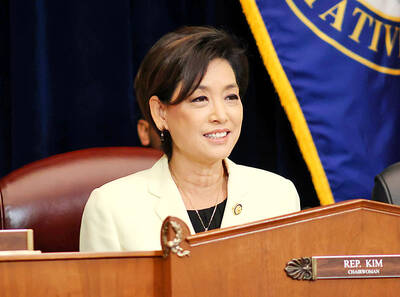
‘CLEAR MESSAGE’: The bill would set up an interagency ‘tiger team’ to review sanctions tools and other economic options to help deter any Chinese aggression toward Taiwan US Representative Young Kim has introduced a bill to deter Chinese aggression against Taiwan, calling for an interagency “tiger team” to preplan coordinated sanctions and economic measures in response to possible Chinese military or political action against Taiwan. “[Chinese President] Xi Jinping [習近平] has directed the People’s Liberation Army to be ready to invade Taiwan by 2027. China has a plan. America should have one too,” Kim said in a news release on Thursday last week. She introduced the “Deter PRC [People’s Republic of China] aggression against Taiwan act” to “ensure the US has a coordinated sanctions strategy ready should


 RSS
RSS