


Serbian President Aleksandar Vucic yesterday said that “Taiwan is China” as he made a speech welcoming Chinese President Xi Jinping (習近平) to Belgrade, state broadcaster Radio Television of Serbia (RTS) said.
“We have a clear and simple position regarding Chinese territorial integrity,” he told a crowd outside the government offices while Xi applauded him. “Yes, Taiwan is China.”
Xi landed in Belgrade on Tuesday night on the second leg of his European tour, and was greeted by Vucic and most government ministers. Xi had just completed a two-day trip to France, where he held talks with French President Emmanuel Macron as the EU takes a tougher stance on trade with China.
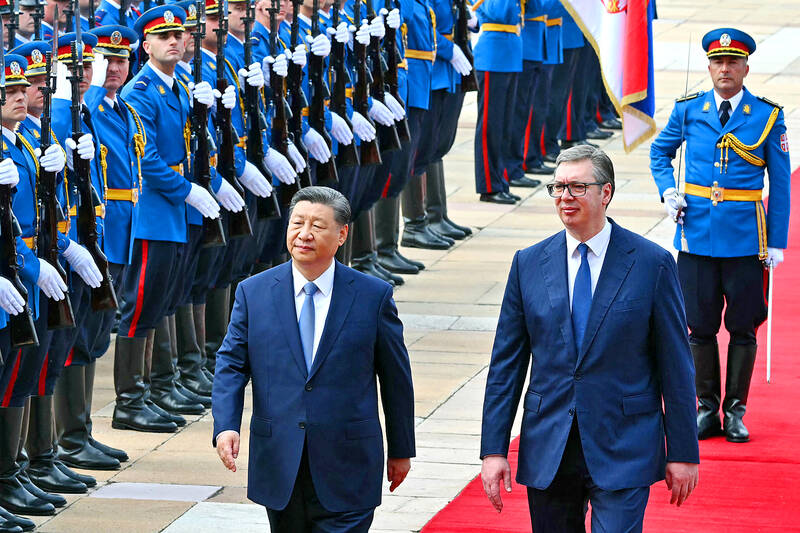
Photo: AFP
In Serbia, he aims to bolster economic and political ties with a country that has thrown open its arms to Chinese trade and investment. He is to finish up his five-day trip with a stop in Hungary, where Hungarian Prime Minister Viktor Orban stands nearly alone among EU leaders in drawing closer to China.
Xi said in a statement after landing in Belgrade that China-Serbia cooperation “serves the fundamental and long-term interests of both countries.”
He added that he looked forward to speaking with Vucic about relations between their nations “and other issues of mutual interest.”
His visit coincides with the 25th anniversary of the deadly US bombing of the Chinese embassy during the 1999 NATO operation aimed at pushing Yugoslav troops out of Kosovo. That event, which the White House later called a mistake and blamed on faulty maps, triggered widespread protests in China.
On Tuesday, Xi vowed to “never forget” the bombing in an article published in Politika, Serbia’s oldest daily newspaper.
“Twenty-five years ago today, NATO flagrantly bombed the Chinese embassy in Yugoslavia, killing three Chinese journalists,” Xi said.
Chinese and Serbian flags fluttered along the highway leading to the city center ahead of the meetings yesterday, when the two sides were expected to sign as many as 30 agreements, the government in Belgrade said without elaborating.
Xi is to highlight projects such as a new high-speed railway linking Belgrade to Budapest.
Direct Chinese investment in Hungary and Serbia exceeds US$15 billion with more coming, ranging from car battery plants in Hungary to copper mining in Serbia.
“We are completely open to Chinese investment,” Serbian First Deputy Prime Minister Sinisa Mali told RTS shortly before Xi’s arrival. “China is one of the two biggest powers in the world, and Xi is the most important statesman coming to Serbia in the last several years.”
Additional reporting by AFP

Crowds in Bangladesh are flocking to snap photographs with an unlikely social media star — an albino buffalo with flowing blond hair nicknamed “Donald Trump” that is due to be sacrificed within days. Owner Zia Uddin Mridha, 38, said his brother named the 700kg bull over its flowing helmet of hair resembling the signature look of the US president. “My younger brother picked this name because of the buffalo’s extraordinary hair,” he said at his farm in Narayanganj, just outside the capital, Dhaka. Mridha said that a constant stream of curious visitors — social media fans, onlookers and children — have come throughout

The Bolivian government on Friday struck a deal with protesting miners, but was still grappling with blockades and demonstrations by other workers across La Paz. Other groups are still blocking access roads into the city, which is also the seat of the government. Police on Thursday prevented the miners from entering the main square by using tear gas, while the demonstrators hurled stones and explosives with slingshots. Protests against the policies of Bolivian President Rodrigo Paz have convulsed the Andean nation since early this month, and roadblocks were choking routes into La Paz throughout Friday, the national road authority said. Miners demanded that Paz
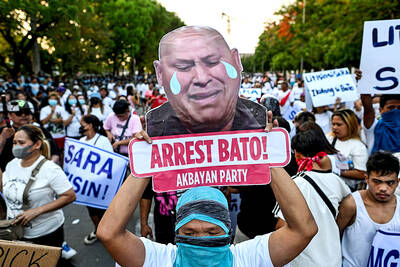
The Philippines said it has asked the country’s Supreme Court to allow it to arrest former Philippine president Rodrigo Duterte’s chief drug war enforcer to stand trial in an international tribunal. The International Criminal Court (ICC) last week unsealed an arrest warrant against Philippine Senator Ronald dela Rosa, accusing him along with Duterte and other “coperpetrators” of the “crime against humanity of murder.” Dela Rosa briefly sought refuge in the Philippine Senate last week while asking the Philippine Supreme Court to stop an ongoing attempt by government agents to arrest him. “By his own conduct, he has placed himself outside the protection of

The researchers in Ireland looked at their computer screen, marveling at a medieval book tracked down in a Roman library. They flipped through its digitized pages and found their sought-after treasure: the oldest surviving English poem. “We were extremely surprised. We were speechless. We couldn’t believe our eyes when we first saw that,” said Elisabetta Magnanti, a visiting research fellow at Trinity College Dublin’s school of English. The poem was also within the main body of Latin text, she said, calling it “extraordinary.” Composed in Old English by a Northumbrian agricultural worker in the 7th century, Caedmon’s Hymn appears within some copies of


 RSS
RSS