


South Korean President Yoon Suk-yeol on Monday said Japan is a partner as the two countries face “common threats,” offering to improve ties between the allies of the US whose help Washington has sought in putting up a united front against the likes of China, Russia and North Korea.
Yoon said in a speech to mark Japan’s World War II surrender and the end of its 1910-1945 colonial rule over the Korean Peninsula that he wants to “swiftly and properly improve” relations with Tokyo stemming from historical disputes.
“When Korea-Japan relations move toward a common future, and when the mission of our times align, based on our shared universal values, it will also help us solve the historical problems that exist between our two countries,” Yoon said in the Liberation Day speech.
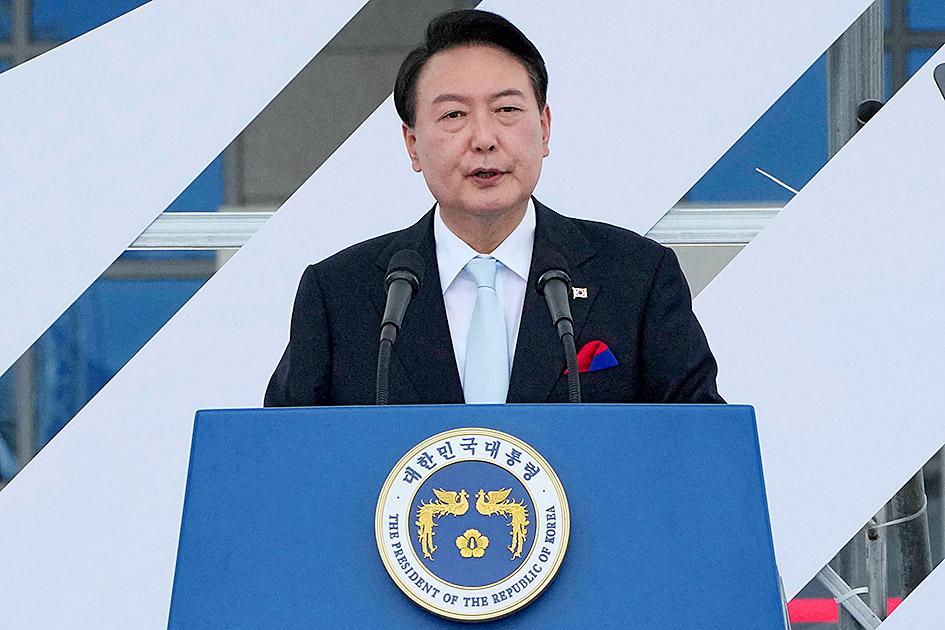
Photo: Bloomberg
Last month, the two countries’ foreign ministers met in Tokyo and said they would seek an early resolution to the issue of compensation for Koreans conscripted during the colonial period to work in factories and mines that helped power Japan’s Imperial Army.
Ties between the neighbors fell to new lows under Yoon’s predecessor, South Korean president Moon Jae-in, over a series of court decisions awarding compensation to the former workers. Japan sees the decisions as unlawful and the issue as “settled completely and finally” under a 1965 agreement that established diplomatic ties and was accompanied by US$500 million in aid and loans.
A plan being floated by Yoon for a joint fund between the governments stands little chance of support in Japan, still angry after a separate fund for women trafficked into Imperial Japanese Army brothels was scuttled by Moon.
The South Korean Ministry of Foreign Affairs submitted an argument to the Supreme Court last month, asking for a delay of the verdict on liquidizing assets of a Japanese company to pay compensation for the conscripted workers.
The ministry added that it was making various diplomatic efforts to resolve the issue.
Yoon is unlikely to get money for any joint fund, or for South Korea to pay on its own, from a parliament where Moon’s Democratic Party holds a majority and has demanded Japan show what it sees as proper contrition.
Yoon, whose support rate has fallen sharply, risks further alienating the South Korean public by moves seen as cozying up to long-time rival Japan.
Yoon, a conservative who took power in May, has advocated a tougher line with China and North Korea, bringing his country’s security policies in greater alignment with those of the US and Japan. In his Liberation Day speech, he called on North Korea to make “genuine and substantive process for denuclearization,” offering food, energy and infrastructure aid if it does.
Yoon’s government has said the possible operation of a US-made missile shield that raised the ire of China was “not negotiable,” pushing back at Beijing’s efforts to hold him to Moon’s policy to freeze its deployment.
Decisions on the deployment of Lockheed Martin Corp’s Terminal High-Altitude Area Defense system are a matter of South Korean self-defense, a senior presidential official told reporters in Seoul last week.
The Yoon administration is accelerating efforts to “normalize” the operation of the US base in the southern city of Seongju that deployed the Thaad system, the official said.
Meanwhile in Japan, a cabinet minister and a top official of the ruling Liberal Democratic Party (LDP) visited the Yasukuni Shrine on Monday, media reports said.
Japanese Minister of State for Economic Security Sanae Takaichi and Koichi Hagiuda, chairman of the LDP’s Policy Research Council, paid their respects at the site, where 14 Class-A war criminals are enshrined along with other war dead. The shrine is seen by victims of Japan’s imperial army as a symbol of the country’s past militarism.
Japanese Minister of Economy, Trade and Industry Yasutoshi Nishimura visited Yasukuni on Saturday, Kyodo reported, making him the first sitting cabinet member to make such a visit since Japanese Prime Minister Fumio Kishida’s government took power in October last year.

SPEAKING OUT: After Siranudh Scott’s allegations surfaced, celebrities and public figures took to social media to share their own experiences of sexual misconduct and abuse A high-profile alleged sexual abuse case within a wealthy Thai beer brewing family has prompted a wave of painful accounts from survivors of unconnected abuse in the conservative nation. Siranudh Scott, a member of the billionaire Thai family that founded the ubiquitous Singha beer brand, posted an emotional video this month accusing his elder brother Sunit of repeatedly abusing him when he was a teenager. Sunit, who is in his 30s, later denied the allegations in a video posted online, but Singha parent Boonrawd dismissed him from his executive role with the company on Tuesday last week. “I felt I needed to speak
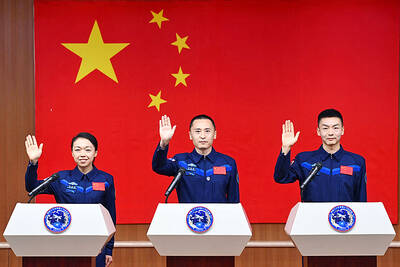
A Hong Kong astronaut is to join a Chinese space mission for the first time as part of a three-person crew launching today, as Beijing edges closer to its goal of landing people on the moon. The Tiangong space station — crewed by teams of three astronauts that are typically rotated every six months — is the crown jewel of China’s space program, boosted by billions in state investment in a bid to catch up with the US and Russia. The Shenzhou-23 mission is to blast off at 11:08pm from the Jiuquan Satellite Launch Center in northwestern China, carrying three astronauts to

UPGRADED ALERT: The risk inside DR Congo is now considered ‘very high,’ while neighboring countries face a ‘high’ threat as the outbreak continues, the WHO said Ebola is spreading faster than responders can track it in eastern Congo, where health workers managed to follow up with barely one in five identified contacts in a single day. Authorities in the Democratic Republic of the Congo (DR Congo) reported 83 confirmed infections, 746 suspected cases and 1,603 identified contacts as of Thursday, but health workers were able to follow up on only 342 contacts that day — about 21 percent of the total under monitoring — data released by the DR Congo Ministry of Public Health on Friday showed. The figures suggest the response is falling behind the outbreak itself,

SEEKING ORDER: Rodrigo Paz said that ‘anyone who wants to destroy the nation will have to deal with this president and the full force of the constitution’ Bolivian President Rodrigo Paz on Wednesday said that the nation was at a “breaking point” after nearly a month of protests that have caused shortages of food, fuel and medicine. Paz, who took office six months ago amid the worst economic crisis there in four decades, is battling a groundswell of fury over his policies. The political capital, La Paz, has been besieged by low-income workers and members of the indigenous majority calling for his resignation. “The country needs order and is reaching breaking point,” the 58-year-old said at a public event in La Paz, renewing his appeal for dialogue. On Tuesday, the Bolivian


 RSS
RSS