


Australian activist Drew Pavlou has been arrested in the UK over a false “bomb threat” delivered to the Chinese embassy in London that he claims came from a fake e-mail address designed to frame him.
Pavlou said the “absurd” e-mail claimed he would blow up the embassy over Beijing’s oppression of its Uighur Muslim minority, but that it was fabricated by the embassy to have him arrested.
Pavlou said he held a “small peaceful human rights protest” carrying a Uighur flag outside the Chinese embassy in central London, adding that the embassy reported him to police as a terrorist in retaliation.
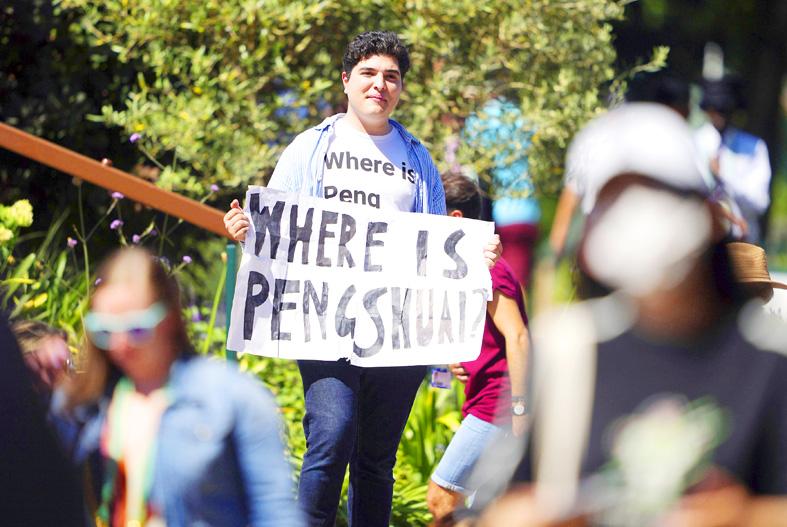
Photo: AP
The fake e-mail allegedly said: “This is Drew Pavlou, you have until 12pm to stop the Uighur genocide or I blow up the embassy with a bomb. Regards, Drew.”
Pavlou, a longstanding and vociferous critic of Beijing’s oppression of China’s Uighur minority, said the email was allegedly sent from the account drewpavlou99@protonmail.me.
The Metropolitan police confirmed it had received a report of a bomb threat made by e-mail, and had arrested a man outside the embassy because of his “suspicious behavior,” and that he had attempted to glue his hand to the embassy.
Pavlou said the e-mail account is fake, and he had no involvement with it and had never sent any threat.
“The UK police arrested me. They said the Chinese embassy had reported me as a terrorist, as a bomb threat. I was so shocked. I’ve always been a peaceful protester,” Pavlou said. “They’ve made up this e-mail claiming that I sent in the bomb threat. It’s just absolute insanity. Why would I throw away my life like that?”
“I miss my family, I can’t leave the country, they’ve threatened to arrest me at the border,” he said. “I’ve done nothing wrong. I just wanted to peacefully protest and the Chinese embassy have invented this narrative that I’m a terrorist. It’s insanity.”
Pavlou said online that he was arrested by the London Metropolitan Police Service and detained for 23 hours without access to a lawyer.
“UK police handcuffed me in stress position and held me incommunicado for 23 hours with no access to lawyers. Facing seven years in prison,” he wrote on Twitter.
“They wouldn’t let me talk to anyone on the outside, no one knew where I was,” he added.
The Australian Department of Foreign Affairs and Trade confirmed Pavlou’s arrest.
It “has offered consular assistance to Drew Pavlou, an Australian who was arrested, and subsequently released, in the United Kingdom,” the department said in a statement.
Pavlou has consistently protested China’s authoritarian regime, in particular Beijing’s treatment of its Uighur Muslim minority.
Last month, he was ejected from the Wimbledon’s men’s singles final after holding up a sign that said: “Where is Peng Shuai?”
Shuai (彭帥) is a retired Chinese tennis player who alleged she had been sexually assaulted by a senior Chinese Communist Party official before disappearing, later retracting the allegation in a series of carefully stage-managed interviews.
In June, Pavlou interrupted a speech in Sydney by Chinese Ambassador to Australia Xiao Qian (肖千), saying: “Stop platforming murderers, this is a representative of a dictatorship with 1 million Muslims in concentration camps.”
Pavlou’s protest campaign rose to prominence at the University of Queensland, where he studies, and where he demonstrated against the influence of the university’s Chinese government-funded Confucius Institute.
Xinjiang, in China’s northwest, is the site of a years-long crackdown by Chinese authorities on Uighurs and other Muslim minorities. An estimated 1 million people have been incarcerated in a vast network of detention and re-education camps, which Beijing insists are “vocational education and training centers.”
Document leaks have revealed that thousands have been arrested or jailed for alleged crimes, including studying scripture, growing a beard or traveling overseas, and that authorities have established “shoot to kill” policies in response to attempted escapes.
Human rights groups and several governments have labeled the campaign a genocide or crime against humanity. Beijing denies all allegations of mistreatment and said its policies are to counter terrorism and religious extremism.

‘CROSSING THE LINE’: China’s embassy in Seoul criticized US Forces Korea Commander General Xavier Brunson, asking if his ‘hostile’ remarks were authorized by Washington South Korea and the US are in talks over recent public remarks by the commander of US Forces Korea, Seoul’s presidential office said yesterday, after the comments drew sharp criticism from China. In a recent podcast interview, US Forces Korea Commander General Xavier Brunson described South Korea as “the dagger in the heart of Asia” from China’s east coast, prompting the Chinese embassy in Seoul to say that he had “truly crossed the line.” The interview came amid growing speculation that Washington might seek to expand the role of US Forces Korea in countering the growing regional influence of China, a key

SEEKING ORDER: Rodrigo Paz said that ‘anyone who wants to destroy the nation will have to deal with this president and the full force of the constitution’ Bolivian President Rodrigo Paz on Wednesday said that the nation was at a “breaking point” after nearly a month of protests that have caused shortages of food, fuel and medicine. Paz, who took office six months ago amid the worst economic crisis there in four decades, is battling a groundswell of fury over his policies. The political capital, La Paz, has been besieged by low-income workers and members of the indigenous majority calling for his resignation. “The country needs order and is reaching breaking point,” the 58-year-old said at a public event in La Paz, renewing his appeal for dialogue. On Tuesday, the Bolivian
Forecasters in Europe yesterday warned of exceptional heat as record temperatures driven by a “heat dome” push temperatures well above seasonal norms across the continent. The surge follows a record-breaking Monday, with France logging its hottest day in the month of May on record, its weather agency said, and the UK also posting unprecedented highs. A so-called “heat dome” of warm air from northern Africa trapped under a high-pressure system over western Europe is behind the high temperatures not usually seen until high summer. Restrictions on outdoor work were imposed in parts of Italy, beaches in southwest France filled earlier than usual and

Australian researchers have trained lab-grown brain cells on a silicon computer chip to play the 1990s shooter game Doom and said they are just scratching the surface of what the neurons could be capable of doing. It is the science-fiction work of biotech boffins at Cortical Labs, who researched and developed the technology that harnesses the workings of the brain’s networking system. Each so-called “biological computer” contains about 200,000 living human brain cells, grown from stem cells that were harvested from blood donations. Having mastered the simple computer game Pong, where a paddle is moved up and down to send a ball


 RSS
RSS