


Indonesia yesterday awarded the title of national hero to late president Suharto, provoking outrage from rights groups who said the move was an attempt to whitewash decades of human rights abuses and corruption that took place during his 32 years in power.
Suharto was a US ally during the Cold War who presided over decades of authoritarian rule, during which up to 1 million political opponents were killed, until he was toppled by protests in 1998.
He was one of 10 people recognized by Indonesian President Prabowo Subianto in a televised ceremony held at the presidential palace in Jakarta to mark National Hero Day.
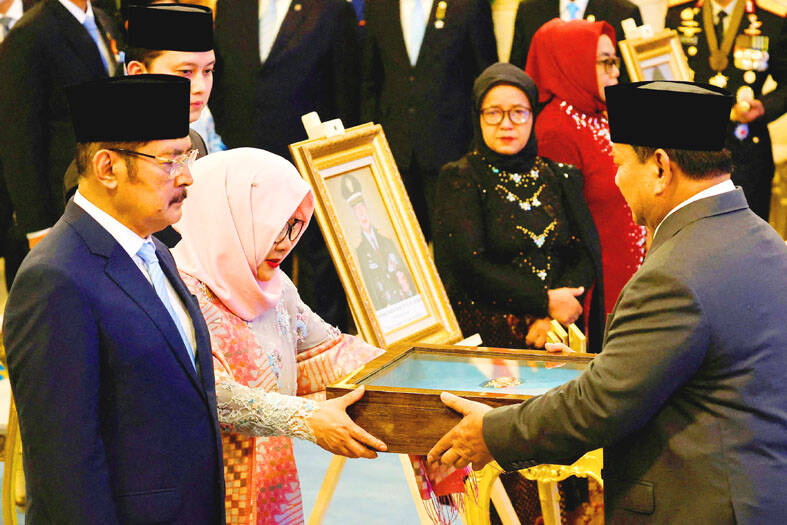
Photo: Reuters
Indonesian Minister of Culture Fadli Zon said that Suharto played a key role during the struggle for independence against its Dutch colonial rulers, and later served as commander of a military operation that helped take control of what is now West Papua from the Dutch.
Zon also credited the former dictator with alleviating poverty and taming inflation, as well as defeating a Communist uprising. He said allegations of corruption and serious human rights abuses were unproven.
Prabowo had close ties to Suharto, under whom he rose through the ranks of an Indonesian special forces unit accused of extensive human rights abuses. He and other members of the unit were banned from traveling to the US until 2020, when it was lifted while he was serving Indonesia’s defense minister.
He was married to Suharto’s daughter Siti Hediati Hariyadi from 1983 to 1998. Prabowo did not make any statement after the ceremony.
Former Indonesian president Abdurrahman Wahid, who revoked many of Suharto’s repressive laws, and Marsinah, a prominent labor activist who was killed during the dictatorship, were also among 10 figures recognized as heroes yesterday.
Suharto held power with an authoritarian approach that saw soldiers stationed in every village until he was chased from office by widespread unrest at the peak of the 1997-1998 Asian financial crisis.
He was accused of responsibility for the killings of hundreds of thousands of political opponents during his time in office, but poor health — and, critics charged, continuing corruption — kept him from facing trial until his death in 2008.
The bulk of killings occurred in 1965-1966, when between 300,000 and 800,000 alleged communists were rounded up and slain during his rise to power. Over the next three decades, a further 300,000 people were killed, disappeared or starved in the independence-minded regions of East Timor, Aceh and Papua, according to human rights groups and the UN.
Survivors of state violence under Suharto voiced outrage about the honor.
“I was shocked, disappointed and angry with this government’s absurd decision,” said Bedjo Untung, who was imprisoned without trial after being accused of involvement with the Indonesian Communist Party and now chairs the 1965 Murder Victim’s Research Foundation.
Untung, who was tortured during his 1970-1979 imprisonment, said his family suffered years of discrimination and hardship due to his alleged ties to communism.
“It feels deeply unfair, we are still living with the suffering until today,” Untung said.
Suharto has been nominated for the title of national hero multiple times since 2010, but previous Indonesian leaders rejected the idea in the face of debate and national outcry.
Indonesian Minister of State Secretary Prasetyo Hadi said the candidates for this year’s honors were recommended by the parliament after an in-depth discussion with the national assessment committee for national hero and society groups.
Jaleswari Pramodhawardani, a senior policy analyst at Laboratorium Indonesia 2045, said the national hero title conferred on Suharto challenges not only the nation’s collective memory, but also its unwavering commitment to transitional justice and the mandates of the 1998 reform movement.
To bestow the title of hero upon the architect of the gross human rights abuses is “to de facto pardon state violence, permanently freezing the pursuit of justice for countless victims,” Pramodhawardani wrote.

Through the noise of rushing papers and whirring belts at a print factory in Kyoto, two creators watch their photo essay come to life in broadsheet form — part of an effort to win new audiences in the age of artificial intelligence (AI). Despite the decline of the publishing industry, self-publication and handmade “zine” magazines are growing in popularity in Japan, reflecting the nation’s enduring love of paper in the digital era. While speaking to Agence France-Presse at the plant, his hands black with ink, one of the creators, Kazuma Obara, said: “I think [paper] is a medium that engages all five
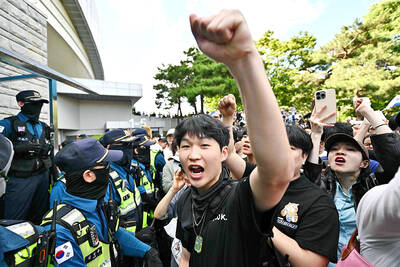
‘ABSURD MISTAKE’: The election commission said that there had been a failure to anticipate turnout after 14 polling stations ran short of ballot papers South Korean riot police yesterday cleared protesters from a Seoul polling station after a 35-hour blockade sparked by a shortage of ballot papers during local elections earlier this week. Wednesday’s election was the first nationwide vote since South Korean President Lee Jae-myung took office following the ouster of Yoon Suk-yeol over his short-lived martial law declaration. Lee’s ruling Democratic Party swept most races, but failed to flip the crucial Seoul mayoral seat. The South Korean National Election Commission apologized, blaming a failure to anticipate turnout after 14 polling stations in Seoul ran short of ballot papers. Some polling stations stayed open until 10pm to

Australian researchers have trained lab-grown brain cells on a silicon computer chip to play the 1990s shooter game Doom and said they are just scratching the surface of what the neurons could be capable of doing. It is the science-fiction work of biotech boffins at Cortical Labs, who researched and developed the technology that harnesses the workings of the brain’s networking system. Each so-called “biological computer” contains about 200,000 living human brain cells, grown from stem cells that were harvested from blood donations. Having mastered the simple computer game Pong, where a paddle is moved up and down to send a ball

France experienced its hottest spring on record, the French weather service said on Tuesday, after an exceptional early heat wave that also broke highs for the season in England and Wales. Meteo-France said the average nationwide temperature over March to May was 13.8°C — about 1.7°C above the norm, and surpassing records set in 2011 and 2020. “The warmest spring since records began in 1900,” it said in a bulletin. All three months were warmer than average, but the onset of an “unprecedented heatwave” late last month pushed the mercury to highs typically seen at the height of the summer. “Our country had never


 RSS
RSS