


The US promised more military support for Ukraine, including drones, and is considering whether to send fighter aircraft, as Russian forces relentlessly shelled towns and cities in the east with the war about to enter its sixth month.
Moscow and Kyiv signed a landmark deal on Friday that raised hopes of unblocking vast grain exports from Black Sea ports.
Ukrainian President Volodymyr Zelenskiy hailed the accord, but with heavy fighting continuing on several fronts, he said there could be no ceasefire unless lost territory was retaken.
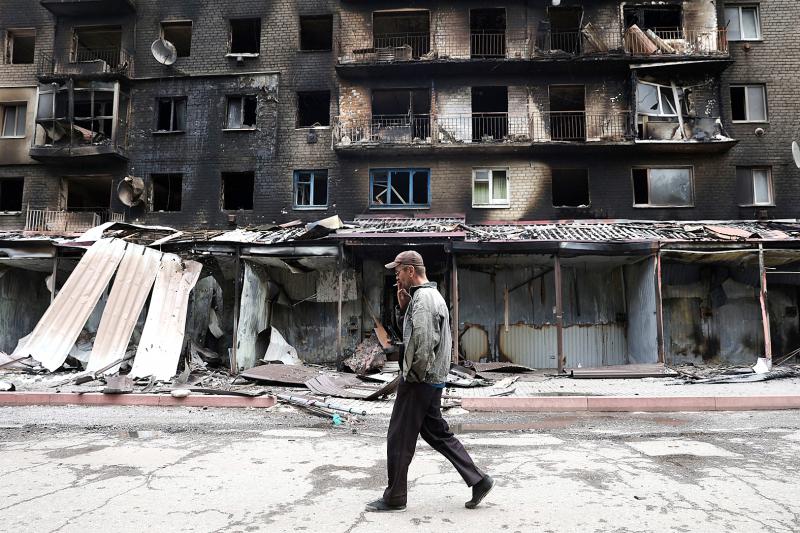
Photo: AFP
Warning: Smoking can damage your health
“Freezing the conflict with the Russian Federation means a pause that gives the Russian Federation a break for rest,” he told the Wall Street Journal.
“Society believes that all the territories must be liberated first, and then we can negotiate about what to do and how we could live in the centuries ahead,” he said.
There have been no breakthroughs on the front lines since Russian forces seized the last two Ukrainian-held cities in the eastern province of Luhansk late last month and early this month.
Russian forces failed to establish control over Ukraine’s second-biggest power plant at Vuhlehirska, northeast of Donetsk, and troops tried to advance west from the city of Lysychansk, but were pushed back, the Ukrainian General Staff of the Armed Forces said.
A number of people were killed and wounded when 13 Russian missiles hit a military airfield and railway infrastructure in the central region of Kirovohrad yesterday, its governor said.
In the southern town of Nikopol on the Dnipro river, continued Russian shelling killed at least one person, a Ukrainian official said on his Telegram channel.
The attack on Nikopol, the target of more than 250 rockets in the past week, damaged 11 homes and farm buildings, cut off gas and water pipes, and destroyed a railway track, said Oleksandr Vilkul, head of the Military Administration of Kryvyi Rih in central Ukraine.
Up river in the Dnipropetrovsk region, rockets targeted a town and nearby villages, regional governor Valentyn Reznychenko said.
Heavy fighting has taken place over the past 48 hours as Ukrainian forces continued their offensive against Russia in Kherson Oblast, west of the Dnipro river, British military intelligence said yesterday.
“Supply lines of the Russian forces west of the river are increasingly at risk,” the British Ministry of Defence said in an intelligence update.
In the northeast, “several powerful strikes” yesterday morning hit the center of Kharkiv, Ukraine’s second-largest city, Kharkiv Mayor Ihor Terekhov wrote in a post on Telegram.
The Russian Ministry of Defense did not immediately reply to a request for comment outside regular hours.
Kyiv hopes that its gradually increasing supply of western arms, such as US High Mobility Artillery Rocket System (HIMARS), will allow it to recapture territory.
Russia’s defense ministry on Friday said its forces had destroyed four HIMARS systems between July 5 and Wednesday, which was refuted by the US and Ukraine.
Ukraine’s mayor of Russian-occupied city Melitopol, Ivan Fedorov, reported that two explosions were heard early yesterday at the Azov Sea resort Kyrylivka, where he said Russia had moved material to avoid becoming targets for HIMARS.
“They hoped that neither our HIMARS nor the armed forces and the resistance movement would get them there, but someone definitely got them,” Fedorov said from territory still in Ukrainian hands.
Reuters could not verify the battlefield reports.
The White House on Friday announced US$270 million in fresh support for Kyiv, saying it was doing preliminary work on whether to send fighter aircraft, although such a move would not happen in the near term.
The Feb. 24 invasion of Ukraine has caused Europe’s biggest conflict since 1945, forcing millions to flee and turning entire cities to rubble.
The Kremlin says it is engaged in a “special military operation” to demilitarize and “denazify” Ukraine. Kyiv and its allies say the war is an unprovoked act of aggression.

Through the noise of rushing papers and whirring belts at a print factory in Kyoto, two creators watch their photo essay come to life in broadsheet form — part of an effort to win new audiences in the age of artificial intelligence (AI). Despite the decline of the publishing industry, self-publication and handmade “zine” magazines are growing in popularity in Japan, reflecting the nation’s enduring love of paper in the digital era. While speaking to Agence France-Presse at the plant, his hands black with ink, one of the creators, Kazuma Obara, said: “I think [paper] is a medium that engages all five

‘CROSSING THE LINE’: China’s embassy in Seoul criticized US Forces Korea Commander General Xavier Brunson, asking if his ‘hostile’ remarks were authorized by Washington South Korea and the US are in talks over recent public remarks by the commander of US Forces Korea, Seoul’s presidential office said yesterday, after the comments drew sharp criticism from China. In a recent podcast interview, US Forces Korea Commander General Xavier Brunson described South Korea as “the dagger in the heart of Asia” from China’s east coast, prompting the Chinese embassy in Seoul to say that he had “truly crossed the line.” The interview came amid growing speculation that Washington might seek to expand the role of US Forces Korea in countering the growing regional influence of China, a key

Australian researchers have trained lab-grown brain cells on a silicon computer chip to play the 1990s shooter game Doom and said they are just scratching the surface of what the neurons could be capable of doing. It is the science-fiction work of biotech boffins at Cortical Labs, who researched and developed the technology that harnesses the workings of the brain’s networking system. Each so-called “biological computer” contains about 200,000 living human brain cells, grown from stem cells that were harvested from blood donations. Having mastered the simple computer game Pong, where a paddle is moved up and down to send a ball

France experienced its hottest spring on record, the French weather service said on Tuesday, after an exceptional early heat wave that also broke highs for the season in England and Wales. Meteo-France said the average nationwide temperature over March to May was 13.8°C — about 1.7°C above the norm, and surpassing records set in 2011 and 2020. “The warmest spring since records began in 1900,” it said in a bulletin. All three months were warmer than average, but the onset of an “unprecedented heatwave” late last month pushed the mercury to highs typically seen at the height of the summer. “Our country had never


 RSS
RSS