


Six people have died and 350,000 have been treated for a fever that has spread “explosively” across North Korea, state media said yesterday, sparking new calls for the government to accept aid that could save lives, help protect its battered economy, and possibly lead to a diplomatic opening.
North Korea likely does not have sufficient COVID-19 tests and said it did not know the cause of the mass fevers.
A big outbreak of COVID-19 could be devastating in a country with a broken health care system and an unvaccinated, malnourished population.
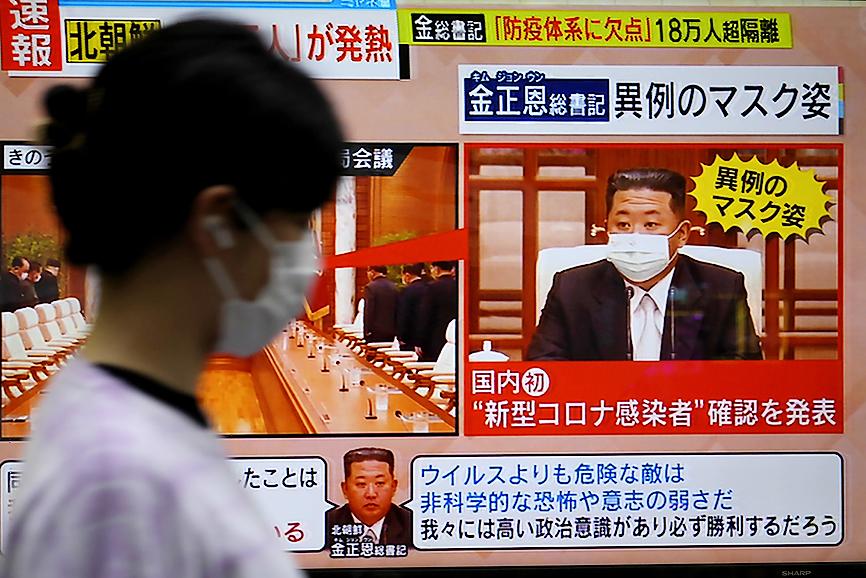
Photo: AP
The Korean Central News Agency (KCNA) said that of the 350,000 people who developed fevers since late last month, 162,200 have recovered.
It added that 18,000 people were newly found with fever symptoms on Thursday, and 187,800 people are being isolated for treatment.
One of the six people who died was infected with the Omicron variant of SARS-CoV-2, the agency said.
State TV showed North Korean leader Kim Jong-un Kim wearing a mask as he entered what the broadcast described as the country’s headquarters of its pandemic response, which appeared to be Pyongyang’s landmark Koryo Hotel. He took off the mask and smoked a cigarette while talking with officials.
KCNA said that Kim criticized officials for failing to prevent “a vulnerable point in the epidemic prevention system.”
He said that the outbreak was centered around the capital, Pyongyang, and said that all work and residential units should be isolated from one another, while residents should be provided every convenience during a lockdown.
The spread of the virus might have been accelerated by a massive military parade on April 25, where Kim gave a speech and showcased his army and weaponry in front of tens of thousands of people.
The office of South Korean President Yoon Suk-yeol said yesterday that it intends to help North Korea, including by providing vaccines, and that specific measures would be discussed with Pyongyang.
North Korea is not known to have imported or administered any COVID-19 vaccines, and is one of only two countries that have not begun a vaccination campaign.
“Unveiling the outbreak through KCNA, which is a primary channel for external communications, indicates that North Korea could seek vaccine support,” said Yang Moo-jin, a professor at the University of North Korean Studies in Seoul. “Isolation and control are not enough to overcome the crisis without vaccines.”
Others said that it remains unclear whether North Korea’s stance is softening, and that there are many hurdles with geopolitical implications.
Some analysts said that “vaccine diplomacy” with North Korea could ease tensions in other areas such as the country’s nuclear weapons and ballistic missile programs.
“If inter-Korean cooperation does happen, it would help defuse military tension and reopen talks, and potentially lead to humanitarian exchanges such as a reunion of separated families,” said Cheong Seong-chang, director of the Sejong Institute’s North Korea studies center in South Korea.
The politicization of aid might also be a major reason why North Korea has been hesitant to accept.
Pyongyang might be more likely to reach out to its allies in Beijing first, Cheong said, although Pyongyang turned down an earlier offer of 3 million COVID-19 vaccine doses of China’s Sinovac Biotech.
“If the situation gets more uncontrollable, it would be difficult to refuse Western support,” he said.

A US YouTuber who caused outrage for filming himself kissing a statue commemorating Korean wartime sex slaves has been sentenced to six months in prison, a court in Seoul said yesterday. Johnny Somali, 25, gained notoriety several years ago for recording himself doing a series of provocative stunts in South Korea and Japan, and streaming them on platforms such as YouTube and Twitch. South Korean authorities indicted Somali — whose real name is Ramsey Khalid Ismael — in 2024 on public order violations and obstruction of business, and banned him from leaving the country. “The court has sentenced him to six months in

Former Lima mayor Rafael Lopez Aliaga, a Peruvian presidential hopeful, gathered hundreds of supporters in Lima on Tuesday and gave authorities 24 hours to annul the first round of the country’s election over allegations of fraud. Lopez Aliaga is locked in a tight three-way race with two other candidates for second place in Sunday’s vote. The election runner-up wins a ticket to June’s presidential run-off against front-runner Keiko Fujimori. “I am giving them 24 hours to declare this electoral fraud null and void,” said Lopez Aliaga, surrounded by a crowd of several hundred supporters. “If it is not declared null and void tomorrow,
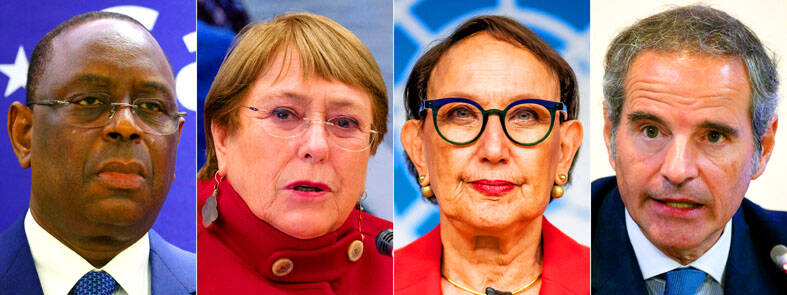
Four contenders are squaring up to succeed Antonio Guterres as secretary-general of the UN, which faces unprecedented global instability, wars and its own crushing budget crisis. Chile’s Michelle Bachelet, Argentina’s Rafael Grossi, Costa Rica’s Rebeca Grynspan and Senegal’s Macky Sall are each to face grillings by 193 member states and non-governmental organizations for three hours today and tomorrow. It is only the second time the UN has held a public question-and-answer, a format created in 2016 to boost transparency. Ultimately the five permanent members of the UN’s top body, the Security Council, hold the power, wielding vetoes over who leads the
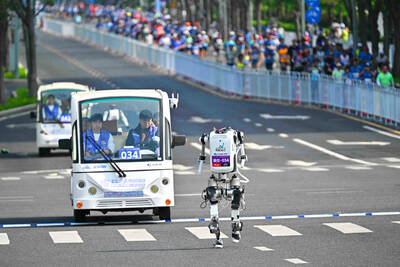
A humanoid robot that won a half-marathon race for robots in Beijing on Sunday ran faster than the human world record in a show of China’s technological leaps. The winner from Honor, a Chinese smartphone maker, completed the 21km race in 50 minutes and 26 seconds, said a WeChat post by the Beijing Economic-Technological Development Area, also known as Beijing E-Town, where the race began. That was faster than the human world record holder, Ugandan Jacob Kiplimo, who finished the same distance in about 57 minutes in March at the Lisbon road race. The performance by the robot marked a significant step forward


 RSS
RSS