

Shanghai yesterday announced a record 21,000 new cases and a third consecutive day of COVID-19 testing as a lockdown of its 26 million people showed no sign of easing and Chinese cities tightened curbs — even in places with no recent infections.
Beijing intervened in Shanghai after the failure of its slice-and-grid approach, and insisted that China stick to its elimination approach to COVID-19, which it says is essential to keeping death rates low and preventing its medical system from breaking down.
Local authorities across China are stepping up virus control measures, including movement restrictions, mass testing and new quarantine centers.
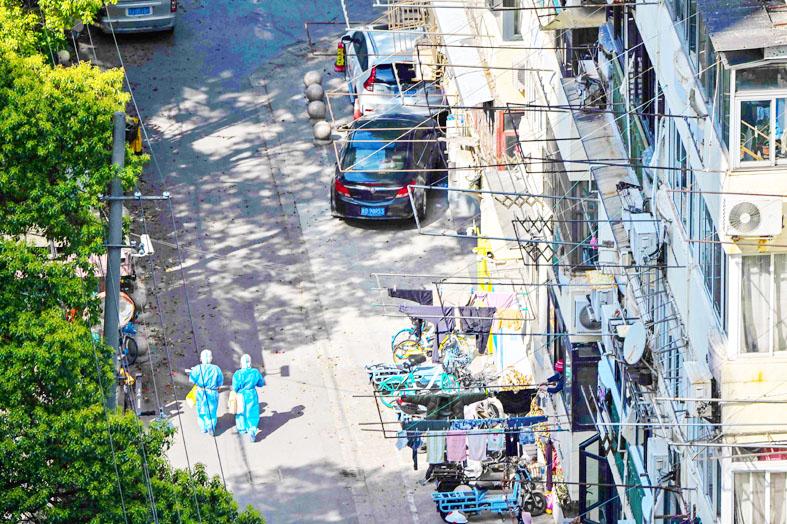
Photo: AFP
Cities that jumped into action this week included Henan Province’s Zhengzhou, which on Thursday said it would test all 12.6 million residents after finding a few asymptomatic cases in the previous few days.
Beijing has increased regular screening for employees in the city’s key sectors, requiring all staff at elderly care agencies, schools and institutions handling imported goods to undergo a test at least once a week.
In Yunnan Province’s Shizong County, shops were shut, transport suspended and residents barred from leaving their towns or villages after a person who was asymptomatic returned home from Shanghai and infected a household member.
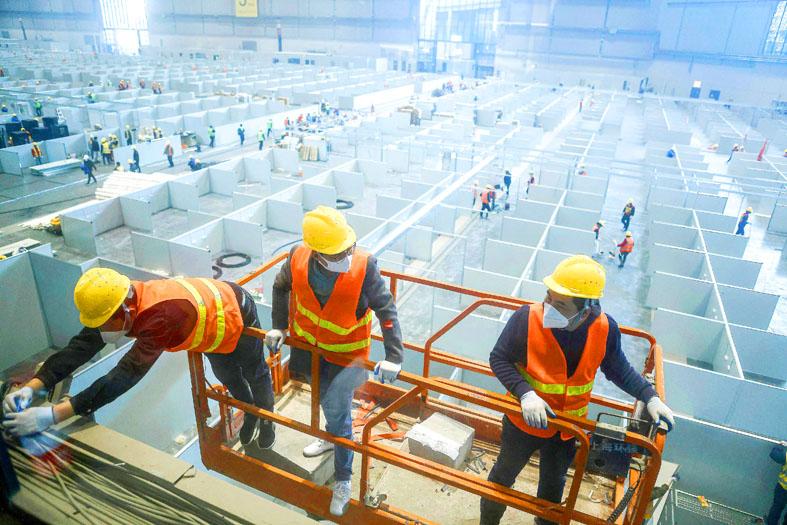
Photo: AFP
Nomura this week estimated that 23 Chinese cities have implemented either full or partial lockdowns.
The cities collectively are home to an estimated 193 million people and contribute 22 percent of China’s GDP.
These include Changchun, a major manufacturing hub that has been locked down for 28 days.
Cui Ernan, a China consumer analyst at Gavekal Dragonomics who studies COVID-19 policies announced by China’s 100 largest cities, said that most were keeping restrictions in place even after case numbers returned to zero.
“The extremely widespread COVID restrictions beyond Shanghai, and the risk-averse attitude of both central and local government officials, suggest that the economic impact of the various lockdowns will not ease in a matter of days or even weeks,” Cui said in a note.
Stories of crowded and unsanitary central quarantine centers and fears of family separation have driven calls for home quarantine in Shanghai and for China to review its “dynamic clearance” approach.
Although the government has not acceded to these requests, it has started allowing some close contacts to isolate at home and on Wednesday eased its policy of separating infected children from their parents.
It is also transferring some patients to neighboring provinces.
However, food supply remains a concern with residents, due to a shortage of couriers.
Authorities said that they would allow more delivery personnel to leave locked-down areas and local media yesterday reported that Alibaba and online grocer Dingdong Maicai had recalled about 3,500 such workers altogether.
Shanghai has not indicated when it might lift its lockdown.
On Thursday, Chinese Center for Disease Control and Prevention lead epidemiologist Wu Zunyou (吳尊友) said in a post online that action taken in Shanghai had to be “thunderous” to cut off the chain of transmission.
In theory, if multiple rounds of polymerase chain reaction testing were conducted in mega-cities with populations as large as 27 million within two to three days, they could reach zero cases “on the community level” within 10 days to two weeks.
“As long as these measures are implemented well, our country’s severe coronavirus epidemic situation will soon improve,” Wu said.

Former British prime minister Rishi Sunak on Wednesday urged so-called middle powers to become a “poisonous shrimp” to carve out strategic economic leverage in a more turbulent global environment. Sunak drew from a metaphor by former Singaporean prime minister Lee Kuan Yew (李光耀): A big fish will eat a smaller fish, and the smaller fish will eat the shrimp. Lee made the point a year after the Asian nation’s independence in 1966 that the city-state needed to build up its defense mechanisms — like a shrimp that stings — so it would be left alone by predators. “He was thinking about what Singapore’s

POLL POSITION: Democrats criticized the timing of the raid, saying that the US justice department historically avoids public investigations within 60 days of an election Federal agents on Monday searched the home of Democratic US Representative Ilhan Omar, a startling escalation in a criminal investigation that brings renewed focus to the frequent target of White House derision in the final weeks of her re-election bid. The search of the Minnesota congresswoman’s home so close to next month’s midterm contests that would determine control of the US House and the Senate was swiftly condemned by top Democrats in Congress, who raised questions about the timing given longstanding US Department of Justice (DOJ) protocol to avoid overt investigative steps involving political candidates in the direct run-up to an

A Rhode Island pumpkin grower appears to have broken the world record for the heaviest pumpkin, with his giant squash topping the record by nearly 136kg. Ron Wallace of Greene, Rhode Island, weighed his pumpkin on Saturday at a contest in New England and is waiting for the Guinness World Records to confirm he smashed the record, set about a week earlier by a grower in England. Wallace said he has been in contact with Guinness officials who say his record is on track to be verified. “It’s truly massive, it was a pleasure to grow,” Wallace said on Monday. Guinness World Records lists

BUILDUP: The report comes as Japanese Prime Minister Sanae Takaichi boosts defense spending in the face of China’s military expansion and the North Korean threat French defence contractor Thales will establish a maintenance and operational support base in Japan in what is seen as the first such move by a foreign firm in the country, a report said yesterday. Thales chairman and CEO Patrice Caine told the Nikkei business daily that the base “will mark a milestone toward Thales’ long-term engagement in Japan.” It is believed to be the first time a foreign defense company has established a dedicated base in Japan for the maintenance and operation of Japanese defense equipment, the Nikkei said. It added that Thales might also expand its Japan-based business to


 RSS
RSS