


Famed Japanese manga artist Fujiko Fujio A, known for beloved children’s cartoons including Ninja Hattori and Little Ghost Q-Taro, has died aged 88, local media reported yesterday.
The artist, whose real name was Motoo Abiko, was found near his home in Tokyo yesterday, broadcaster TBS and others said.
Police declined to confirm the reports, but tributes to Abiko were posted on Twitter by artists and publishers.
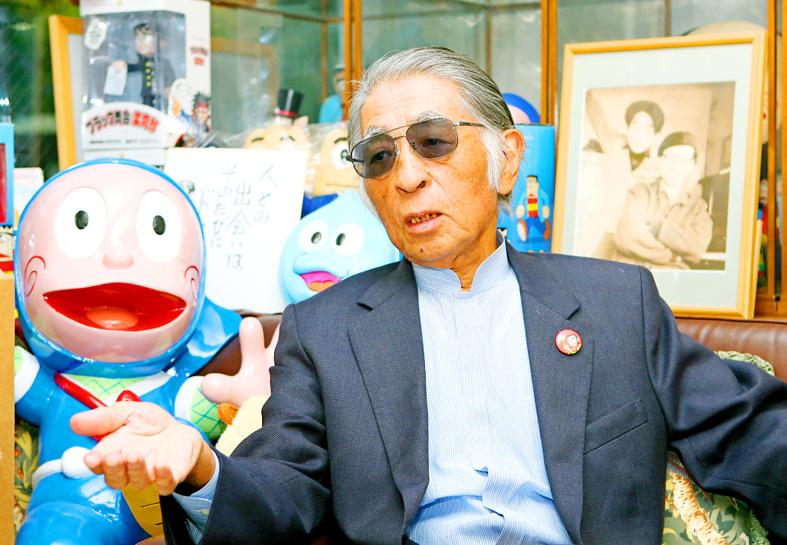
Photo: AFP
Abiko was the eldest son of a monk at a temple in the central Toyama region, but his family left after the death of his father when Abiko was in fifth grade.
“My father’s death changed my life the most. If he had not died, I think I would have been a monk,” he told Asahi Shimbun in 2020.
In high school, he became friends with Hiroshi Fujimoto, who later created Japan’s much-loved cartoon Doraemon, and the pair started to work together.
They formed a partnership that debuted in 1951, jointly producing works under the pen name “Fujiko Fujio,” and shared a Tokyo apartment with other famous manga artists, including Osamu Tezuka.
One of the duo’s works was Q-Taro, about a good-natured, mischievous ghost child who starts living with a human family, which found fans in Japan and abroad.
Abiko also created various manga by himself, including Ninja Hattori, a ninja who becomes best friends with a regular kid, as well as other works targeted at adults.
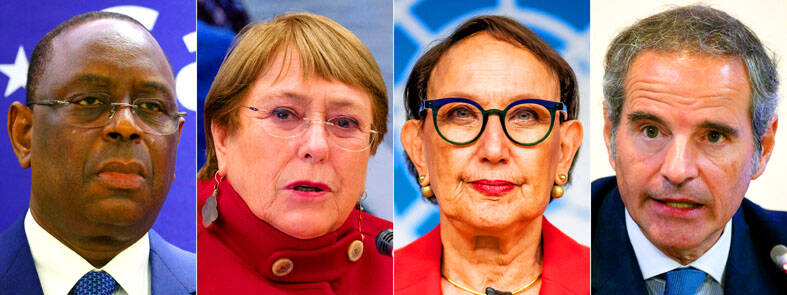
Four contenders are squaring up to succeed Antonio Guterres as secretary-general of the UN, which faces unprecedented global instability, wars and its own crushing budget crisis. Chile’s Michelle Bachelet, Argentina’s Rafael Grossi, Costa Rica’s Rebeca Grynspan and Senegal’s Macky Sall are each to face grillings by 193 member states and non-governmental organizations for three hours today and tomorrow. It is only the second time the UN has held a public question-and-answer, a format created in 2016 to boost transparency. Ultimately the five permanent members of the UN’s top body, the Security Council, hold the power, wielding vetoes over who leads the

South Korea’s air force yesterday apologized for a 2021 midair collision involving two fighter jets, a day after auditors said the pilots were taking selfies and filming during the flight and held them responsible for the accident. “We sincerely apologize to the public for the concern caused by the accident that occurred in 2021,” an air force spokesman told a news conference, adding that one of the pilots involved had been suspended from flying duties, received severe disciplinary action and has since left the military. The apology followed a report released on Wednesday by the South Korean Board of Audit and Inspection,

An earthquake registering a preliminary magnitude of 7.7 off northern Japan on Monday prompted a short-lived tsunami alert and the advisory of a higher risk of a possible mega-quake for coastal areas there. The Cabinet Office and the Japan Meteorological Agency said there was a 1% chance for a mega-quake, compared to a 0.1% chance during normal times, in the next week or so following the powerful quake near the Chishima and Japan trenches. Officials said the advisory was not a quake prediction but urged residents in 182 towns along the northeastern coasts to raise their preparedness while continuing their daily lives. Prime

About 240 Indians claiming descent from a Biblical tribe landed at Tel Aviv airport on Thursday as part of a government operation to relocate them to Israel. The newcomers passed under a balloon arch in blue and white, the colors of the Israeli flag, as dozens of well-wishers welcomed them with a traditional Jewish song. They were the first “bnei Menashe” (“sons of Manasseh”) to arrive in Israel since the government in November last year announced funding for the immigration of about 6,000 members of the community from the states of Manipur and Mizoram in northeast India. The community claims to descend from


 RSS
RSS