


When Japanese brewing giant Kirin called time on its Burmese operations last month, the news made little difference to Kyaw Gyi — like many drinkers, he had long boycotted the beer it produced with a military conglomerate.
For years, Myanmar Beer dominated bars and supermarket shelves, its Japanese backing a sign of the economic liberalization washing into the Southeast Asian nation after the military relaxed its iron grip on power in 2011, but after the generals ousted Aung San Suu Kyi’s civilian government in February last year, many turned their backs on the brew, along with a host of other goods made by companies linked to the armed forces, from soap to coffee.
“We know other beer brands are paying tax to the military, but we don’t want all of our money going to them,” said sailor Kyaw Gyi, sitting outside a bar on Yangon’s 19th Street, a popular drinking haunt. “We avoid it. If there is only Myanmar Beer in the restaurant, then we don’t drink beer.”
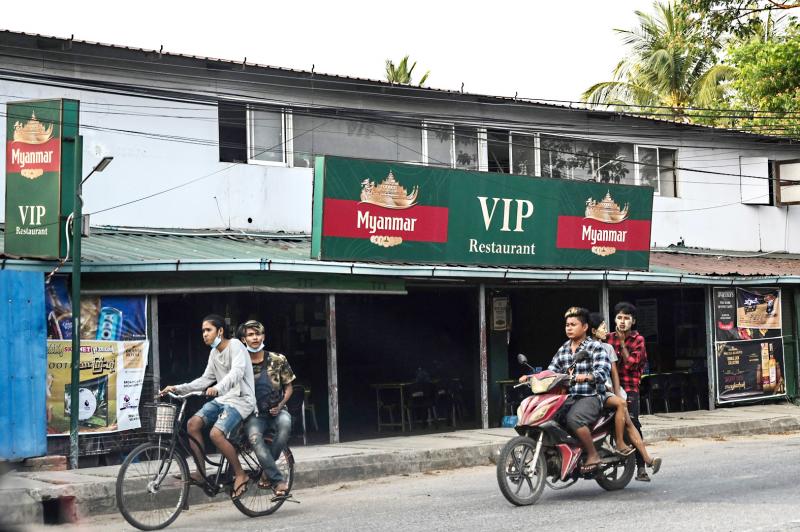
Photo: AFP
Farther along the street in Yangon’s bustling downtown, restaurant manager Zaw Naing said that his establishment had not sold the light, 5 percent brew since April last year.
It was not just the beer orders they had canceled, he added — they also asked the brand to take back all the chairs, tables and umbrellas that bore its red, white and gold emblem.
“If people see the Myanmar Beer logo with our restaurant name, they won’t come,” he said.
As anger seethes at the military’s crackdown on dissent — which a local monitoring group says has killed more than 1,700 people — establishments still serving the beer have faced more serious consequences.
Bombs were set off last month outside two Yangon bars and a restaurant in second city Mandalay that were still selling the beer, local media reported.
Drivers transporting the beer in the rural central plains have also been stopped by local anti-coup groups and their cargoes trashed, the reports said.
Myanmar Brewery — the firm run by Kirin and military conglomerate Myanma Economic Holdings — had enjoyed a market share of nearly 80 percent, according to data published by Kirin in 2018.
Following months of COVID-19 and coup-related disruption last year, its year-end operating profit was just ¥6.6 billion (US$53.8 million) — compared with ¥13.8 billion the previous year.
In February, after months of trying to dissolve its partnership with the military-backed firm, and as pressure from rights groups escalated, the Japanese giant announced it would leave Myanmar.
The boycott and its upcoming exit is leaving rivals Heineken, Carlsberg and Thailand’s Chang eyeing a gap in the market.
The three breweries “have picked up market share from Myanmar Beer, particularly in the cities,” said a Yangon-based market observer who did not want to be named.
A representative for Heineken who requested anonymity said that it was “too early to assess and comment on consumer purchasing habits.”
Back on 19th Street, Aung Myo said that customers had long switched to beers untainted by connections to military-backed firms, such as Chang, Tiger — owned by Heineken — and Carlsberg’s Tuborg.
“People don’t want to drink Myanmar Beer even though it tastes good,” he said. “Demand is definitely down.”
In Myanmar’s complex political landscape, there are still some areas where punters can enjoy a Myanmar Beer in peace.
Crowded bars in the military-built capital, Naypyidaw, were still serving it on a recent Saturday night, and the brew is reportedly still available in further-flung rural areas that have seen little coup-related violence.
The boycott has also been rebuffed in Rakhine state, where a truce between the junta and Arakan Army rebels fighting for greater autonomy has insulated the state from the turmoil gripping much of the rest of Myanmar.
“We don’t see any boycott movement here,” said government employee Htun Htun, 28, at a bar in the state capital, Sittwe, where billboards for the beer still lined the streets. “So, we keep drinking it... The alcohol rate is not too high and the taste is good.”
While the current peace lasts, Nyi Nyi, 27, said that he would not be looking to change.
“If there’s no problem with the military, we will still choose our usual Myanmar Beer,” he said.
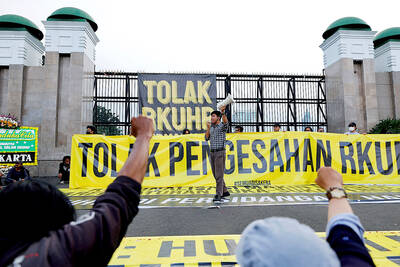
Indonesia yesterday began enforcing its newly ratified penal code, replacing a Dutch-era criminal law that had governed the country for more than 80 years and marking a major shift in its legal landscape. Since proclaiming independence in 1945, the Southeast Asian country had continued to operate under a colonial framework widely criticized as outdated and misaligned with Indonesia’s social values. Efforts to revise the code stalled for decades as lawmakers debated how to balance human rights, religious norms and local traditions in the world’s most populous Muslim-majority nation. The 345-page Indonesian Penal Code, known as the KUHP, was passed in 2022. It
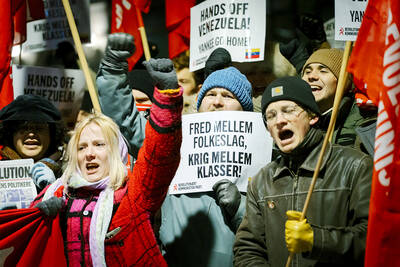
‘DISRESPECTFUL’: Katie Miller, the wife of Trump’s most influential adviser, drew ire by posting an image of Greenland in the colors of the US flag, captioning it ‘SOON’ US President Donald Trump on Sunday doubled down on his claim that Greenland should become part of the US, despite calls by the Danish prime minister to stop “threatening” the territory. Washington’s military intervention in Venezuela has reignited fears for Greenland, which Trump has repeatedly said he wants to annex, given its strategic location in the arctic. While aboard Air Force One en route to Washington, Trump reiterated the goal. “We need Greenland from the standpoint of national security, and Denmark is not going to be able to do it,” he said in response to a reporter’s question. “We’ll worry about Greenland in
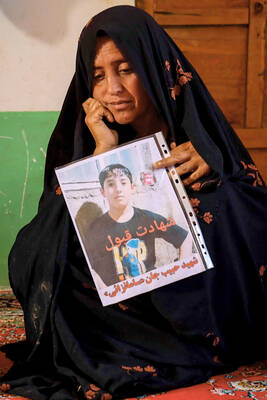
PERILOUS JOURNEY: Over just a matter of days last month, about 1,600 Afghans who were at risk of perishing due to the cold weather were rescued in the mountains Habibullah set off from his home in western Afghanistan determined to find work in Iran, only for the 15-year-old to freeze to death while walking across the mountainous frontier. “He was forced to go, to bring food for the family,” his mother, Mah Jan, said at her mud home in Ghunjan village. “We have no food to eat, we have no clothes to wear. The house in which I live has no electricity, no water. I have no proper window, nothing to burn for heating,” she added, clutching a photograph of her son. Habibullah was one of at least 18 migrants who died
Russia early yesterday bombarded Ukraine, killing two people in the Kyiv region, authorities said on the eve of a diplomatic summit in France. A nationwide siren was issued just after midnight, while Ukraine’s military said air defenses were operating in several places. In the capital, a private medical facility caught fire as a result of the Russian strikes, killing one person and wounding three others, the State Emergency Service of Kyiv said. It released images of rescuers removing people on stretchers from a gutted building. Another pre-dawn attack on the neighboring city of Fastiv killed one man in his 70s, Kyiv Governor Mykola


 RSS
RSS