


Millions of workers yesterday began a nationwide two-day strike across India to express their anger at the government’s economic policies and to back demands for improved rights for industrial workers, employees and farmers.
About a dozen of the country’s labor unions that have organized the strike want the government to provide universal social security cover for workers in the vast unorganized sector, hike the minimum wage under its flagship employment guarantee program and stop the privatization of public sector banks.
The strikers are also demanding the government halt its plans to monetize state assets.
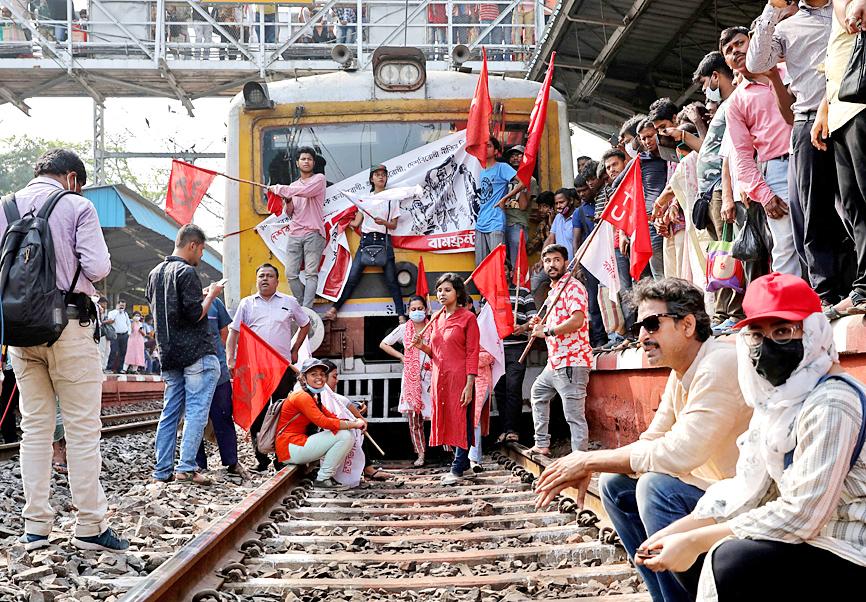
Photo: Reuters
Indian Prime Minister Narendra Modi’s government says privatizing some state-owned banks would overhaul the banking industry and that the asset monetization model would help raise money to spur economic growth.
All Indian Trade Union Congress, one of the largest trade unions in the country, said it was expecting more than 200 million formal and informal workers to join the strike. Demonstrations were planned in New Delhi, Mumbai, Kolkata and other major cities.
The Bharatiya Mazdoor Sangh, an important trade union affiliated with the ruling Bharatiya Janata Party, said it would not be participating in the strike, calling it “politically motivated.”
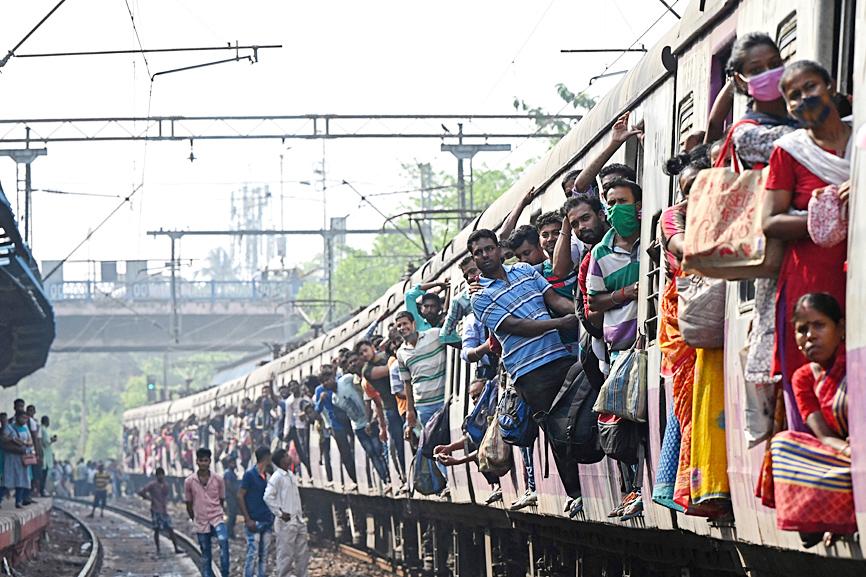
Photo: AFP
Essential services related to banking, transportation, railways and electricity are likely to be affected in several states due to the strike.
A number of public sector banks, including India’s largest lender, the state-run State Bank of India, have said that banking services might be affected because many employees are expected to participate in the strike.
India’s economy has bounced back after experiencing a major blow during the first two years of the COVID-19 pandemic, but many jobs have disappeared, with the unemployment rate rising to 8 percent in December last year.
Modi’s government last year grappled with huge farmer protests that demanded a complete repeal of the controversial agriculture laws it had billed as necessary reforms.

An American scientist convicted of lying to US authorities about payments from China while he was at Harvard University has rebuilt his research lab in Shenzhen, China, to pursue technology the Chinese government has identified as a national priority: embedding electronics into the human brain. Charles Lieber, 67, is among the world’s leading researchers in brain-computer interfaces. The technology has shown promise in treating conditions such as amyotrophic lateral sclerosis and restoring movement in paralyzed people. It also has potential military applications: Scientists at the Chinese People’s Liberation Army have investigated brain interfaces as a way to engineer super soldiers by boosting

Indonesian police have arrested 13 people after shocking images of alleged abuse against small children at a daycare center went viral, sparking outrage across the nation, officials said on Monday. Police on Friday last week raided Little Aresha, a daycare center in Yogyakarta on Java island, following a report from a former employee. CCTV footage circulating on social media showed children, most younger than two, lying on the floor wearing only diapers, their hands and feet bound with rags. The police have confirmed that the footage is authentic. Police said they also found 20 children crammed into a room just 3m by 3m. “So
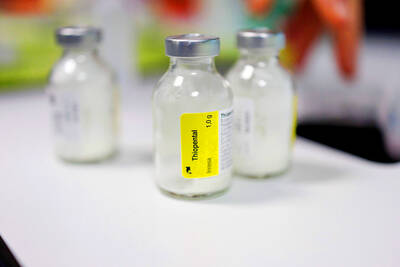
A grieving mother has ended her life at a clinic in Switzerland four years after the death of her only child. Wendy Duffy, 56, a physically healthy woman, died at the Pegasos clinic in Basel after struggling to cope with the death of her 23-year-old son, Marcus. The former care worker, from the West Midlands, England, had previously attempted to take her own life. The case comes as assisted dying would not become law in England and Wales after proposed legislation, branded “hopelessly flawed” by opponents, ran out of time. Ruedi Habegger, the founder of Pegasos, described Duffy’s death as
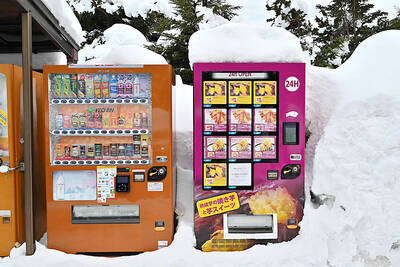
From post offices and parks to stations and even the summit of Mount Fuji, Japan’s vending machines are ubiquitous, but with the rapid pace of inflation cooling demand for their drinks, operators are being forced to rethink the business. Last month beverage giant DyDo Group Holdings announced it would remove about 20,000 vending machines — about 7 percent of their stock nationwide — by January next year, to “reconstruct a profitable network.” Pokka Sapporo Food & Beverage, based in Nagoya, also said last month it would sell its 40,000-machine operation to Osaka-based Lifedrink Co. “The strength of the vending machine


 RSS
RSS