


Even as authorities lock down cities in China’s worst COVID-19 outbreak in two years, they are looking for an exit from what has been an arguably successful, but onerous disease prevention strategy.
A statement by Chinese President Xi Jinping (習近平), a study, interviews with Chinese public health staff and public messaging by government-affiliated experts indicate that China is exploring ways of slowly easing its zero-tolerance approach — with the emphasis on slowly.
China would “strive to achieve the maximum prevention and control effect at the least cost and minimize the impact of the epidemic on economic and social development,” Xi told a meeting of the Chinese Communist Party Politburo Standing Committee late on Thursday.

Photo: AFP
It was the first time that Xi has emphasized minimizing the economic cost of disease prevention measures at a politburo meeting since the start of the COVID-19 pandemic in 2020.
The statement followed an essay published on Monday by Shanghai Huashan Hospital infectious diseases director Zhang Wenhong (張文宏) — who state media have described as “China’s Fauci,” after US National Institute of Allergy and Infectious Diseases Director Anthony Fauci.
Zhang wrote in the business magazine Caixin that the public needs to know that the virus is becoming less deadly if people are vaccinated and their health is not compromised.
“Dispelling the terror toward it is a step we must take,” he wrote. “We should carve a very clear path and not spend all our time debating whether we should continue zero COVID-19 or coexist” with the virus.
Change does not appear imminent, with more than 15,000 new cases this month in multiple outbreaks across the country.
For now, the Chinese government is sticking with the policy of lockdowns, repeated mass testing of millions of people and a two-week or more quarantine for overseas arrivals.
When it does come, any change would all but certainly be gradual and cautious.
Opening up carries risks, because the country’s success in protecting people from COVID-19 means many do not have antibodies to fight the virus from previous infection.
Moreover, China is using only domestically developed COVID-19 vaccines that are less effective than those developed by drugmakers in other countries.
“Given the still relatively low infection rate, the lack of the natural immunity and also the ineffectiveness of the vaccines in preventing infections, this is guaranteed to invite another wave of attack,” said Yanzhong Huang (黃嚴忠), a senior fellow for global health at the US Council on Foreign Relations think tank.
Additional reporting by Bloomberg
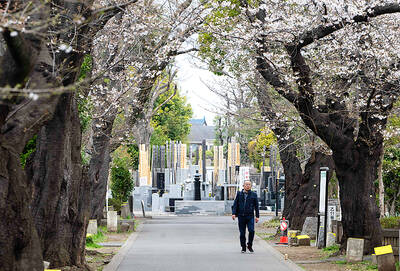
ROCKY RELATIONS: The figures on residents come as Chinese tourist numbers drop following Beijing’s warnings to avoid traveling to Japan The number of Chinese residents in Japan has continued to rise, even as ties between the two countries have become increasingly fractious, data released on Friday showed. As of the end of December last year, the number of Chinese residents had increased by 6.5 percent from the previous year to 930,428. Chinese people accounted for 22.6 percent of all foreign residents in Japan, making them by far the largest group, Japanese Ministry of Justice data showed. Beijing has criticized Tokyo in increasingly strident terms since Japanese Prime Minister Sanae Takaichi last year suggested that a military conflict around Taiwan could

A retired US colonel behind a privately financed rocket launch site in the Dominican Republic sees the project as a response to China’s dominance of the space race in Latin America. Florida-based Launch on Demand is slated to begin building a US$600 million facility in a remote region near the border with Haiti late this year. The project is designed to meet surging demand for the heavy-lift rockets needed to put clusters of satellites into orbit. It is also an answer to China’s growing presence in the region, said CEO Burton Catledge, a former commander of the US Air Force’s 45th Operations

Germany is considering Australia’s Ghost Bat robot fighter as it looks to select a combat drone to modernize its air force, German Minister of Defense Boris Pistorius said yesterday. Germany has said it wants to field hundreds of uncrewed fighter jets by 2029, and would make a decision soon as it considers a range of German, European and US projects developing so-called “collaborative combat aircraft.” Australia has said it will integrate the Ghost Bat, jointly developed by Boeing Australia and the Royal Australian Air Force, into its military after a successful weapons test last year. After inspecting the Ghost Bat in Queensland yesterday,
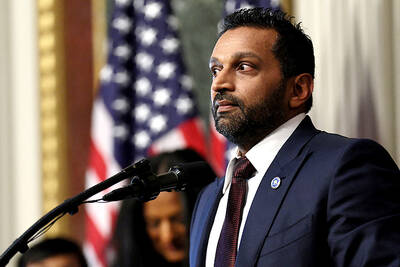
A pro-Iran hacking group claimed to breach FBI Director Kash Patel’s personal e-mail inbox and posted some of the contents online. The e-mails provided by the hacking group include travel details, correspondence with leasing agents in Washington and global entry, and loyalty account numbers. The e-mail address the hackers claim to have compromised has been previously tied to Patel’s personal details, and the leaked e-mails contain photos of Patel and others, in addition to correspondence with family members and colleagues. “The FBI is aware of malicious actors targeting Director Patel’s personal email information,” the agency said in a statement on


 RSS
RSS