


Residents in Fukushima and Miyagi prefectures were yesterday cleaning their homes after a sleepless night following a magnitude 7.4 earthquake that struck off Japan’s northern coasts, smashing furniture, knocking out power and killing four people.
The region is part of an area devastated by a deadly magnitude 9 earthquake and tsunami 11 years ago that caused nuclear reactor meltdowns, spewing massive radiation that still makes some parts uninhabitable.
Japanese Chief Cabinet Secretary Hirokazu Matsuno yesterday morning told reporters that four people died during the quake and the cause of their deaths are being investigated, while 107 people were injured.
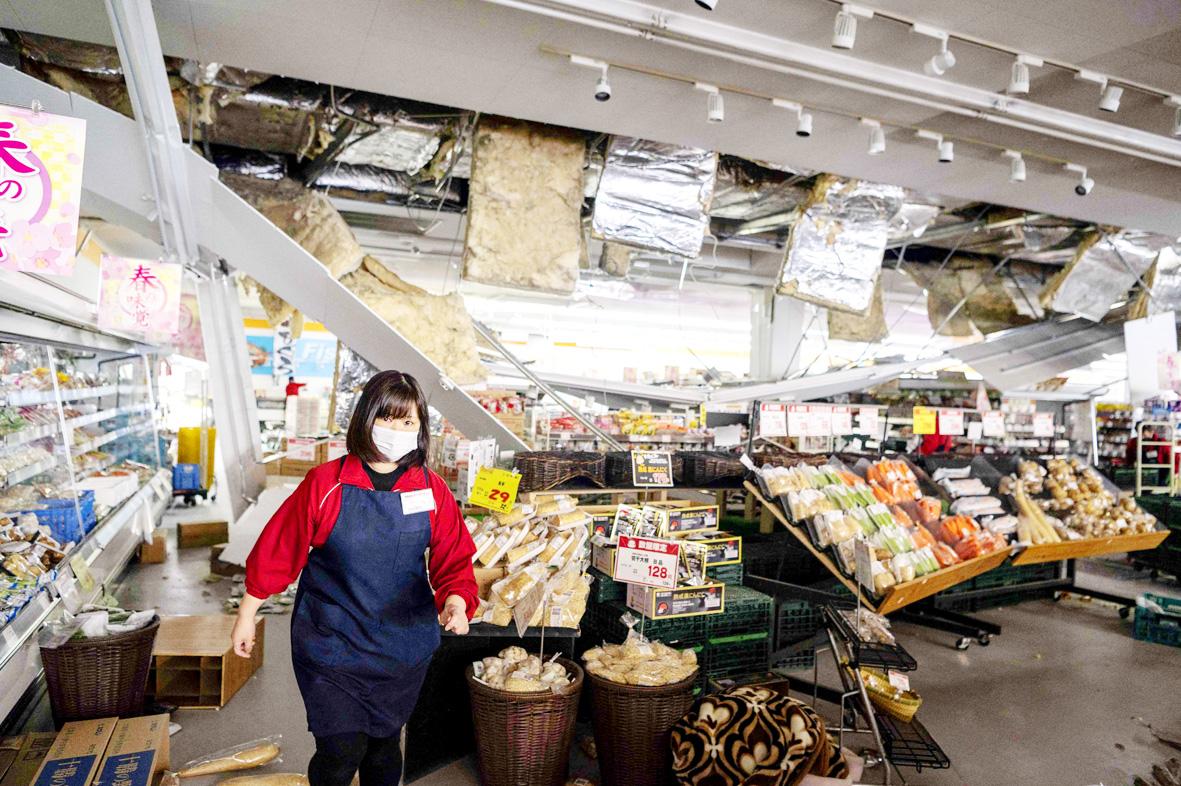
Photo: AFP
A man in his 60s in Soma died after falling from the second floor of his house while trying to evacuate, and a man in his 70s died of a heart attack, Kyodo News reported earlier.
The Japan Meteorological Agency early yesterday lifted its low-risk advisory for a tsunami along the coasts of Fukushima and Miyagi. Tsunami waves as high as 30cm reached Ishinomaki, about 390km northeast of Tokyo.
The agency upgraded the magnitude of the quake to 7.4 from 7.3, and the depth from 60km below the sea to 56km.
Residents in hard-hit areas found new damage in daylight yesterday, cleaning their homes, putting fallen furniture and appliances back into place, and scooping up broken dishes and windows.
At a hotel in Yabuki in Fukushima, where its wall was broken, front door thrown out of place and dishes were broken, employees were starting to clean up.
“I don’t even know where to start,” hotel president Mineyuki Otake told NHK.
NHK footage showed broken walls of a department store building that fell to the ground and shards of windows scattered on the street near the main train station in the inland prefectural capital of Fukushima city. Roads were cracked and water poured out from pipes underground.
Self-Defense Forces yesterday delivered fresh water to residents in Soma, Iitate and several other coastal towns in Fukushima where water systems were damaged.
Footage also showed furniture and appliances smashed to the floor at apartments in Fukushima. Cosmetics and other merchandise at convenience stores fell from shelves and scattered on the floor.
In Yokohama, near Tokyo, an electric pole nearly fell.
Tokyo Electric Power, which operates the Fukushima Dai-ichi nuclear power plant where the cooling systems failed after the 2011 disaster, yesterday said that workers at the site — which is being decommissioned — found some tanks holding treated radioactive water were out of alignment due to the rattling, and what could be a steel beam fell from a roof of the No. 4 reactor building, which has no fuel inside.
Japan’s Nuclear Regulation Authority said a fire alarm went off at the turbine building of No. 5 reactor at the Fukushima Dai-ichi plant, but there was no actual fire.
Water pumps for the spent fuel cooling pool at two of the four reactors at Fukushima Daini nuclear power plant briefly stopped, but later resumed operation. Fukushima Daini, which survived the 2011 tsunami, is also set for decommissioning.
More than 2.2 million homes were temporarily without electricity in 14 prefectures, including the Tokyo region, but power was restored at most places by the morning, except for about 37,000 homes in Fukushima and Miyagi, said Tohoku Electric Power, which services the region.
The quake shook large parts of eastern Japan, including Tokyo, where buildings swayed violently.
East Japan Railway said that most of its train services were suspended for safety checks. Many people formed long lines outside of major stations while waiting for trains to resume operation late on Wednesday, but trains in Tokyo operated normally yesterday morning.
A Tohoku Shinkansen express train partially derailed between Fukushima and Miyagi due to the earthquake, but nobody was injured, Japanese Prime Minister Fumio Kishida said.
“We are doing the utmost in rescue operations and putting people’s lives first,” Matsuno said.
He urged residents in the affected areas to use extra caution for possible major aftershocks for about a week.

MONEY MATTERS: Xi was to highlight projects such as a new high-speed railway between Belgrade and Budapest, as Serbia is entirely open to Chinese trade and investment Serbian President Aleksandar Vucic yesterday said that “Taiwan is China” as he made a speech welcoming Chinese President Xi Jinping (習近平) to Belgrade, state broadcaster Radio Television of Serbia (RTS) said. “We have a clear and simple position regarding Chinese territorial integrity,” he told a crowd outside the government offices while Xi applauded him. “Yes, Taiwan is China.” Xi landed in Belgrade on Tuesday night on the second leg of his European tour, and was greeted by Vucic and most government ministers. Xi had just completed a two-day trip to France, where he held talks with French President Emmanuel Macron as the

With the midday sun blazing, an experimental orange and white F-16 fighter jet launched with a familiar roar that is a hallmark of US airpower, but the aerial combat that followed was unlike any other: This F-16 was controlled by artificial intelligence (AI), not a human pilot, and riding in the front seat was US Secretary of the Air Force Frank Kendall. AI marks one of the biggest advances in military aviation since the introduction of stealth in the early 1990s, and the US Air Force has aggressively leaned in. Even though the technology is not fully developed, the service is planning
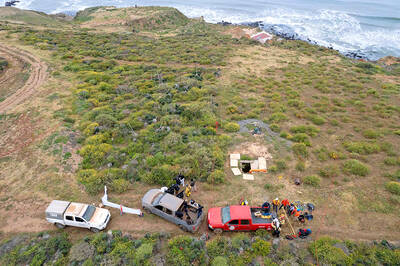
INTERNATIONAL PROBE: Australian and US authorities were helping coordinate the investigation of the case, which follows the 2015 murder of Australian surfers in Mexico Three bodies were found in Mexico’s Baja California state, the FBI said on Friday, days after two Australians and an American went missing during a surfing trip in an area hit by cartel violence. Authorities used a pulley system to hoist what appeared to be lifeless bodies covered in mud from a shaft on a cliff high above the Pacific. “We confirm there were three individuals found deceased in Santo Tomas, Baja California,” a statement from the FBI’s office in San Diego, California, said without providing the identities of the victims. Australian brothers Jake and Callum Robinson and their American friend Jack Carter
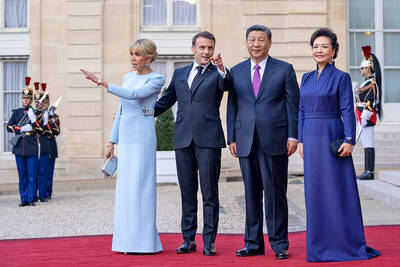
CUSTOMS DUTIES: France’s cognac industry was closely watching the talks, fearing that an anti-dumping investigation opened by China is retaliation for trade tensions French President Emmanuel Macron yesterday hosted Chinese President Xi Jinping (習近平) at one of his beloved childhood haunts in the Pyrenees, seeking to press a message to Beijing not to support Russia’s war against Ukraine and to accept fairer trade. The first day of Xi’s state visit to France, his first to Europe since 2019, saw respectful, but sometimes robust exchanges between the two men during a succession of talks on Monday. Macron, joined initially by EU Commission President Ursula von der Leyen, urged Xi not to allow the export of any technology that could be used by Russia in its invasion


 RSS
RSS