


India has eased its COVID-19 rules on testing, quarantine and hospital admissions in a bid to free up resources for its neediest people, a strategy hailed by experts even though it carries the risk of a heavy undercount of infections and deaths.
The moves offer breathing space for healthcare facilities, often overstretched in a far-flung nation of 1.4 billion, as they battle a 33-fold surge in infections over the past month from the highly contagious Omicron variant of SARS-CoV-2.
This week, federal authorities told states to drop mandatory testing for contacts of confirmed cases unless they were old or battling other conditions, while halving the isolation period to a week and advising hospital care only for the seriously ill.
“Contact tracing has been the most resource-intensive activity since the pandemic began,” said Sanjay Rai, a professor of community medicine at the All-India Institute of Medical Sciences in New Delhi, the capital.
“That strategy did not work and wasted resources,” he added, saying serological surveys had shown it had detected only a fraction of infections.
India’s tally of infections crossed 36 million yesterday with 247,417 new cases, although daily testing has stayed well below the capacity of more than 2 million.
Four Indian epidemiologists echoed Rai’s view, saying it was better to monitor the numbers of those in hospital rather than infections, while targeting crowded spaces such as workplaces, dormitories and barracks with rapid testing.
They added that the guidelines on shorter isolation and hospital admissions are in line with global practice, as most Omicron sufferers recover quicker, although they spread the virus faster.
However, some experts said that the new rules could lull people into taking infections lightly until it is too late, especially in the rural areas home to two-thirds of the population, where few seek tests unless directed by authorities.
“This new strategy will affect data from rural India or certain states in a disproportionate way,” University of Michigan professor of epidemiology Bhramar Mukherjee said.
“It will be harder to predict upcoming hotspots and epicenters,” she added, which would leave authorities less time to marshal resources against the disease.
It would also affect the tracking of COVID-19 deaths, an effort Mukherjee said was “already highly imperfect and under-reported.”
Health experts have said that India massively undercounts infections, with its death toll outstripping the official figure of about 485,000, as few victims of earlier waves, chiefly in rural areas, learned of their condition until the last moment.
India’s best healthcare facilities are clustered in major cities, while poor people across vast swathes of the country have to rely on dilapidated government networks.
For example, government-run district hospitals in the sprawling mineral-rich state of Bihar struggle with one of India’s worst ratios of medical staff to patients, while New Delhi is staffed at more than twice the national average.
There was no shortage of test kits, with thousands of people having bought kits in the past week, Indian Council of Medical Research director-general Balram Bhargava said on Wednesday, but did not say if rural areas were as well supplied as urban areas.
Some Indian states have decided to ignore the new testing guidelines as they are not bound by them.
The state of Karnataka, home to the southern technology hub of Bengaluru, has reported India’s third-highest tally of infections, and plans to continue tests for close contacts of the infected.
A survey published this week by New Delhi-based Web site LocalCircles found that 15 percent of respondents knew of at least one family member or friend who did not get tested, despite showing symptoms similar to COVID-19 in the past month.
It said the gap between actual and reported daily cases would widen when the virus reaches smaller towns and villages.

When a hiker fell from a 55m waterfall in wild New Zealand bush, rescuers were forced to evacuate the badly hurt woman without her dog, which could not be found. After strangers raised thousands of dollars for a search, border collie Molly was flown to safety by a helicopter pilot who was determined to reunite the pet and the owner. A week earlier, an emergency rescue helicopter found the woman with bruises and lacerations after a fall at a rocky spot at the waterfall on the South Island’s West Coast. She was airlifted on March 24, but they were forced to
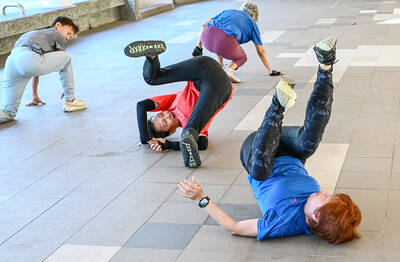
CONFIDENCE BOOSTER: ’After parkour ... you dare to do a lot of things that you think only young people can do,’ a 67-year-old parkour enthusiast said In a corner of suburban Singapore, Betty Boon vaults a guardrail, crawls underneath a slide, executes forward shoulder rolls and scales a steep slope, finishing the course to applause. “Good job,” the 69-year-old’s coach cheers. This is “geriatric parkour,” where about 20 retirees learned to tackle a series of relatively demanding exercises, building their agility and enjoying a sense of camaraderie. Boon, an upbeat grandmother, said learning parkour has aided her confidence and independence as she ages. “When you’re weak, you will be dependent on someone,” she said after sweating it out with her parkour classmates in suburban Toa Payoh,
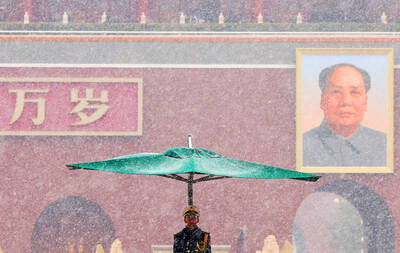
Chinese dissident artist Gao Zhen (高兟), famous for making provocative satirical sculptures of former Chinese leader Mao Zedong (毛澤東), was tried on Monday over accusations of “defaming national heroes and martyrs,” his wife and a rights group said. Gao, 69, who was detained in 2024 during a visit from the US, faces a maximum three-year prison sentence, said his wife, Zhao Yaliang (趙雅良), and Shane Yi, a researcher at the Chinese Human Rights Defenders group which operates outside the nation. The closed-door, one-day trial took place at Sanhe City People’s Court in Hebei Province neighboring the capital, Beijing, and ended without a
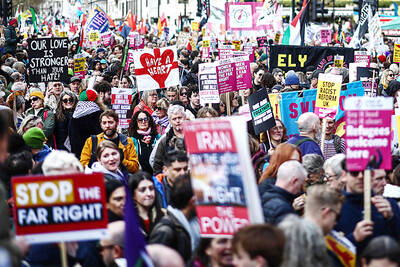
‘TOXIC CLIMATE’: ‘I don’t really recognize Labour anymore... The idea that you can implement far-right ideas in order to stop the far right is nonsense,’ a protester said Tens of thousands of people on Saturday marched through central London to protest against the far right, weeks ahead of local elections and six months after Britain saw one of its largest far-right demonstrations. Organized by hundreds of civic groups, including trade unions, anti-racism campaigners and Muslim representative bodies, Saturday’s Together Alliance event was billed as the biggest in UK history to counter right-wing extremism. A separate pro-Palestinian march had also converged with the main rally. While organizers claimed 500,000 had turned out in total, the police gave a figure of about 50,000. Protesters carrying placards with slogans such as


 RSS
RSS