


A wind turbine sitting idle on a calm day or spinning swiftly when power demand is already met poses a problem for renewables, and is one researchers think can be tackled under the sea.
In one vision, offshore wind farms could use seawater to essentially store energy until it is needed, helping wean humanity off fossil fuels.
“We came up with a solution that we call the ocean battery,” Frits Bliek, CEO of Dutch start-up Ocean Grazer, said while showing off the system at the Consumer Electronics Show in Las Vegas.
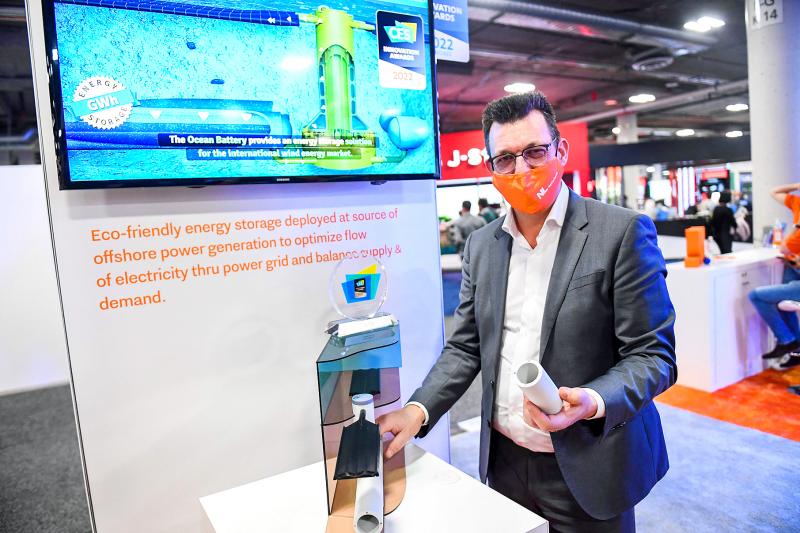
Photo: AFP
Amid the growing push away from climate-warming energy sources such as coal, stockpiling green energy is key, experts say.
That is because nature does not always deliver wind — or sun — at the moment when electricity is most in demand.
Bliek’s “ocean battery” relies on massive flexible bladders on the seabed, which are filled with seawater by the wind farm.
When the power is needed, the pressure of the ocean squeezes the water through the system on the seafloor that includes turbines — and the result is electricity.
A key consideration with energy is cost, and storage systems involving some type of battery are not only very expensive, but also at risk of leaks or contamination in an ocean environment.
Systems that rely on pressure are already used in hydroelectric dams that pump water into the reservoir behind the dam when electricity demand falls, effectively storing it to come back through the facility’s turbines.
The US Department of Energy traces the concept, called “pumped storage hydropower,” to Italy and Switzerland in the 1890s, although facilities can be found all around the world.
As for the underwater version of this type of storage, Ocean Grazer is not alone in trying to make it work.
FLASC, a spin-off of the University of Malta, has a system that uses renewably made electricity to pump water into a chamber that contains under-pressure air, which can then turn a hydraulic turbine to generate power.
Another initiative called StEnSea (Stored energy in the sea), uses hollow concrete spheres under the pressure of the deep ocean, and was tested in a German lake in 2016.
Bliek, the Ocean Grazer CEO, said undersea systems take advantage of the pressure below the ocean that is free, while creating a system that he said is about 80 percent efficient in storing energy.
He sees storage systems as key for renewables, which have boomed as the price to produce such energy has dropped and made them a steadily growing part of the energy mix worldwide.
Renewables are the fastest-growing source in the US, increasing 42 percent from 2010 to 2020, according to the nonprofit Center for Climate and Energy Solutions.
Deploying systems like the “ocean battery” on the scale needed to work as part of an electricity grid is still years away.
Bliek said his company aims to have an offshore system in place by 2025, although one will be deployed onshore in the northern Netherlands by next year.
Although various aspects of energy storage through pressure are not new, the pairing of it with green energy sources carries significant potential.
“With wind and solar now becoming part of the grid — basically allowing us to get rid of fossil fuels — in that context this is very exciting,” said Claudio Canizares, an engineering professor and renewables expert at the University of Waterloo in Canada.

FEROCIOUS FISH-EATER Scientists have found a new species of dinosaur from the Cretaceous Period, a ‘hell heron’ that stalked the rivers, deep in the Saharan desert At a remote Sahara desert site in Niger, scientists have unearthed fossils of a new species of Spinosaurus, among the biggest of the meat-eating dinosaurs, notable for its large blade-shaped head crest and jaws bearing interlocking teeth for snaring fish. It prowled a forested inland environment and strode into rivers to catch sizable fish like a modern-day wading bird — a “hell heron,” as one of the researchers put it, considering it was about 12 meters long and weighed 5-7 tons. The dinosaur presented a striking profile on the Cretaceous Period landscape of Africa some 95 million years ago as it hunted
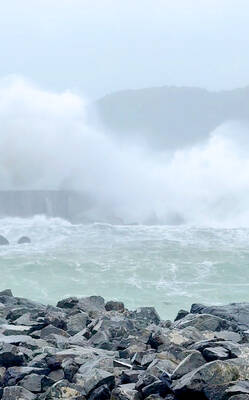
Heavy rain and strong winds yesterday disrupted flights, trains and ferries, forcing the closure of roads across large parts of New Zealand’s North Island, while snapping power links to tens of thousands. Domestic media reported a few flights had resumed operating by afternoon from the airport in Wellington, the capital, although cancelations were still widespread after airport authorities said most morning flights were disrupted. Air New Zealand said it hoped to resume services when conditions ease later yesterday, after it paused operations at Wellington, Napier and Palmerston North airports. Online images showed flooded semi-rural neighborhoods, inundated homes, trees fallen on vehicles and collapsed

‘COST OF DEFECTION’: Duterte’s announcement could be an effort to keep allies in line with the promise of a return to power amid political uncertainty, an analyst said Philippine Vice President Sara Duterte yesterday announced she would run for president of the Southeast Asian nation of 116 million in 2028. Duterte, who is embroiled in a bitter feud with Philippine President Ferdinand Marcos Jr, was impeached last year only to see the country’s Supreme Court throw the case out over procedural issues. Her announcement comes just days before her father, former Philippine president Rodrigo Duterte, begins a pretrial hearing at the International Criminal Court (ICC) in the Netherlands over crimes against humanity allegedly committed as part of a brutal crackdown on drugs. “I offer my life, my strength and my future

NOT YET THERE: While the show was impressive, it failed to demonstrate their ability to move in unstructured environments, such as a factory floor, an expert said Dancing humanoid robots on Monday took center stage during the annual China Media Group’s Spring Festival Gala, China’s most-watched official television broadcast. They lunged and backflipped (landing on their knees), they spun around and jumped. Not one fell over. The display was impressive, but if robots can now dance and perform martial arts, what else can they do? Experts have mixed opinions, with some saying the robots had limitations and that the display should be viewed through a lens of state propaganda. Developed by several Chinese robotics firms, the robots performed a range of intricate stunts, including martial arts, comedy sketches and choreographed


 RSS
RSS