


A Harvard University professor charged with hiding his ties to a Chinese-run recruitment program was found guilty on all counts on Tuesday.
Charles Lieber, 62, the former chair of Harvard’s Department of Chemistry and Chemical Biology, had pleaded not guilty to two counts of filing false tax returns, two counts of making false statements and two counts of failing to file reports for a foreign bank account in China.
The jury deliberated for about 2 hours, 45 minutes before announcing the verdict following five days of testimony in Boston federal court.
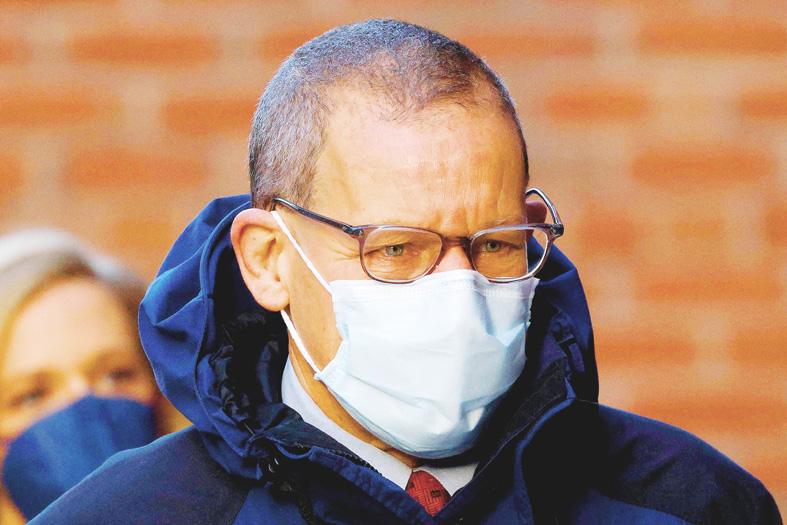
Photo: Reuters
Lieber’s defense attorney Marc Mukasey had argued that prosecutors lacked proof of the charges.
He said that investigators did not keep any record of their interviews with Lieber prior to his arrest.
He argued that prosecutors would be unable to prove that Lieber acted “knowingly, intentionally or willfully, or that he made any material false statement.”
Mukasey also said Lieber was not charged with illegally transferring any technology or proprietary information to China.
Prosecutors argued that Lieber, who was arrested in January, knowingly hid his involvement in China’s Thousand Talents Plan — a program designed to recruit people with knowledge of foreign technology and intellectual property to China — to protect his career and reputation.
Lieber denied his involvement during inquiries from US authorities, including the National Institutes of Health, which had provided him with millions of dollars in research funding, prosecutors said.
Lieber also concealed his income from the Chinese program, including US$50,000 a month from Wuhan University of Technology, up to US$158,000 in living expenses and more than US$1.5 million in grants, prosecutors said.
In exchange, Lieber agreed to publish articles, organize international conferences and apply for patents on behalf of the Chinese university, they said.

An American scientist convicted of lying to US authorities about payments from China while he was at Harvard University has rebuilt his research lab in Shenzhen, China, to pursue technology the Chinese government has identified as a national priority: embedding electronics into the human brain. Charles Lieber, 67, is among the world’s leading researchers in brain-computer interfaces. The technology has shown promise in treating conditions such as amyotrophic lateral sclerosis and restoring movement in paralyzed people. It also has potential military applications: Scientists at the Chinese People’s Liberation Army have investigated brain interfaces as a way to engineer super soldiers by boosting

Indonesian police have arrested 13 people after shocking images of alleged abuse against small children at a daycare center went viral, sparking outrage across the nation, officials said on Monday. Police on Friday last week raided Little Aresha, a daycare center in Yogyakarta on Java island, following a report from a former employee. CCTV footage circulating on social media showed children, most younger than two, lying on the floor wearing only diapers, their hands and feet bound with rags. The police have confirmed that the footage is authentic. Police said they also found 20 children crammed into a room just 3m by 3m. “So
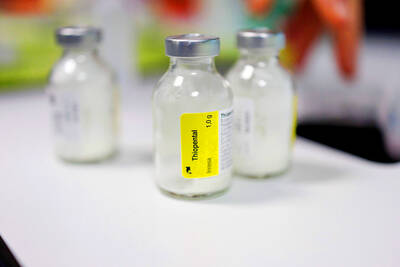
A grieving mother has ended her life at a clinic in Switzerland four years after the death of her only child. Wendy Duffy, 56, a physically healthy woman, died at the Pegasos clinic in Basel after struggling to cope with the death of her 23-year-old son, Marcus. The former care worker, from the West Midlands, England, had previously attempted to take her own life. The case comes as assisted dying would not become law in England and Wales after proposed legislation, branded “hopelessly flawed” by opponents, ran out of time. Ruedi Habegger, the founder of Pegasos, described Duffy’s death as
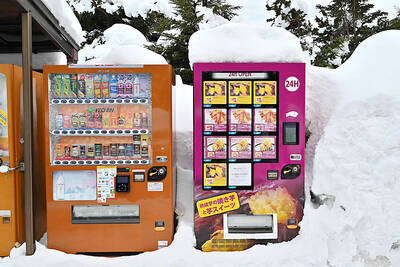
From post offices and parks to stations and even the summit of Mount Fuji, Japan’s vending machines are ubiquitous, but with the rapid pace of inflation cooling demand for their drinks, operators are being forced to rethink the business. Last month beverage giant DyDo Group Holdings announced it would remove about 20,000 vending machines — about 7 percent of their stock nationwide — by January next year, to “reconstruct a profitable network.” Pokka Sapporo Food & Beverage, based in Nagoya, also said last month it would sell its 40,000-machine operation to Osaka-based Lifedrink Co. “The strength of the vending machine


 RSS
RSS