


This summer, the Uffizi Gallery threatened to sue Pornhub for using its masterpieces in a “classic nudes” video.
“Some people think of museums as boring, stuffy or dull,” the adult streaming site wrote. “But what if we told you they housed a collection of priceless porn?”
The video re-enacted erotic scenes from art history using works including Botticelli’s Birth of Venus, housed in the Uffizi in Florence, Italy.
Pornhub swiftly took down the unauthorized nudes, prompting debate about who controls the copying of cultural artifacts that are long out of copyright and in the public domain.
Traditionally, museums have been protective of high-resolution versions of their works, charging stiff fees for photographs or venue hire. There are multiple reasons: protecting copyrights, preventing forgeries and controlling lucrative revenues from brand deals.
In 2019, the Uffizi made about 1 million euros (US$1.14 million) in revenue from the sale of photos of its collection. That year, global sales of licensed goods was US$293 billion, with the art and non-profit sectors seeing the highest growth.
Museums around the world are increasingly capitalizing on the intellectual property of their priceless pieces, in unexpected collaborations from luxury lingerie to KFC packaging. China is leading this area, with Beijing’s Palace Museum reportedly making US$222 million through product sales in 2018.
These deals offer a lifeline for cash-strapped attractions after COVID-19 triggered a plunge in visitor numbers. In London, the Victoria and Albert Museum’s (V&A) visitor count fell by 97 percent to 130,000, forcing it to cut opening hours to five days a week.
However, sales of licensed goods have rocketed, with homeware the best seller.
Since 2019, the Louvre in Paris has stepped up its licensing efforts, teaming up with DS Automobiles, the Swiss watchmaker Swatch and the macaron bakery Laduree.
The Louvre’s brand partnerships reportedly generated 4.5 million euros last year, compared with 2.7 million euros in 2019, according to Le Monde.
This year, it signed a four-year deal with Japanese retailer Uniqlo and launched a graphic T-shirt collection inspired by the Mona Lisa, Venus de Milo and Liberty Leading the People.
He Yizan (何一讚), cofounder of Shanghai-based intellectual property licensing agency Artistory said museums are turning to merchandise to tap Gen Z audiences, who are more likely to access museum content online, rather than in person. The aim is to make their archives familiar to all.
Artistory’s designers opt for creative mashups of the old masters.
“We never slap the paintings on to the products, instead we create original patterns inspired by artworks and share them on TikTok and livestreamed events,” he said. “We want to transform something ancient and boring into something modern and exciting.”
However, these corporate gigs have riled those who fear museums’ cultural heritage is under threat.
In 2019, the Louvre partnered with Airbnb on a competition to let one couple stay the night in its hallowed halls.
Then-Paris deputy mayor of housing Ian Brossat wrote to then-French minister of culture Franck Riester that “this use of a public institution for commercial purposes by a digital giant is a shocking political gesture.”
Brossat has campaigned to ban Airbnb in Paris’ city center, saying that they are pushing Parisians out of the housing market.
Others ask why galleries should be free to profit from art no longer bound by copyright, which in the UK and EU lasts until 70 years after the creator’s death.
Then, the work is freely available intellectual property, although in certain countries, such as France, museums can claim perpetual moral rights of an author’s work. This gives custodians the right of attribution and ability to take down damaging reproductions.
Grischka Petri, a lawyer and art historian at the University of Glasgow, said it is problematic that museums are acting as trustees of long-dead artists whose works are no longer in copyright.
“It becomes interesting from a copyright perspective when a museum wants to monopolize its public domain collections and prohibit reproductions,” Petri said.
He said museums risk being “hypocritical” if they promot the commercialization of their collection, while also banning usage by others for moral reasons.
“Many ancient artworks work in a soft pornographic way anyway,” Petri said.
In the past few years, as the Internet has led to an explosion of low-quality copies, institutions are rethinking their strategy.
The Rijksmuseum in Amsterdam allows audiences download high-resolution photographs of its collections that include Rembrandt, Vermeer and Van Gogh.
“If they want to have a Vermeer on their toilet paper, I’d rather have a very high-quality image than a very bad reproduction,” Rijksmuseum director of collections Taco Dibbits said.
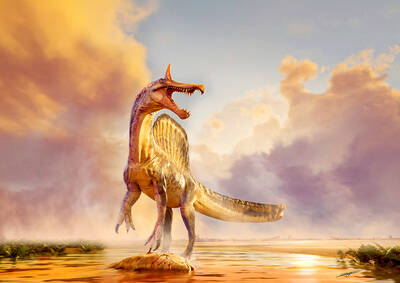
FEROCIOUS FISH-EATER Scientists have found a new species of dinosaur from the Cretaceous Period, a ‘hell heron’ that stalked the rivers, deep in the Saharan desert At a remote Sahara desert site in Niger, scientists have unearthed fossils of a new species of Spinosaurus, among the biggest of the meat-eating dinosaurs, notable for its large blade-shaped head crest and jaws bearing interlocking teeth for snaring fish. It prowled a forested inland environment and strode into rivers to catch sizable fish like a modern-day wading bird — a “hell heron,” as one of the researchers put it, considering it was about 12 meters long and weighed 5-7 tons. The dinosaur presented a striking profile on the Cretaceous Period landscape of Africa some 95 million years ago as it hunted
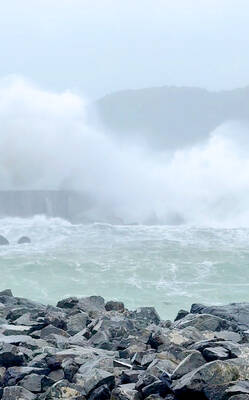
Heavy rain and strong winds yesterday disrupted flights, trains and ferries, forcing the closure of roads across large parts of New Zealand’s North Island, while snapping power links to tens of thousands. Domestic media reported a few flights had resumed operating by afternoon from the airport in Wellington, the capital, although cancelations were still widespread after airport authorities said most morning flights were disrupted. Air New Zealand said it hoped to resume services when conditions ease later yesterday, after it paused operations at Wellington, Napier and Palmerston North airports. Online images showed flooded semi-rural neighborhoods, inundated homes, trees fallen on vehicles and collapsed

‘COST OF DEFECTION’: Duterte’s announcement could be an effort to keep allies in line with the promise of a return to power amid political uncertainty, an analyst said Philippine Vice President Sara Duterte yesterday announced she would run for president of the Southeast Asian nation of 116 million in 2028. Duterte, who is embroiled in a bitter feud with Philippine President Ferdinand Marcos Jr, was impeached last year only to see the country’s Supreme Court throw the case out over procedural issues. Her announcement comes just days before her father, former Philippine president Rodrigo Duterte, begins a pretrial hearing at the International Criminal Court (ICC) in the Netherlands over crimes against humanity allegedly committed as part of a brutal crackdown on drugs. “I offer my life, my strength and my future
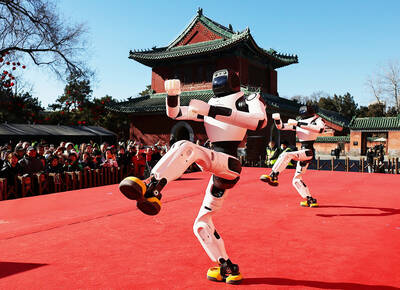
NOT YET THERE: While the show was impressive, it failed to demonstrate their ability to move in unstructured environments, such as a factory floor, an expert said Dancing humanoid robots on Monday took center stage during the annual China Media Group’s Spring Festival Gala, China’s most-watched official television broadcast. They lunged and backflipped (landing on their knees), they spun around and jumped. Not one fell over. The display was impressive, but if robots can now dance and perform martial arts, what else can they do? Experts have mixed opinions, with some saying the robots had limitations and that the display should be viewed through a lens of state propaganda. Developed by several Chinese robotics firms, the robots performed a range of intricate stunts, including martial arts, comedy sketches and choreographed


 RSS
RSS