


Sudan’s army chief on Thursday ordered the release of four civilian ministers detained since he led a military coup last month as international pressure mounted to restore the democratic transition.
The move by General Abdel Fattah al-Burhan came as the army said that the formation of a new government was “imminent.”
Burhan — Sudan’s de facto leader since the 2019 ouster of former Sudanese president Omar al-Bashir — last week dissolved the government, detained the civilian leadership, including Sudanese Prime Minister Abdalla Hamdok, and declared a state of emergency.
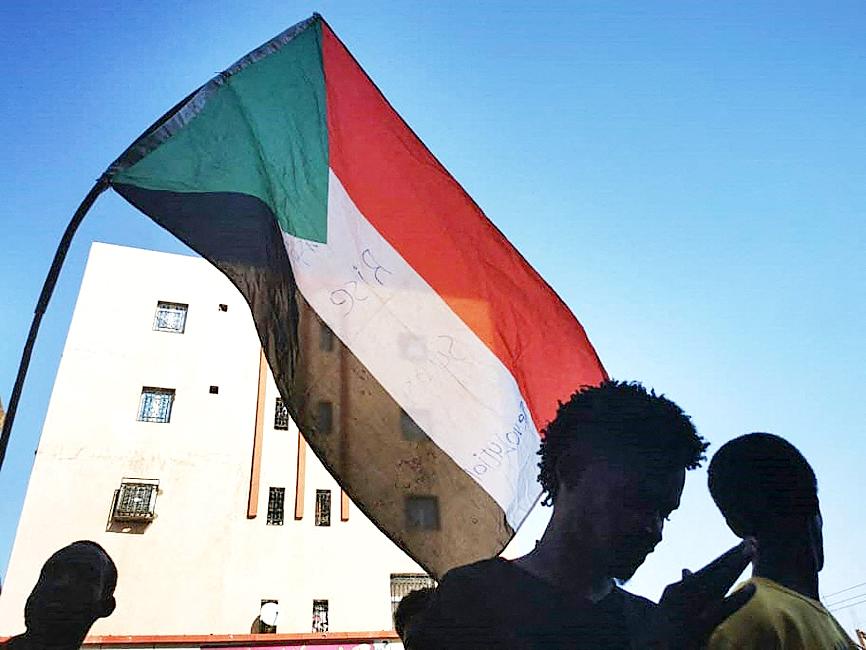
Photo: AFP
“We are considering all internal and external initiatives to serve the national interest,” said Taher Abouhaga, Burhan’s media adviser. “The government formation is imminent.”
Hours later, Sudan TV said that Burhan had ordered the release of four officials: Hashem Hassabalrasoul, Ali Geddo, Hamza Baloul and Youssef Adam.
Hassabalrasoul is telecommunications minister, Geddo heads the trade ministry, Baloul is information minister, and Adam holds the youth and sports portfolio.
It was not immediately clear when the ministers would be released.
The decision came shortly after a telephone call between Burhan and UN Secretary-General Antonio Guterres, who personally appealed to the head of the military to restore the democratic transition.
Guterres encouraged “all efforts towards resolving the political crisis in Sudan and urgently restoring the constitutional order and Sudan’s transitional process,” a UN statement said.
Later on Thursday, US Secretary of State Antony Blinken spoke with Burhan as well, calling for the “immediate restoration of the civilian-led government” and the release of all political figures detained since the coup, State Department spokesman Ned Price said in a statement.
Blinken also spoke with Hamdok, reiterating the “strong support of the United States for the Sudanese people who seek democracy,” Price said in a separate statement.
On Wednesday, Burhan met with African Union (AU) High Representative for the Horn of Africa Olusegun Obasanjo and said that “a government of technocrats was about to be appointed,” the Sudan News Agency said.
The AU suspended Sudan after the coup.
Western diplomats have called for Hamdok’s reinstatement, while Arab powerhouses such as Saudi Arabia and the United Arab Emirates urged the civilian-led transition to be restored.
South Sudanese presidential adviser Tut Gatluak, who heads a mediation delegation, said that the order to free the ministers came after separate meetings with Burhan and Hamdok, who remains under effective house arrest.
“We agreed that detainees would be released in batches,” Gatluak told reporters in Khartoum. “We called for all detainees to be released.”
Key figures have remained in detention, including sovereign council member Mohamed al-Fekki, Hamdok’s adviser Yasser Arman and minister of Cabinet affairs Khalid Omar Youssef.
Sudan has since August 2019 been ruled by a joint civilian-military council as part of the now derailed transition to full civilian rule.
Deepening splits between the military and civilians have marred the transition.
Gatluak said that negotiations were ongoing to form a government.
“Burhan has no problem with Hamdok returning to his position of prime minister, but he doesn’t want the situation to go back as before October 25,” the day of the coup, Gatlauk said. “Hamdok remains the first nominee for the head of Cabinet, but that’s in case he agrees.”
However, Hamdok, a British-educated economist who worked for the UN and AU, “wants the situation to go back as it was before October 25,” he said.
Burhan, a veteran general who served under al-Bashir, said that the army takeover was “not a coup,” but a move “to rectify the course of the transition.”
The army’s power grab sparked days of mass protest in cities across Sudan, with at least a dozen people killed as security forces opened fire, medics said.
On Thursday, small gatherings of protesters rallied in neighborhoods across Khartoum chanting: “Down with military rule.”

When a hiker fell from a 55m waterfall in wild New Zealand bush, rescuers were forced to evacuate the badly hurt woman without her dog, which could not be found. After strangers raised thousands of dollars for a search, border collie Molly was flown to safety by a helicopter pilot who was determined to reunite the pet and the owner. A week earlier, an emergency rescue helicopter found the woman with bruises and lacerations after a fall at a rocky spot at the waterfall on the South Island’s West Coast. She was airlifted on March 24, but they were forced to
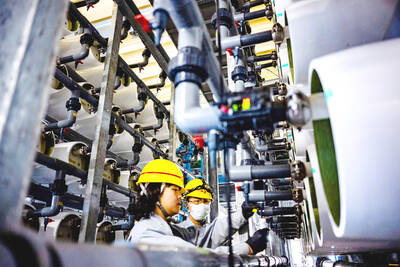
HIGH HOPES: The power source is expected to have a future, as it is not dependent on the weather or light, and could be useful for places with large desalination facilities A Japanese water plant is harnessing the natural process of osmosis to generate renewable energy that could one day become a common power source. The possibility of generating power from osmosis — when water molecules pass from a less salty solution to a more salty one — has long been known. However, actually generating energy from that has proved more complicated, in part due the difficulty of designing the membrane through which the molecules pass. Engineers in Fukuoka, Japan, and their private partners think they might have cracked it, and have opened what is only the world’s second osmotic power plant. It generates
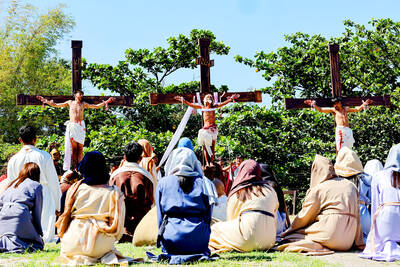
Hundreds of Filipinos and tourists flocked to a sun-bleached field north of Manila yesterday, on Good Friday, to witness one of the country’s most blood-soaked displays of religious fervor, undeterred by rising fuel prices. Scores of bare-chested flagellants with covered faces walked barefoot through the dusty streets of Pampanga Province’s San Fernando as they flogged their backs with bamboo whips in the scorching heat. Agence France-Presse (AFP) journalists said they saw devotees deliberately puncturing their skin with glass shards attached to a small wooden paddle to ensure their bleeding during the ritual, a way to atone for sins and seek miracles from
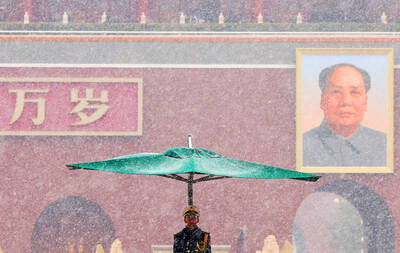
Chinese dissident artist Gao Zhen (高兟), famous for making provocative satirical sculptures of former Chinese leader Mao Zedong (毛澤東), was tried on Monday over accusations of “defaming national heroes and martyrs,” his wife and a rights group said. Gao, 69, who was detained in 2024 during a visit from the US, faces a maximum three-year prison sentence, said his wife, Zhao Yaliang (趙雅良), and Shane Yi, a researcher at the Chinese Human Rights Defenders group which operates outside the nation. The closed-door, one-day trial took place at Sanhe City People’s Court in Hebei Province neighboring the capital, Beijing, and ended without a


 RSS
RSS