


Germany’s closely fought election today is to set the direction of the EU’s most populous country after 16 years under German Chancellor Angela Merkel, whose party is scrambling to avoid defeat by its center-left rivals after a roller-coaster campaign. The environmentalist Greens are also eyeing at least a share of power.
About 60.4 million people in the nation of 83 million are eligible to elect the new parliament, which decides who will be the next head of government. Recent polls point to a neck-and-neck race between Merkel’s center-right Christian Democratic Union (CDU) and the Social Democrats, with the latter marginally ahead.
The polls show the Greens, making their first bid for the chancellorship, in third place after a campaign in which all three have held the lead.
The Social Democrats’ candidate, German Minister of Finance and Vice Chancellor Olaf Scholz, has seen his personal ratings climb amid error-strewn campaigns by his rivals, the CDU’s Armin Laschet and the Greens’ Annalena Baerbock.
Merkel, who remains personally popular after steering Germany through a string of crises, announced in 2018 that she would not go for a fifth term. That set up the first election since West Germany’s initial vote in 1949 in which there is no incumbent chancellor seeking re-election.
Voters appear underwhelmed by the choices. Whoever finishes first is expected to get a historically low share of the vote, with polls showing no party expected to get 30 percent support. The lowest score so far for a winning party is the CDU’s 31 percent in 1949, which also is the bloc’s worst showing to date.
Such an outcome would likely trigger lengthy haggling on a new governing coalition, with whichever party finishes first best-placed — but not guaranteed — to have its candidate succeed Merkel.
A first-place finish for the Social Democrats, who provided three of Germany’s eight post-World War II chancellors, but have been Merkel’s junior governing partners for 12 of the past 16 years, would be remarkable after a long poll slump for the party.
When the CDU and the Greens chose their candidates this spring, the election was widely expected to be a race between the two.
The CDU was prepared for a Laschet-Baerbock battle and “Laschet wanted practically to act as the incumbent, with all his leadership expertise” from his current job as governor of Germany’s most populous state, North Rhine-Westphalia, political science professor Andrea Roemmele of the Hertie School in Berlin said this week.
“But now the duel isn’t Laschet against Baerbock, it’s Laschet against Scholz, and in this combination Mr Laschet has been forced into the role of challenger,” she said.
“Scholz is deploying all the power of his vice chancellorship, of the finance minister, and is enjoying campaigning this way; he has simply managed to build up trust,” she added.
Scholz also has had the smoothest campaign, although opponents sought to capitalize on a recent police search at his ministry. Baerbock suffered from early gaffes, notably having to correct details in a resume and facing allegations of plagiarism in a new book.
Laschet was nominated after a divisive internal battle with a rival, then suffered from perceptions that he poorly handled deadly floods that hit his state in July.
A scene in which he was seen laughing in the background as Germany’s president delivered solemn remarks about the disaster did not help his campaign image.
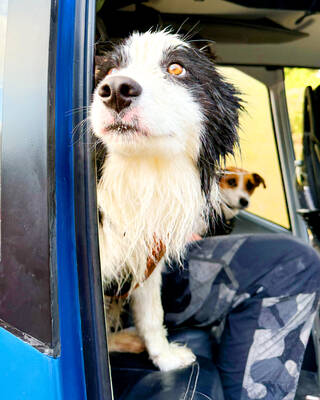
When a hiker fell from a 55m waterfall in wild New Zealand bush, rescuers were forced to evacuate the badly hurt woman without her dog, which could not be found. After strangers raised thousands of dollars for a search, border collie Molly was flown to safety by a helicopter pilot who was determined to reunite the pet and the owner. A week earlier, an emergency rescue helicopter found the woman with bruises and lacerations after a fall at a rocky spot at the waterfall on the South Island’s West Coast. She was airlifted on March 24, but they were forced to
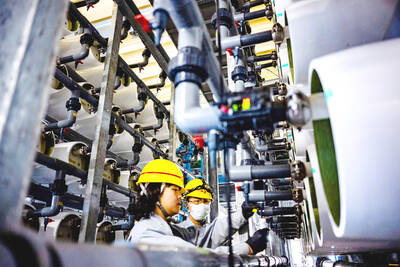
HIGH HOPES: The power source is expected to have a future, as it is not dependent on the weather or light, and could be useful for places with large desalination facilities A Japanese water plant is harnessing the natural process of osmosis to generate renewable energy that could one day become a common power source. The possibility of generating power from osmosis — when water molecules pass from a less salty solution to a more salty one — has long been known. However, actually generating energy from that has proved more complicated, in part due the difficulty of designing the membrane through which the molecules pass. Engineers in Fukuoka, Japan, and their private partners think they might have cracked it, and have opened what is only the world’s second osmotic power plant. It generates
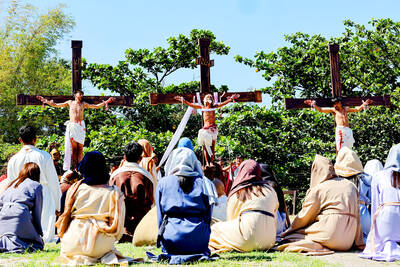
Hundreds of Filipinos and tourists flocked to a sun-bleached field north of Manila yesterday, on Good Friday, to witness one of the country’s most blood-soaked displays of religious fervor, undeterred by rising fuel prices. Scores of bare-chested flagellants with covered faces walked barefoot through the dusty streets of Pampanga Province’s San Fernando as they flogged their backs with bamboo whips in the scorching heat. Agence France-Presse (AFP) journalists said they saw devotees deliberately puncturing their skin with glass shards attached to a small wooden paddle to ensure their bleeding during the ritual, a way to atone for sins and seek miracles from
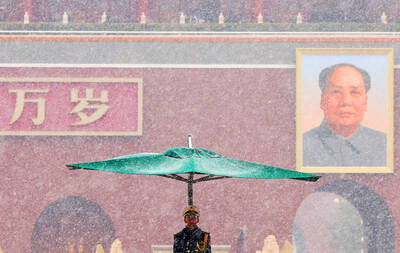
Chinese dissident artist Gao Zhen (高兟), famous for making provocative satirical sculptures of former Chinese leader Mao Zedong (毛澤東), was tried on Monday over accusations of “defaming national heroes and martyrs,” his wife and a rights group said. Gao, 69, who was detained in 2024 during a visit from the US, faces a maximum three-year prison sentence, said his wife, Zhao Yaliang (趙雅良), and Shane Yi, a researcher at the Chinese Human Rights Defenders group which operates outside the nation. The closed-door, one-day trial took place at Sanhe City People’s Court in Hebei Province neighboring the capital, Beijing, and ended without a


 RSS
RSS