


Hospitals are overwhelmed, ventilators are difficult to find and there is no longer enough space at the main cemetery for COVID-19 victims in Mauritius.
Barely three weeks before it fully opens its doors to international travelers at the start of the peak tourist season, the island nation is struggling with an alarming explosion in COVID-19 infections and deaths.
In just two months, cases have jumped more than fivefold to more than 12,600 as of Friday, by far the largest increase across Africa during this period, data compiled by Agence France-Presse showed.
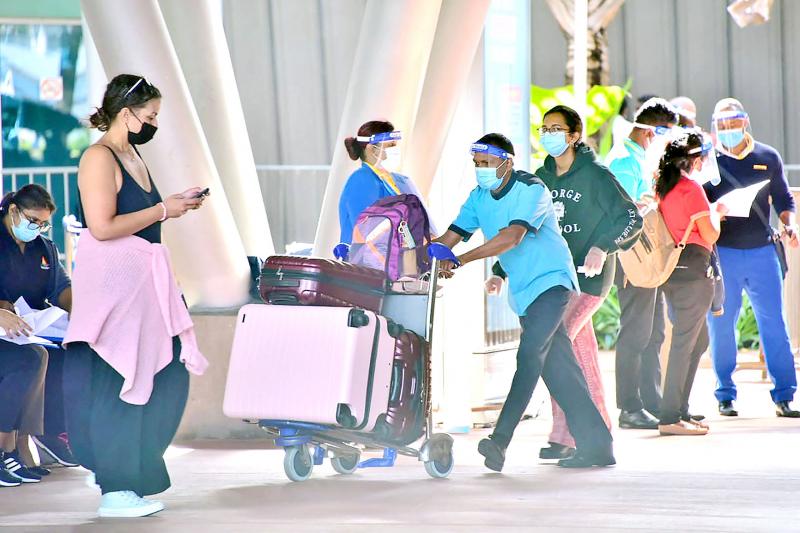
Photo: AFP
Since the pandemic started, Mauritius has recorded 1,005 cases of COVID-19 per 100,000 inhabitants, far higher than the continent’s average of 598.
The crisis has become so acute that 74-year-old former Mauritian prime minister Navin Ramgoolam has flown to India for COVID-19 treatment, and the opposition leader has discussed his struggle to find a bed for an ailing friend.
“People do not realize how bad the situation is,” said one nurse at a COVID-19 treatment center, speaking on condition of anonymity for fear of possible reprisals. “We are already above capacity.”
In July, the Indian Ocean holiday destination, renowned for its white sandy beaches and turquoise waters, partly reopened to vaccinated international visitors.
However, they had to remain in “resort bubbles” for 14 days before being allowed to venture further afield, provided they had a negative polymerase chain reaction test.
The government this month reduced that timeframe to seven days ahead of a full reopening planned for Oct. 1, when tourists would be free to explore the island as long as they test negative up to 72 hours before arrival.
“The situation is worsening,” one doctor said on condition of anonymity, adding that medical professionals had been instructed not to talk about the crisis.
“The priority of the government is to ensure a smooth opening of the borders on Oct. 1,” the doctor said.
The government has not given any explanation for the surge, but local media reports speak of people ignoring social distancing and not following precautions after getting inoculated.
The authorities had ordered people in some sectors to have COVID-19 vaccines, or risk hefty fines and jail terms of up to five years.
As of Saturday, 61 percent of the population was fully vaccinated, but the virus situation remains bleak.
Bernard, a worker at Bigara Cemetery on the main island, said that the area reserved for COVID-19 victims is full.
The dead are being buried at another graveyard in the north of the island, but locals are furious, saying that COVID-19 victims are being buried too close to their homes.
L’Express newspaper reported that police had to be summoned last week when some youths began throwing stones at health workers who were burying the dead at Bois-Marchand Cemetery.
The authorities have been slow to paint a clear picture of the pandemic death toll, and announced a sharp revision to official figures on Friday, from 34 to 89.
The Mauritian Ministry of Health explained its initial calculations by saying that most of the 89 fatalities were due to comorbidities and not directly caused by COVID-19.
Locals are conflicted about the relaxation of restrictions, with tourism contributing 25 percent of the archipelago’s GDP prior to the pandemic.
“We had closed the country, but, despite this, the number of cases exploded,” said taxi driver Paul Pierre, who said that the prospect of a tourist surge made him “shudder.”
Hotel receptionist Diana Mootoosamy echoed his fears, saying that “suddenly we find ourselves without a safety net.”
“By welcoming tourists, are we going to attract foreign exchange or [SARS-CoV-2] variants?” she asked.
Others have said that the economy, which shrank by 15 percent during the past fiscal year, desperately needs a boost.
“My restaurant has been empty since March 2020. If the tourists don’t come back, I’ll have to put the key under the doormat,” restaurateur John Beeharry said.
The country’s healthcare system is struggling to cope.
Mauritian Leader of the Opposition Xavier Duval rang alarm bells over his “traumatic” hunt earlier this month for a hospital bed with a ventilator for a close friend.
With family members in tears, Duval tried several private clinics and the main hospital with no luck, before one center agreed to admit his friend — but only for 48 hours.
“All this indicates that the system is overwhelmed,” he said, calling the situation “alarming.”
“I’m afraid Mauritius will come to a stage where we might need to decide who will get the air supply and who will have to die,” he said.
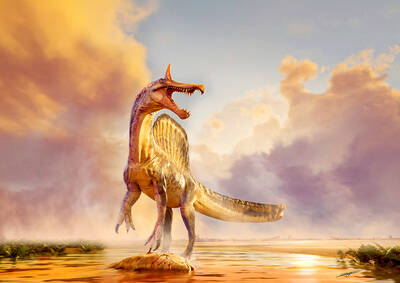
FEROCIOUS FISH-EATER Scientists have found a new species of dinosaur from the Cretaceous Period, a ‘hell heron’ that stalked the rivers, deep in the Saharan desert At a remote Sahara desert site in Niger, scientists have unearthed fossils of a new species of Spinosaurus, among the biggest of the meat-eating dinosaurs, notable for its large blade-shaped head crest and jaws bearing interlocking teeth for snaring fish. It prowled a forested inland environment and strode into rivers to catch sizable fish like a modern-day wading bird — a “hell heron,” as one of the researchers put it, considering it was about 12 meters long and weighed 5-7 tons. The dinosaur presented a striking profile on the Cretaceous Period landscape of Africa some 95 million years ago as it hunted
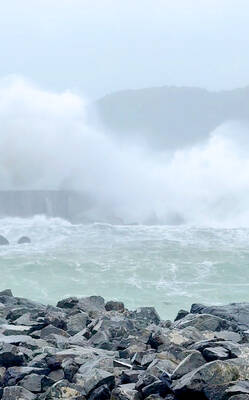
Heavy rain and strong winds yesterday disrupted flights, trains and ferries, forcing the closure of roads across large parts of New Zealand’s North Island, while snapping power links to tens of thousands. Domestic media reported a few flights had resumed operating by afternoon from the airport in Wellington, the capital, although cancelations were still widespread after airport authorities said most morning flights were disrupted. Air New Zealand said it hoped to resume services when conditions ease later yesterday, after it paused operations at Wellington, Napier and Palmerston North airports. Online images showed flooded semi-rural neighborhoods, inundated homes, trees fallen on vehicles and collapsed
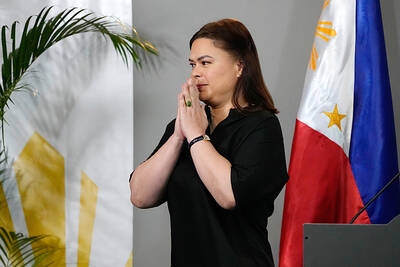
‘COST OF DEFECTION’: Duterte’s announcement could be an effort to keep allies in line with the promise of a return to power amid political uncertainty, an analyst said Philippine Vice President Sara Duterte yesterday announced she would run for president of the Southeast Asian nation of 116 million in 2028. Duterte, who is embroiled in a bitter feud with Philippine President Ferdinand Marcos Jr, was impeached last year only to see the country’s Supreme Court throw the case out over procedural issues. Her announcement comes just days before her father, former Philippine president Rodrigo Duterte, begins a pretrial hearing at the International Criminal Court (ICC) in the Netherlands over crimes against humanity allegedly committed as part of a brutal crackdown on drugs. “I offer my life, my strength and my future

NOT YET THERE: While the show was impressive, it failed to demonstrate their ability to move in unstructured environments, such as a factory floor, an expert said Dancing humanoid robots on Monday took center stage during the annual China Media Group’s Spring Festival Gala, China’s most-watched official television broadcast. They lunged and backflipped (landing on their knees), they spun around and jumped. Not one fell over. The display was impressive, but if robots can now dance and perform martial arts, what else can they do? Experts have mixed opinions, with some saying the robots had limitations and that the display should be viewed through a lens of state propaganda. Developed by several Chinese robotics firms, the robots performed a range of intricate stunts, including martial arts, comedy sketches and choreographed


 RSS
RSS