


The UN faces a dilemma when its General Assembly convenes next week, after Myanmar’s military junta and the country’s shadow National Unity Government (NUG) launched rival bids to fill the country’s seat.
Myanmar’s military, which seized power in February, has sought to replace Burmese Ambassador to the UN Kyaw Moe Tun, an outspoken critic of the coup.
The junta and the NUG, which was set up partly by ousted politicians, are believed to have submitted applications to the UN’s credentials committee.
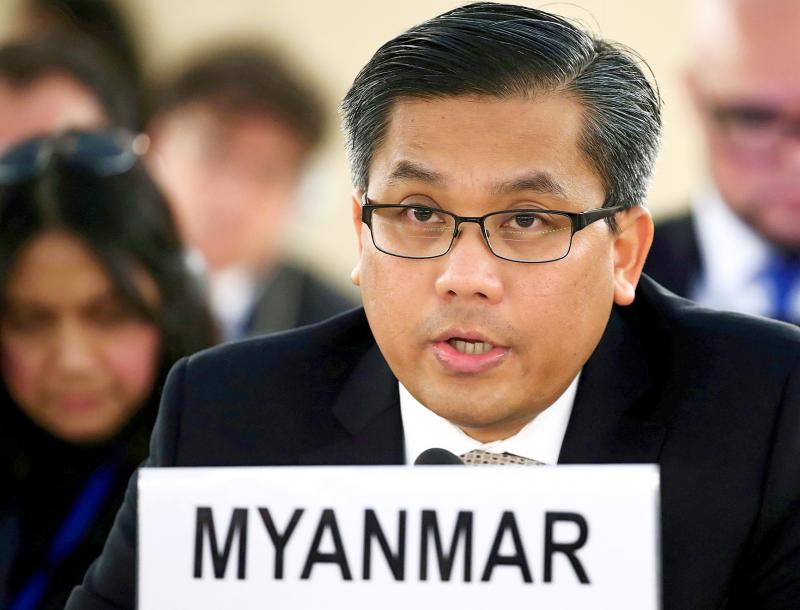
Photo: Reuters
Anti-coup campaigners have said a decision that favors the military could further embolden the junta, which has used brutal violence against unarmed civilians and is accused of killing more than 1,000 people since February.
Leaving the seat empty, they say, could undermine chances of a political solution.
Others say that appointing an NUG representative risks isolating the military at a time when regional diplomats are pushing for a ceasefire to deliver humanitarian aid.
The junta’s rule is widely opposed by the public, which launched a civil disobedience movement after the coup, with many refusing to work under military rule.
Over the past few months, groups of civilians have taken up arms, launching guerrilla-style attacks on military targets and defending their areas from raids by security forces.
The conflict and unrest after the coup have left an estimated 176,000 people displaced within Myanmar, according to the UN, while the economy is collapsing and the health system is in crisis.
A legal opinion signed by a 11 prominent legal academics said that the NUG’s representative should be accepted, as the military has a deplorable record on human rights, has largely ignored condemnation by the UN and others, and there are “no prospects of dialogue.”
“While the NUG does not have effective territorial control over the entire territory of Myanmar, neither does the junta,” it said.
It was signed by legal experts including Richard Goldstone, the founding chief prosecutor of the UN International Criminal Tribunal for the former Yugoslavia, as well as Rwanda; Chris Sidoti, member of the UN Independent International Fact-Finding Mission on Myanmar; Yuyun Wahyuningrum, representative of Indonesia to the ASEAN Intergovernmental Commission on Human Rights; and Sriprapha Petcharamesree, former Thai representative to the ASEAN commission.
The official criteria for approving envoys is vague, but various factors have been considered in past cases, including “effective territorial control, democratic legitimacy and respect for international human rights standards,” said the analysis, published by the Myanmar Accountability Project advocacy group.
The UN Credentials Committee could defer a decision. This could mean an empty seat, or it could allow Kyaw Moe Tun to continue on a provisional basis.
The junta announced it had fired him after his dramatic address to the General Assembly in February, where he called for the “strongest possible action from the international community.”
Last month, two Burmese citizens were arrested in New York for plotting to kill or injure Kyaw Moe Tun in an attempt to force him to step down from the post.

When a hiker fell from a 55m waterfall in wild New Zealand bush, rescuers were forced to evacuate the badly hurt woman without her dog, which could not be found. After strangers raised thousands of dollars for a search, border collie Molly was flown to safety by a helicopter pilot who was determined to reunite the pet and the owner. A week earlier, an emergency rescue helicopter found the woman with bruises and lacerations after a fall at a rocky spot at the waterfall on the South Island’s West Coast. She was airlifted on March 24, but they were forced to
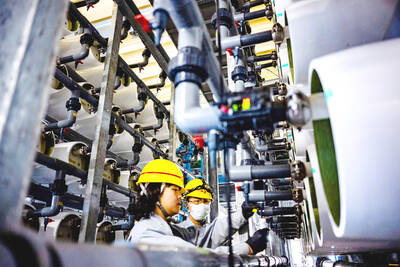
HIGH HOPES: The power source is expected to have a future, as it is not dependent on the weather or light, and could be useful for places with large desalination facilities A Japanese water plant is harnessing the natural process of osmosis to generate renewable energy that could one day become a common power source. The possibility of generating power from osmosis — when water molecules pass from a less salty solution to a more salty one — has long been known. However, actually generating energy from that has proved more complicated, in part due the difficulty of designing the membrane through which the molecules pass. Engineers in Fukuoka, Japan, and their private partners think they might have cracked it, and have opened what is only the world’s second osmotic power plant. It generates

Hundreds of Filipinos and tourists flocked to a sun-bleached field north of Manila yesterday, on Good Friday, to witness one of the country’s most blood-soaked displays of religious fervor, undeterred by rising fuel prices. Scores of bare-chested flagellants with covered faces walked barefoot through the dusty streets of Pampanga Province’s San Fernando as they flogged their backs with bamboo whips in the scorching heat. Agence France-Presse (AFP) journalists said they saw devotees deliberately puncturing their skin with glass shards attached to a small wooden paddle to ensure their bleeding during the ritual, a way to atone for sins and seek miracles from
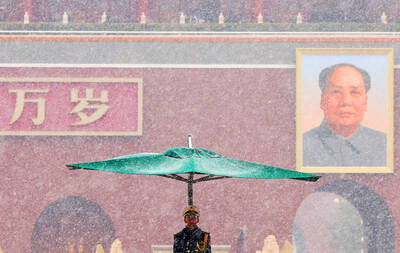
Chinese dissident artist Gao Zhen (高兟), famous for making provocative satirical sculptures of former Chinese leader Mao Zedong (毛澤東), was tried on Monday over accusations of “defaming national heroes and martyrs,” his wife and a rights group said. Gao, 69, who was detained in 2024 during a visit from the US, faces a maximum three-year prison sentence, said his wife, Zhao Yaliang (趙雅良), and Shane Yi, a researcher at the Chinese Human Rights Defenders group which operates outside the nation. The closed-door, one-day trial took place at Sanhe City People’s Court in Hebei Province neighboring the capital, Beijing, and ended without a


 RSS
RSS