


Built and trained at a two-decade cost of US$83 billion, Afghan security forces collapsed so quickly and completely — in some cases without a shot fired — that the ultimate beneficiary of the US investment turned out to be the Taliban. They grabbed not only political power, but also US-supplied firepower — guns, ammunition, helicopters and more.
The Taliban captured an array of modern military equipment when they overran Afghan forces who failed to defend district centers. Bigger gains followed, including combat aircraft, when the Taliban rolled up provincial capitals and military bases with stunning speed, topped by capturing the biggest prize, Kabul, over the weekend.
A US defense official on Monday confirmed that the Taliban’s sudden accumulation of US-supplied Afghan equipment is enormous. The official spoke on condition of anonymity because he was not authorized to discuss the matter publicly. The reversal is an embarrassing consequence of misjudging the viability of Afghan government forces — by the US military as well as intelligence agencies — which in some cases chose to surrender their vehicles and weapons rather than fight.
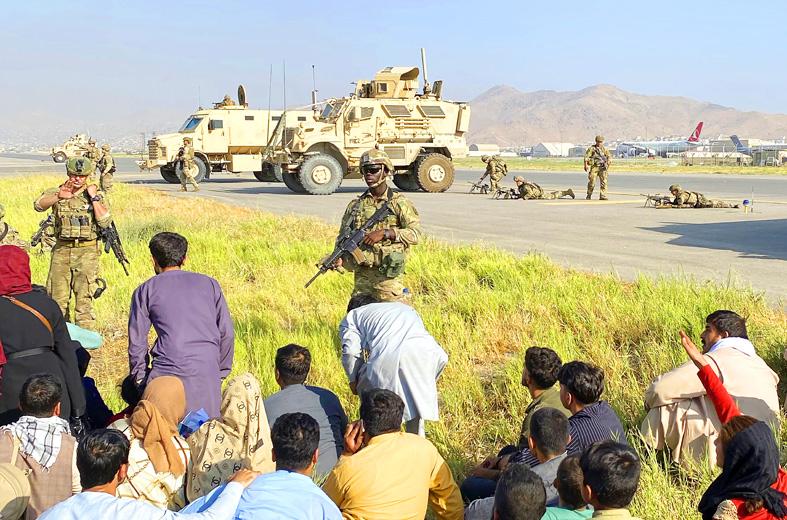
Photo: AP
The US failure to produce a sustainable Afghan army and police force, and the reasons for their collapse, will be studied for years by military analysts. However, the basic dimensions are clear and are not unlike what happened in Iraq. The forces turned out to be hollow, equipped with superior arms, but largely missing the crucial ingredient of combat motivation.
“Money can’t buy will. You cannot purchase leadership,” John Kirby, chief spokesman for US Secretary of Defense Lloyd Austin, said on Monday.
Doug Lute, a retired US Army lieutenant general who help direct Afghan war strategy under former US presidents George W. Bush and Barack Obama, said that what the Afghans received in tangible resources they lacked in the more important intangibles.
“The principle of war stands — moral factors dominate material factors,” he said. “Morale, discipline, leadership, unit cohesion are more decisive than numbers of forces and equipment. As outsiders in Afghanistan, we can provide materiel, but only Afghans can provide the intangible moral factors.”
By contrast, the Taliban insurgents, with smaller numbers, less sophisticated weaponry and no air power, proved a superior force. US intelligence agencies largely underestimated the scope of that superiority, and even after US President Joe Biden announced in April that he was withdrawing all US troops, the intelligence agencies did not foresee a Taliban final offensive that would succeed so spectacularly.
“If we wouldn’t have used hope as a course of action ... we would have realized the rapid drawdown of US forces sent a signal to the Afghan national forces that they were being abandoned,” said Chris Miller, who saw combat in Afghanistan in 2001 and was acting secretary of defense at the end of then-US president Donald Trump’s term.
Stephen Biddle, a professor of international and public affairs at Columbia University and a former adviser to US commanders in Afghanistan, said Biden’s announcement set the final collapse in motion.
“The problem of the US withdrawal is that it sent a nationwide signal that the jig is up — a sudden, nationwide signal that everyone read the same way,” Biddle said.
Before April, the Afghan government troops were slowly, but steadily losing the war, he said.
When they learned that their US partners were going home, an impulse to give up without a fight “spread like wildfire.”
However, the failures go back much further and run much deeper. The US tried to develop a credible Afghan defense establishment on the fly, even as it was fighting the Taliban, attempting to widen the political foundations of the government in Kabul and seeking to establish democracy in a nation rife with corruption and cronyism.
Year after year, US military leaders downplayed the problems and insisted success was coming. Others saw the handwriting on the wall. In 2015, Chris Mason, a professor at the US Army War College’s Strategic Studies Institute, wrote about the military’s failure to learn lessons from past wars; he subtitled his book: “Why the Afghan National Security Forces Will Not Hold.”
“Regarding the future of Afghanistan, in blunt terms, the United States has been down this road at the strategic level twice before, in Vietnam and Iraq, and there is no viable rationale for why the results will be any different in Afghanistan,” Mason wrote.
He added, presciently: “Slow decay is inevitable, and state failure is a matter of time.”
Some elements of the Afghan army did fight hard, including commandos whose heroic efforts are yet to be fully documented. However, as a whole the security forces created by the US and its NATO allies amounted to a “house of cards” whose collapse was driven as much by failures of US civilian leaders as their military partners, said Anthony Cordesman, a longtime Afghanistan war analyst at the Center for Strategic and International Studies.
The Afghan force-building exercise was so completely dependent on US largesse that the Pentagon even paid the Afghan troops’ salaries. Too often that money, and untold amounts of fuel, were siphoned off by corrupt officers and government overseers who cooked the books, creating “ghost soldiers” to keep the misspent dollars coming.
Of the approximately US$145 billion the US government spent trying to rebuild Afghanistan, about US$83 billion went to developing and sustaining its army and police forces, said the US Office of the Special Inspector General for Afghanistan Reconstruction, a congressionally created watchdog that has tracked the war since 2008. The US$145 billion is in addition to US$837 billion the US spent fighting the war, which began with an invasion in October 2001.
The US$83 billion invested in Afghan forces over 20 years is nearly double last year’s budget for the entire US Marine Corps and is slightly more than what Washington budgeted last year for food stamp assistance for about 40 million Americans.
In his book The Afghanistan Papers, journalist Craig Whitlock wrote that US trainers tried to force Western ways on Afghan recruits and gave scant thought to whether US taxpayers dollars were investing in a truly viable army.
“Given that the US war strategy depended on the Afghan army’s performance, however, the Pentagon paid surprisingly little attention to the question of whether Afghans were willing to die for their government,” he wrote.

When a hiker fell from a 55m waterfall in wild New Zealand bush, rescuers were forced to evacuate the badly hurt woman without her dog, which could not be found. After strangers raised thousands of dollars for a search, border collie Molly was flown to safety by a helicopter pilot who was determined to reunite the pet and the owner. A week earlier, an emergency rescue helicopter found the woman with bruises and lacerations after a fall at a rocky spot at the waterfall on the South Island’s West Coast. She was airlifted on March 24, but they were forced to
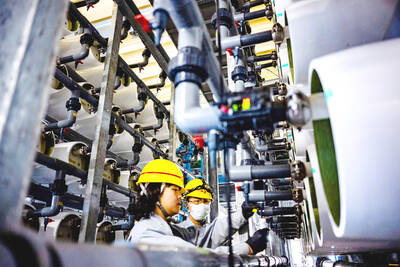
HIGH HOPES: The power source is expected to have a future, as it is not dependent on the weather or light, and could be useful for places with large desalination facilities A Japanese water plant is harnessing the natural process of osmosis to generate renewable energy that could one day become a common power source. The possibility of generating power from osmosis — when water molecules pass from a less salty solution to a more salty one — has long been known. However, actually generating energy from that has proved more complicated, in part due the difficulty of designing the membrane through which the molecules pass. Engineers in Fukuoka, Japan, and their private partners think they might have cracked it, and have opened what is only the world’s second osmotic power plant. It generates

Hundreds of Filipinos and tourists flocked to a sun-bleached field north of Manila yesterday, on Good Friday, to witness one of the country’s most blood-soaked displays of religious fervor, undeterred by rising fuel prices. Scores of bare-chested flagellants with covered faces walked barefoot through the dusty streets of Pampanga Province’s San Fernando as they flogged their backs with bamboo whips in the scorching heat. Agence France-Presse (AFP) journalists said they saw devotees deliberately puncturing their skin with glass shards attached to a small wooden paddle to ensure their bleeding during the ritual, a way to atone for sins and seek miracles from
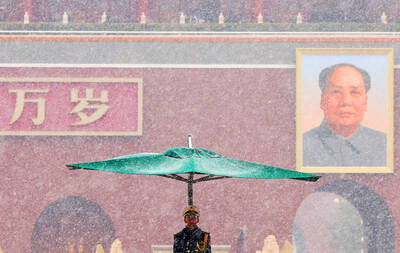
Chinese dissident artist Gao Zhen (高兟), famous for making provocative satirical sculptures of former Chinese leader Mao Zedong (毛澤東), was tried on Monday over accusations of “defaming national heroes and martyrs,” his wife and a rights group said. Gao, 69, who was detained in 2024 during a visit from the US, faces a maximum three-year prison sentence, said his wife, Zhao Yaliang (趙雅良), and Shane Yi, a researcher at the Chinese Human Rights Defenders group which operates outside the nation. The closed-door, one-day trial took place at Sanhe City People’s Court in Hebei Province neighboring the capital, Beijing, and ended without a


 RSS
RSS