


Mohammad Masud braves Dhaka’s sweltering summer heat to pedal across the Bangladeshi capital in his rickshaw and line up at one of the last charities still feeding those left destitute by the COVID-19 pandemic.
Nearby are hundreds of out-of-work or struggling security guards, transport workers, domestic servants and homeless children finishing their plates of rice and lentils at Mehmankhana, whose name means “the dining place for guests.”
“I have been hungry all day,” 28-year-old Masud said. “I did not make enough to buy food.”
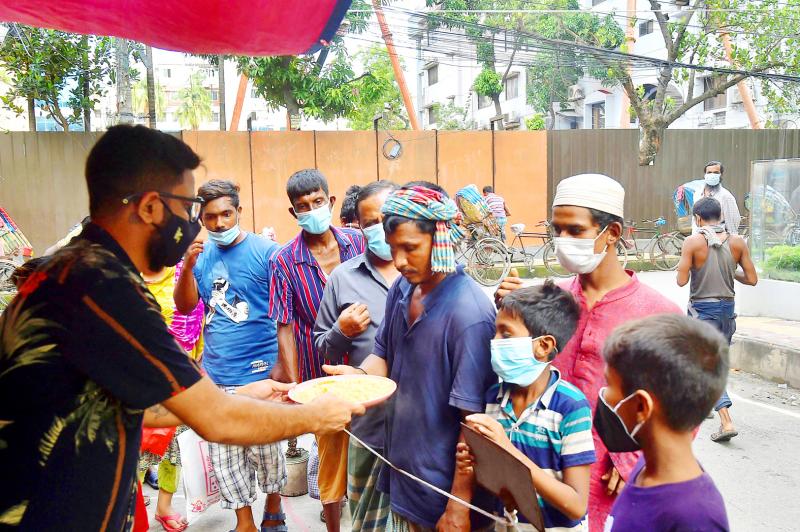
Photo: AFP
When Bangladesh shut down for more than two months last year during its first COVID-19 outbreak, hundreds of charities, civic groups and political parties gave out food, cash, masks and sanitizer to those who had lost their jobs.
However, COVID-19 fatigue has since set in and people have become less willing to finance the goodwill as the pandemic drags on. A new lockdown started last month, but only a handful of charities are on the streets.
“Last year, we got a lot of cash donations,” said Jashim Uddin Khan, an official at the Shonge Achi Foundation, a group helping feed needy people, stray dogs and even monkeys in Dhaka. “This year, we haven’t had many donations. There is a major fatigue for charity work.”
Official figures showed that more than 20,000 Bangladeshis have died of COVID-19, although experts say that the toll is at least four times higher.
Bangladesh recorded economic growth averaging 7 percent in the past decade, which helped reduce the poverty rate to 20 percent.
The SANEM research foundation says that the rate has shot back up to 40 percent during the pandemic.
While the Bangladeshi government has allowed some garment factories to reopen and spent US$15 billion on stimulus packages, hundreds of thousands of people have lost their jobs.
Groups like Mehmankhana have stepped up operations, but more and more people are suffering hunger.
“There are days when I only have one meal,” said Johra Begum, a 27-year-old mother of four in the Mehmankhana line, who lost her job as a domestic servant.
Asma Akhter Liza, a 36-year-old actress, and her cousin launched Mehmankhana in March last year after the start of Bangladesh’s first nationwide lockdown.
They say that they feed more than 2,500 people a day and are proud to tell patrons that they can “eat as much as you like.”
Liza said she resolved to start the charity after seeing children trying to break into a food store while she was out feeding street dogs.
“I thought stray dogs would be the hardest hit during the lockdown, but then I saw this break-in and I realized many thousands of people, including many who had decent jobs before the lockdown, are going hungry,” she said.
At first she borrowed money to fund the kitchen, but now gets private donations from across the country.
Liza said many middle-class people now come to the street kitchen in the evening “when they can enjoy some kind of anonymity.”
About 10,000 people ate there for the Eid al-Adha festival last month, she said.
One of her patrons is Selim Ahmed, a 45-year-old trader who said that his daily income had shrunk to less than 100 taka (US$1.18).
“Many people would have gone hungry if Mehmankhana wasn’t here,” he said.

NO EXCUSES: Marcos said his administration was acting on voters’ demands, but an academic said the move was emotionally motivated after a poor midterm showing Philippine President Ferdinand Marcos Jr yesterday sought the resignation of all his Cabinet secretaries, in a move seen as an attempt to reset the political agenda and assert his authority over the second half of his single six-year term. The order came after the president’s allies failed to win a majority of Senate seats contested in the 12 polls on Monday last week, leaving Marcos facing a divided political and legislative landscape that could thwart his attempts to have an ally succeed him in 2028. “He’s talking to the people, trying to salvage whatever political capital he has left. I think it’s

Polish presidential candidates offered different visions of Poland and its relations with Ukraine in a televised debate ahead of next week’s run-off, which remains on a knife-edge. During a head-to-head debate lasting two hours, centrist Warsaw Mayor Rafal Trzaskowski, from Polish Prime Minister Donald Tusk’s governing pro-European coalition, faced the Eurosceptic historian Karol Nawrocki, backed by the right-wing populist Law and Justice party (PiS). The two candidates, who qualified for the second round after coming in the top two places in the first vote on Sunday last week, clashed over Poland’s relations with Ukraine, EU policy and the track records of their

UNSCHEDULED VISIT: ‘It’s a very bulky new neighbor, but it will soon go away,’ said Johan Helberg of the 135m container ship that run aground near his house A man in Norway awoke early on Thursday to discover a huge container ship had run aground a stone’s throw from his fjord-side house — and he had slept through the commotion. For an as-yet unknown reason, the 135m NCL Salten sailed up onto shore just meters from Johan Helberg’s house in a fjord near Trondheim in central Norway. Helberg only discovered the unexpected visitor when a panicked neighbor who had rung his doorbell repeatedly to no avail gave up and called him on the phone. “The doorbell rang at a time of day when I don’t like to open,” Helberg told television
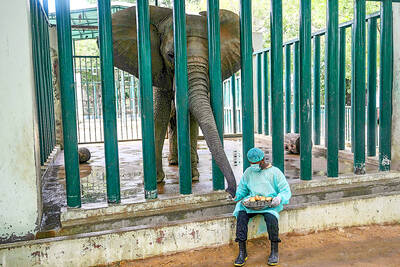
A team of doctors and vets in Pakistan has developed a novel treatment for a pair of elephants with tuberculosis (TB) that involves feeding them at least 400 pills a day. The jumbo effort at the Karachi Safari Park involves administering the tablets — the same as those used to treat TB in humans — hidden inside food ranging from apples and bananas, to Pakistani sweets. The amount of medication is adjusted to account for the weight of the 4,000kg elephants. However, it has taken Madhubala and Malika several weeks to settle into the treatment after spitting out the first few doses they


 RSS
RSS