


Young couples and families pose for glamour shots as the sun lowers over Alexei Cazac’s sprawling field of lavender outside the capital of Moldova.
“Once, in the first year the lavender was blooming, we came and the entire field was just filled with people,” the 40-year-old farmer said.
“It’s like the set of a photo shoot. We didn’t plan it this way,” he added.
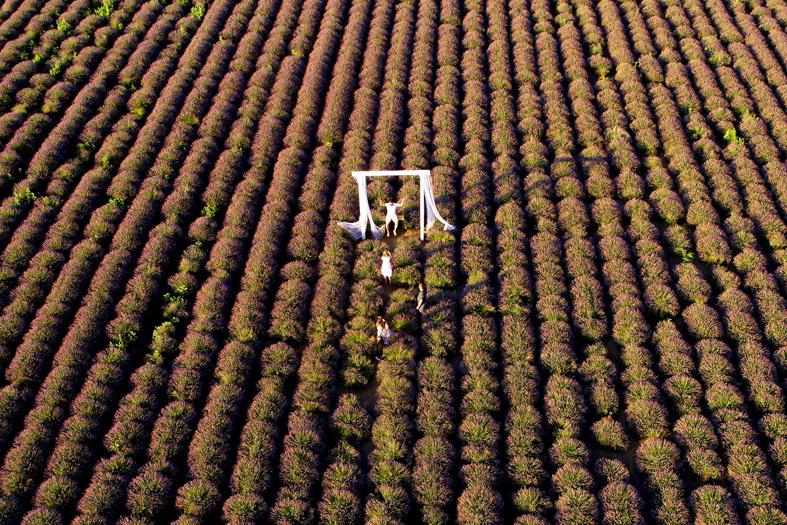
Photo: AFP
Cazac, who planted his first bushels in 2015, is among a growing cohort of farmers in Moldova fueling a resurgence in the aromatic herb, whose cultivation collapsed along with the Soviet Union.
The comeback in the small country bordering Romania has garnered attention not just from locals hungry for likes on social media, but also from global cosmetic firms headquartered in western Europe.
“After the collapse of the Soviet Union, the industry was forgotten,” Lavender Growers Association president Alexandru Badarau said.
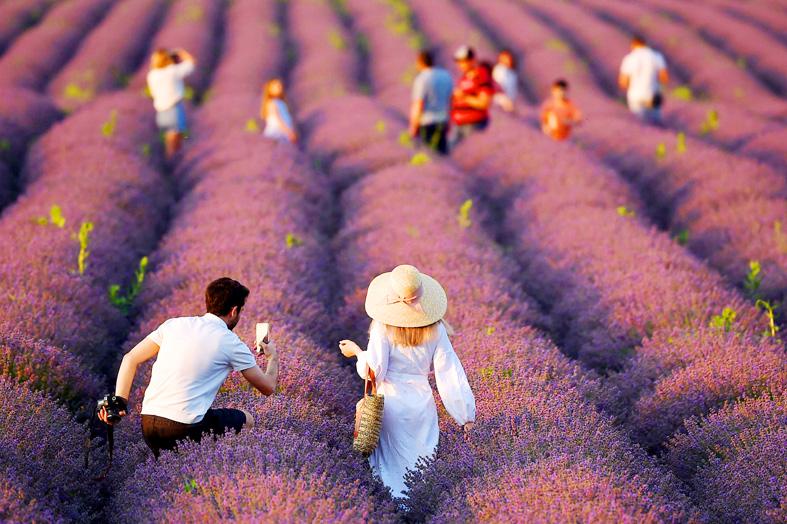
Photo: AFP
“It collapsed precisely because our connection was severed with Moscow, where most of the essential oils produced in Moldova were exported,” he said.
“We’re working hard to revive it,” he added.
About five or six newcomers to the industry are planting rows of the herb every year, he said, a trend which saw Moldova’s lavender oil production double this year to 20 tonnes compared with 20 years ago.
However, that is still a far cry from 1989, when the country produced 180 tonnes.
The association said members export 99 percent of their oil to the EU, specifically Germany, and to two other well-known producers: France and Bulgaria.
The oil is widely used in cosmetics, and its aromas are hailed for their relaxing and soothing qualities that some believe counteract anxiety and insomnia.
Producers in Moldova say Bulgaria, which was also under the Iron Curtain, has benefitted greatly from the EU after it became a member in 2007.
However, where Bulgaria excels in quantity, Moldova trumps it in quality, they said.
The local variety yields less oil, said Nicu Ulinici, who inherited his father’s farm and harvested his first bushels in 2014.
“But it’s higher quality,” he said. Its aroma is “more pleasant, softer.”
For Badarau, lavender has won over growers in Moldova owing to its success in dry climates.
He believes this will help farmers mitigate “risks associated with climate change.”
Indeed, multinational cosmetics firm Weleda, which began sourcing Moldovan lavender in 2005, has described the country as “perfect” for the herb.
French fragrance company Mane is another major brand in Moldova, whose subsidiary works in cultivation and production of essential oils.
Still, recent experience shows the future is not guaranteed to be rosy.
The US Agency for International Development in 2017 said that Moldova was still exposed to climate risks, with likely “adverse effects” for growers.
It said the industry had fluctuating economic success in one of the poorest countries to emerge from the Soviet collapse, with Moldova’s market share still trailing far behind essential oil majors like Turkey and China.
Pointing to climate threats, the UN Development Programme said Moldovan farmers last year harvested up to 50 percent fewer bushels than in 2019, resulting from tepid spring temperatures and a summer drought.
The report also said that demand for essential oils dipped during the COVID-19 pandemic.
Nonetheless, producers in Moldova are not fazed.
Badarau said his association has registered the brand Essential Oils of Moldova to promote products abroad, and that it was aiming for certification from an international agricultural quality assurance group.
This “is of great concern to the end consumer,” he said.
In the meantime, there is money to be made from visitors drawn to the picturesque fields.
Cazac, who has more than 24 hectares of lavender, said he charges visitors the equivalent of about US$3 to meander through his purple bushels.
On the horizon, he sees plenty of room for expansion.
“Moldova is producing much less than it could,” he said. “But first we need to prove we’re producing a quality product at international standards.”
ROCKY RELATIONS: The figures on residents come as Chinese tourist numbers drop following Beijing’s warnings to avoid traveling to Japan The number of Chinese residents in Japan has continued to rise, even as ties between the two countries have become increasingly fractious, data released on Friday showed. As of the end of December last year, the number of Chinese residents had increased by 6.5 percent from the previous year to 930,428. Chinese people accounted for 22.6 percent of all foreign residents in Japan, making them by far the largest group, Japanese Ministry of Justice data showed. Beijing has criticized Tokyo in increasingly strident terms since Japanese Prime Minister Sanae Takaichi last year suggested that a military conflict around Taiwan could

A pro-Iran hacking group claimed to breach FBI Director Kash Patel’s personal e-mail inbox and posted some of the contents online. The e-mails provided by the hacking group include travel details, correspondence with leasing agents in Washington and global entry, and loyalty account numbers. The e-mail address the hackers claim to have compromised has been previously tied to Patel’s personal details, and the leaked e-mails contain photos of Patel and others, in addition to correspondence with family members and colleagues. “The FBI is aware of malicious actors targeting Director Patel’s personal email information,” the agency said in a statement on
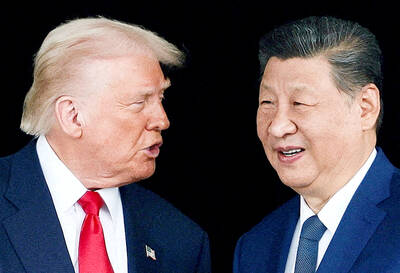
RIVALRY: ‘We know that these are merely symbolic investigations initiated by China, which is in fact the world’s most profligate disrupter of supply chains,’ a US official said China has started a pair of investigations into US trade practices, retaliating against similar probes by US President Donald Trump’s administration as the superpowers stake out positions before an expected presidential summit in May. The move, announced by the Chinese Ministry of Commerce on Friday, is a direct mirror of steps Trump took to revive his tariff agenda after the US Supreme Court last month struck down some of his duties. “China expresses its strong dissatisfaction and firm opposition to these actions,” a ministry spokesperson said in a statement, referring to the so-called Section 301 investigations initiated on March 11.

When a hiker fell from a 55m waterfall in wild New Zealand bush, rescuers were forced to evacuate the badly hurt woman without her dog, which could not be found. After strangers raised thousands of dollars for a search, border collie Molly was flown to safety by a helicopter pilot who was determined to reunite the pet and the owner. A week earlier, an emergency rescue helicopter found the woman with bruises and lacerations after a fall at a rocky spot at the waterfall on the South Island’s West Coast. She was airlifted on March 24, but they were forced to


 RSS
RSS