


Five members of a Hong Kong union behind a series of children’s books about sheep trying to hold back wolves from their village have been arrested for sedition, police announced yesterday.
The arrests by Hong Kong’s new national security police unit, which is spearheading a sweeping crackdown on dissent, are the latest actions against democracy advocates since huge and often violent protests convulsed the territory two years ago.
Police said that two men and three women, aged 25 to 28, “conspired to publish, distribute, exhibit or copy seditious publications.”
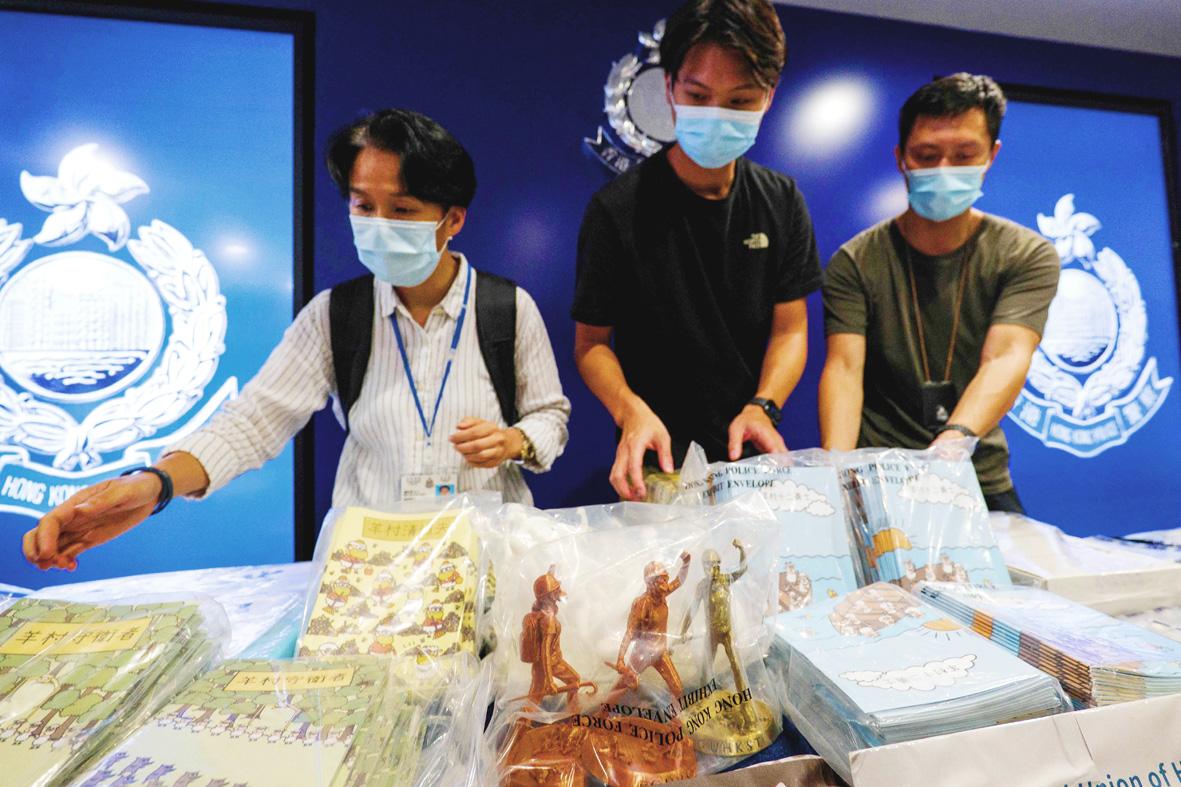
Photo: AFP
The group was attempting to stir up “the public’s — and especially young children’s — hatred towards Hong Kong’s government and judiciary and to incite violence and illegal acts,” police said in a statement.
The five arrested were members of a union, police said, adding that HK$160,000 (US$20,585) in funds had been frozen under Hong Kong’s Beijing-imposed National Security Law.
A police source said that they are members of the General Union of Hong Kong Speech Therapists.
The union in the past few months published three illustrated e-books that try to explain Hong Kong’s democracy movement to children.
Democracy supporters are portrayed as sheep living in a village surrounded by wolves.
The first book, titled Guardians of Sheep Village, explains the 2019 democracy protests that swept through Hong Kong.
The second book, Janitors of Sheep Village, tells the story of cleaners in the village going on strike to force out wolves who leave litter everywhere.
The book’s introduction said that it is a reference to Hong Kong medical workers striking last year to force the government to close the border with mainland China at the start of the COVID-19 pandemic.
The final book in the trilogy, The 12 Braves of Sheep Village, is about a group of sheep who flee their village by boat because of the wolves. It is a direct reference to 12 Hong Kongers who attempted to escape by speedboat to Taiwan last year, but were detained by the Chinese coastguard and jailed.
The sedition charges are based on a colonial-era law that until last year had not been used since Hong Kong’s 1997 handover to China. It carries up to two years in jail for a first offense.
Hong Kong prosecutors are regularly using it alongside the National Security Law to clamp down on political speech.
Most of those arrested for such crimes are denied bail.
Separately, seven government supporters who took part in a violent assault on democracy advocates and commuters were jailed yesterday for what the trial judge described as an “indiscriminate attack.”
The verdict came exactly two years after a gang of men dressed in white shirts and carrying sticks descended on people returning at night from a democracy rally in the district of Yuen Long. The brazen assault was a turning point in the democracy protests, further hammering public trust in security forces and the government.

ROCKY RELATIONS: The figures on residents come as Chinese tourist numbers drop following Beijing’s warnings to avoid traveling to Japan The number of Chinese residents in Japan has continued to rise, even as ties between the two countries have become increasingly fractious, data released on Friday showed. As of the end of December last year, the number of Chinese residents had increased by 6.5 percent from the previous year to 930,428. Chinese people accounted for 22.6 percent of all foreign residents in Japan, making them by far the largest group, Japanese Ministry of Justice data showed. Beijing has criticized Tokyo in increasingly strident terms since Japanese Prime Minister Sanae Takaichi last year suggested that a military conflict around Taiwan could

A retired US colonel behind a privately financed rocket launch site in the Dominican Republic sees the project as a response to China’s dominance of the space race in Latin America. Florida-based Launch on Demand is slated to begin building a US$600 million facility in a remote region near the border with Haiti late this year. The project is designed to meet surging demand for the heavy-lift rockets needed to put clusters of satellites into orbit. It is also an answer to China’s growing presence in the region, said CEO Burton Catledge, a former commander of the US Air Force’s 45th Operations

Germany is considering Australia’s Ghost Bat robot fighter as it looks to select a combat drone to modernize its air force, German Minister of Defense Boris Pistorius said yesterday. Germany has said it wants to field hundreds of uncrewed fighter jets by 2029, and would make a decision soon as it considers a range of German, European and US projects developing so-called “collaborative combat aircraft.” Australia has said it will integrate the Ghost Bat, jointly developed by Boeing Australia and the Royal Australian Air Force, into its military after a successful weapons test last year. After inspecting the Ghost Bat in Queensland yesterday,

A pro-Iran hacking group claimed to breach FBI Director Kash Patel’s personal e-mail inbox and posted some of the contents online. The e-mails provided by the hacking group include travel details, correspondence with leasing agents in Washington and global entry, and loyalty account numbers. The e-mail address the hackers claim to have compromised has been previously tied to Patel’s personal details, and the leaked e-mails contain photos of Patel and others, in addition to correspondence with family members and colleagues. “The FBI is aware of malicious actors targeting Director Patel’s personal email information,” the agency said in a statement on


 RSS
RSS