


A cellist in Denmark, unable to perform during the COVID-19 pandemic, turned to an unusual audience, an experience so rewarding that he is continuing even after concert halls have reopened.
“Playing for cows is a continuation of what I’ve always done in my solo career: I’m passionate about taking classical music out of the concert hall,” Jacob Shaw said.
The British musician, who is also a professor at the Marshall Academy in Barcelona, has set up a cello school in the rural countryside in Stevns, an hour south of Copenhagen, performing throughout the region.
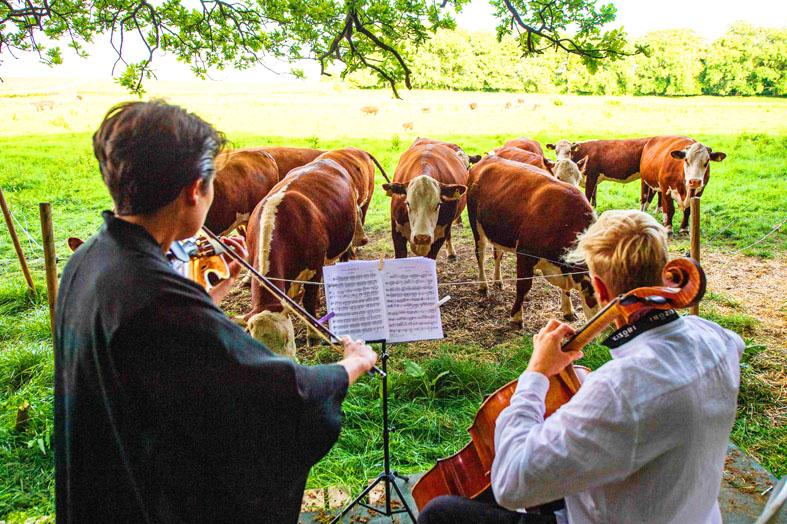
Photo: AFP
“During corona, of course, it wasn’t always possible and we decided to move on to the next best thing: playing for animals,” the 30-year-old said.
In autumn last year, he convinced a music-loving farmer to expose his beef cattle to classical music to improve their welfare.
“When he told me about it, I didn’t think it was crazy, but rather exciting. I feel the calming effect of music on my own body, so I thought it would be the same for the cows, and I was right,” Mogens Haugaard said.
The cows were first introduced to the classical repertoire through loudspeakers installed in their barn in the winter, but it quickly seemed to strike a chord with the bovine audience.
“Everyone could see from the first time that they liked it, so we continued. Now they are getting used to it and the result is that they are fantastically pleasant and healthy animals,” said the cellist, who also runs a music festival in France’s Charente department.
“They are calmer and more relaxed. They are easier to approach,” Haugaard said.
Cattle even have their preferences, even if the subtlety might escape the layman, Shaw said.
“They react differently to different pieces, we played something that was slightly catchier and a bit more modern, and a lot of them didn’t like it and left,” he said.
“I think the type of piece that is closest to their voice, their mooing, is actually similar to the sound of a cello, which is why it’s so popular with them,” he added.
While he sometimes comes to play alone, the cellist is also often accompanied by one or more musicians who have come to spend time at his institution, the Scandinavian Cello School, which opened in 2016.
Playing in the open air in front of this perhaps less discerning audience helps visiting artists relieve some of the stress of a performance, Shaw said.
“If they get a chance to play in front of the cows, I think it allows them to relax and enjoy what they are doing more,” he said.
Roberta Verna, a 22-year-old violinist, came to Stevns to “get a different perspective on things.”
Holding a Stradivarius, Verna, together with Shaw, played pieces by Reinhold Gliere and Bela Bartok for the ruminants, who were seemingly as moved by the beauty of the melody as they were by the distribution of food.
“It was a different situation than usual, but not worse. It was really interesting because they really listen, and they respect us,” the young musician said.
At the end of the fifteen-minute concert, the second of the day for the cattle, calves and cows calmly graze the pasture awaiting the next recital.
“I think it’s going to be very interesting in the next few years: Their children and their children’s children are going to grow up with classical music ... the normal thing for a cow in this field is to listen to music,” Shaw said, adding that he has no plans to stop.

‘CROSSING THE LINE’: China’s embassy in Seoul criticized US Forces Korea Commander General Xavier Brunson, asking if his ‘hostile’ remarks were authorized by Washington South Korea and the US are in talks over recent public remarks by the commander of US Forces Korea, Seoul’s presidential office said yesterday, after the comments drew sharp criticism from China. In a recent podcast interview, US Forces Korea Commander General Xavier Brunson described South Korea as “the dagger in the heart of Asia” from China’s east coast, prompting the Chinese embassy in Seoul to say that he had “truly crossed the line.” The interview came amid growing speculation that Washington might seek to expand the role of US Forces Korea in countering the growing regional influence of China, a key

Through the noise of rushing papers and whirring belts at a print factory in Kyoto, two creators watch their photo essay come to life in broadsheet form — part of an effort to win new audiences in the age of artificial intelligence (AI). Despite the decline of the publishing industry, self-publication and handmade “zine” magazines are growing in popularity in Japan, reflecting the nation’s enduring love of paper in the digital era. While speaking to Agence France-Presse at the plant, his hands black with ink, one of the creators, Kazuma Obara, said: “I think [paper] is a medium that engages all five

Australian researchers have trained lab-grown brain cells on a silicon computer chip to play the 1990s shooter game Doom and said they are just scratching the surface of what the neurons could be capable of doing. It is the science-fiction work of biotech boffins at Cortical Labs, who researched and developed the technology that harnesses the workings of the brain’s networking system. Each so-called “biological computer” contains about 200,000 living human brain cells, grown from stem cells that were harvested from blood donations. Having mastered the simple computer game Pong, where a paddle is moved up and down to send a ball

France experienced its hottest spring on record, the French weather service said on Tuesday, after an exceptional early heat wave that also broke highs for the season in England and Wales. Meteo-France said the average nationwide temperature over March to May was 13.8°C — about 1.7°C above the norm, and surpassing records set in 2011 and 2020. “The warmest spring since records began in 1900,” it said in a bulletin. All three months were warmer than average, but the onset of an “unprecedented heatwave” late last month pushed the mercury to highs typically seen at the height of the summer. “Our country had never


 RSS
RSS